










Synergy Green Industries Limited keeps 80% wind exposure
Key highlights
- Synergy Green identifies 80% of business from wind as a concentration threat.
- Synergy Green has 45,000 tonnes per annum of foundry capacity and 20,000 tonnes per annum of machining capacity.
- Synergy Green cites about 6 million metric tonnes of non-wind large-casting demand versus 1.5 million metric tonnes for wind.
- H1 FY 2026-27 total income rose 20.2% to Rs 192.02 crore, while PBDIT margin declined to 8.9%.
powered by IRIS
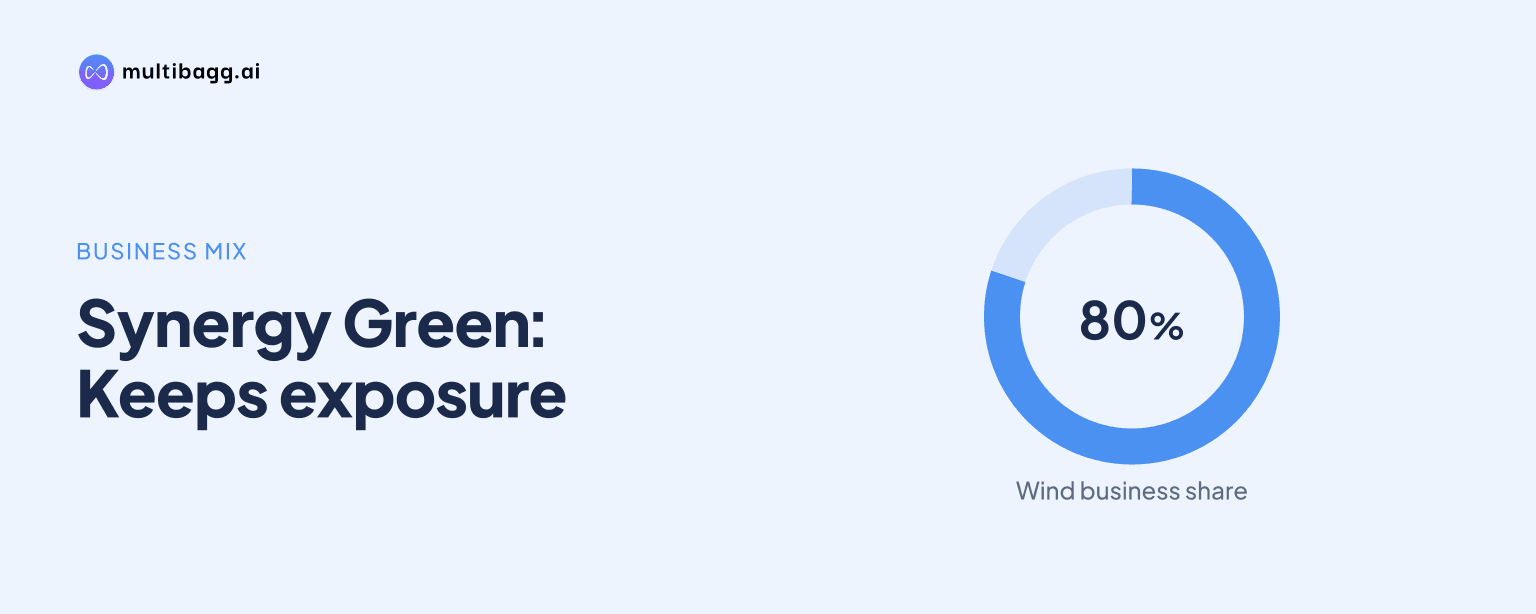
Synergy Green Industries Limited says 80% of its business is tied to wind, a concentration it identifies as a threat, while targeting non-wind requests for quotation in mining, power, plastic injection and automobile dies through a 45,000-tonnes-per-annum foundry capable of producing castings up to 30 tonnes.
Know Synergy Green Industries inside out
Results, valuation, peers and who's buying, in one view.
How dependent is Synergy Green on wind?
Synergy Green says 80% of its business comes from the wind industry, which it identifies as a threat in its 2026 SWOT analysis. The company also says its facilities can make large castings for other industries, but the presentation does not disclose a current non-wind revenue share or a timetable for changing the business mix.
The product presentation provides a separate classification: wind castings account for 70% and gearbox castings for 15%. Wind applications listed include nacelles, main bearings, spinners, main shafts, generators, gearboxes, blade parts, hub castings and nacelle bedplates. The presentation does not reconcile this combined 85% product classification with the 80% business figure in the SWOT analysis.
Synergy Green says it works with six of the 15 leading wind original equipment manufacturers, or OEMs. Its listed wind customers include Vestas, Adani, Vayona Energy, Senvion, GE Renewable Energy, Envision, Flender, ZF, Nordex and Acciona Windpower, while the 2025 global wind-installation table lists 15 OEMs by installed gigawatts.
Which non-wind markets is Synergy Green targeting?
Synergy Green is targeting non-wind requests for quotation, or RFQs, in automobile dies, plastic injection, mining and power. Its non-wind product examples include cone crushers, coal pulverizers, turbine casings, plastic injection machines and pumps, all of which are presented alongside its capability to produce castings up to 30 tonnes.
The company cites about 6 million metric tonnes of non-wind large-casting demand, compared with 1.5 million metric tonnes for large-casting wind. The non-wind figure is therefore four times the wind figure cited in the presentation, although these are market-demand estimates rather than Synergy Green sales, orders or market-share forecasts.
Synergy Green lists Terex, Ferromatik Milacron India, Mather+Platt, Wilo, Mahindra and LT as non-wind customers. It describes Ferromatik Milacron India as a plastics injection moulding machine manufacturer, but gives no order value, revenue contribution, qualification status or production volume for any of these customer relationships.
Got a follow-up? Ask IRIS
What capacity can Synergy Green use beyond wind?
Synergy Green has 45,000 tonnes per annum of foundry capacity and 20,000 tonnes per annum of machining and surface-treatment capacity. It also reports 10 megawatts of captive solar power, while listing SAP, ATAS and simulation software as part of its operating infrastructure.
The SWOT analysis says capacity is limited compared with peers, while noting that Synergy Green has scaled up to 45,000 tonnes per annum and plans to expand further. The company does not disclose the size, timing, capital expenditure or funding method for that further expansion in the supplied presentation pages.
Synergy Green identifies dependency on outsourced machining as a weakness, while stating that about 20,000 tonnes per annum of in-house machining has been established. Its quality infrastructure includes a National Accreditation Board for Testing and Calibration Laboratories certified lab, universal testing machines, an image analyzer and a spectrometer, alongside ISO 9001, 14001, 18001, 27001 and 50001 certifications.
What operating results affect the diversification effort?
Synergy Green reported annual capacity utilisation of 93% in FY 2025-26, up from 88% in FY 2024-25 and 80% in FY 2023-24. Actual utilisation was 75% in H1 FY 2026-27, and the company projects 80% utilisation for the full FY 2026-27.
For H1 FY 2026-27, Synergy Green reported total income of Rs 192.02 crore, compared with Rs 159.76 crore in H1 FY 2025-26, representing 20.2% growth. Production increased 25.8% year on year over the same period, but the presentation does not split either revenue or production between wind and non-wind activities.
Profit before depreciation, interest and tax, or PBDIT, margin was 8.9% in H1 FY 2026-27, down from 15.6% in H1 FY 2025-26. Management attributed the decline primarily to steep input-cost escalation; Synergy Green also says key commodities are hedged with customers quarterly. Loss after tax was Rs 15.19 crore in H1 FY 2026-27, compared with profit after tax of Rs 5.74 crore a year earlier.
Conclusion
Synergy Green remains predominantly exposed to wind, with 80% of business tied to the sector despite a product range that includes mining, power, plastics and pumps. Its cited non-wind large-casting market of about 6 million metric tonnes is larger than the 1.5 million metric tonnes cited for wind, but the presentation does not show whether RFQs have converted into material non-wind sales.
The next disclosed markers are projected FY 2026-27 capacity utilisation of 80%, after 75% actual utilisation in H1, and management’s plan to expand beyond 45,000 tonnes per annum. Readers can also watch whether quarterly customer commodity hedging limits input-cost effects after PBDIT margin declined to 8.9% in H1 FY 2026-27 from 15.6% a year earlier.