










Syrma retains strategic inventory as component shortages persist
Key highlights
- Syrma reported inventory of Rs 1,570 crore in September 2026, versus about Rs 1,000 crore in March 2026.
- Syrma's inventory days were 71 in both March 2026 and September 2026.
- Syrma reported overall working capital of about 63 days against a 60-to-65-day annualised target.
- Management said electronic-component lead times can extend to 36 or 42 weeks.
powered by IRIS
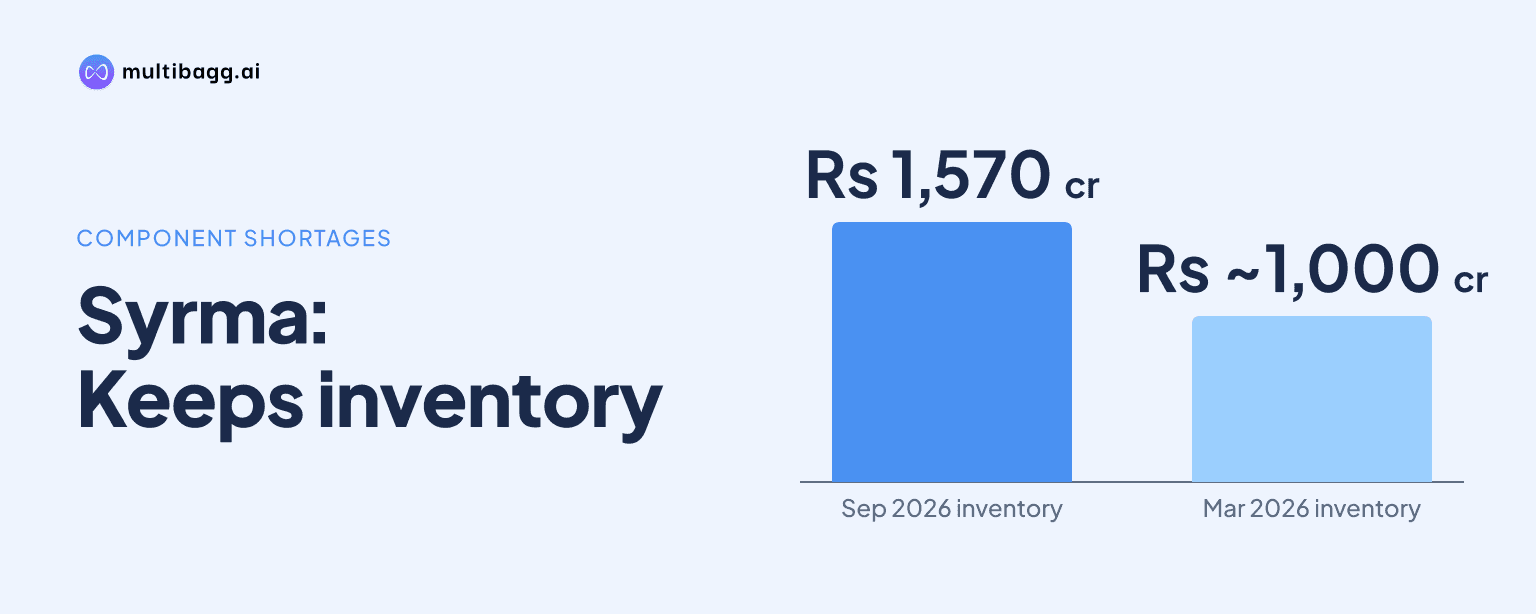
Syrma retained strategic electronic-component inventory in September 2026 despite holding overall working capital at about 63 days, because delivery lead times had extended to 36 or 42 weeks. Inventory stood at Rs 1,570 crore, up from about Rs 1,000 crore in March 2026, while inventory days remained unchanged at 71.
Know Syrma SGS Technology inside out
Results, valuation, peers and who's buying, in one view.
Why is Syrma retaining strategic component inventory?
Syrma is retaining strategic inventory because management places meeting customer requirements ahead of reducing stock while critical electronic components have long delivery schedules. Management said these strategic holdings will remain until the broader supply-chain situation eases, and indicated that the constraint could continue beyond FY27.
The pressure is concentrated in electronics rather than mechanical inputs. Management said copper prices may have risen but wire is not in shortage, whereas electronic components face constraints partly associated with data-centre demand. Lead times for constrained components have reached 36 or 42 weeks, requiring Syrma and customers to plan procurement over a longer horizon.
Customers are also holding critical parts, according to management, particularly in the business-to-business supply chain. Longer lead items prompt customers to provide greater order visibility and longer commitments, while both parties stock components to avoid disruption. Management said a missing component at either Syrma or its customer can stop the final product from shipping.
Management described the choice as a supply-assurance decision rather than an attempt to build inventory ahead of weaker demand. It said it would prefer to carry higher inventory, even by a couple of Rs 100 crore, rather than be unable to meet a customer requirement. That priority reflects the risk that a shortage at one link in the chain can reduce sales for both the manufacturer and its customer.
How did Syrma raise inventory while keeping inventory days flat?
Syrma raised inventory value while keeping inventory days flat because management said revenue increased by about 70%, outpacing the roughly 50% increase in inventory. Inventory days were 71 in both March 2026 and September 2026, despite inventory rising from about Rs 1,000 crore to Rs 1,570 crore.
Management said the days calculation gives more context than the balance-sheet amount in isolation. A component shipment received near a March, June or September quarter-end may be used or shipped in the next quarter, temporarily lifting reported inventory. Syrma therefore said it is focused on working-capital discipline on an annualised basis rather than interpreting a single quarter-end level as a lasting change.
The inventory position coincides with broad growth across operating verticals in H1 FY27. Management said automotive revenue grew by more than 80% from H1 FY26, healthcare by 78%, industrial by 58%, consumer by 62%, railways by 45%, and information technology by more than 100% from a smaller base. This comparison supports management's explanation that stock value rose alongside higher activity across several segments.
Exports grew 59% in H1 FY27 and original design manufacturing, or ODM, grew 100%, according to management. It identified automotive, industrial and consumer as the larger-base segments expected to continue contributing to growth, while healthcare and railways were described as smaller-base, higher-margin categories. Management did not disclose how the Rs 1,570 crore inventory was distributed across these segments.
Got a follow-up? Ask IRIS
What working-capital level is Syrma targeting?
Syrma is targeting overall working capital of 60 to 65 days on an annualised basis, compared with about 63 days in September 2026. Management said its preferred outcome is below 60 days, but it does not expect to reach that level in the coming six months while strategic stock of long-lead components is still required.
Management also said that maintaining working capital at around 60 days, plus or minus two days, would be an acceptable outcome during the shortage period. The reported 63 days sits within the broader 60-to-65-day target range. This leaves limited room for a near-term reduction if inventory remains elevated to protect production continuity.
The stated trade-off is between cash tied up in stock and reliability of supply. Management said it considers uninterrupted fulfilment more important than reducing inventory in the short term because dependable delivery can deepen customer relationships. It did not set a date for inventory days to fall below 71, instead linking the outcome to an easing in the component supply situation.
What supply-chain conditions could affect Syrma's revenue?
Syrma said supply-chain conditions can affect revenue because either its suppliers or its customers may lack a component required to complete and sell a product. Management cited automotive demand that is increasing quarter on quarter and month on month, while component availability remains constrained. This combination compounds the need for longer commitments and strategic holdings of electronic parts.
For the current full year, management guided for 40% to 45% revenue growth and revenue above Rs 7,000 crore, but said the final outcome depends on supply conditions. It said H1 FY27 growth of 71% included some front-loaded customer orders and anticipated a subsequent rationalisation. The full-year guidance is therefore lower than the first-half run rate, reflecting seasonality and supply-chain uncertainty.
Management said its intermediary position creates two possible interruptions: Syrma may have production capacity while a customer lacks a part, or a customer may be ready while Syrma's own supplier cannot deliver. In either case, sales can be lost or deferred. The 36-to-42-week lead times cited for some components explain why the company is not planning an immediate inventory drawdown.
Syrma also said customers and suppliers are working through these constraints in close, transparent coordination. Longer commitments for critical parts can provide visibility into future demand, but management did not quantify customer inventory levels or identify a point at which ordering patterns would normalise. Its disclosed policy is to retain critical electronic components while the shortage risk remains.
Conclusion
Syrma's inventory increased to Rs 1,570 crore in September 2026 from about Rs 1,000 crore in March 2026, but inventory days remained at 71 because management said revenue rose by about 70%. Overall working capital of about 63 days remained within the stated 60-to-65-day range, showing that management is seeking to preserve supply continuity without abandoning its annualised working-capital discipline.
The next point to watch is whether component lead times of 36 or 42 weeks begin to ease. Management does not expect to achieve its below-60-day working-capital objective within the next six months and has said strategic inventory may remain in place beyond FY27 if supply-chain conditions do not improve.