










Syrma targets ₹1,350 crore PCB revenue at full FY29 ramp-up
Key highlights
- Syrma plans ₹800 crore to ₹900 crore of PCB-project capital expenditure by March 2028.
- Syrma’s FY29 PCB revenue potential is ₹1,200 crore to ₹1,350 crore at full capacity ramp-up.
- Syrma estimated ₹900 crore to ₹1,000 crore of FY29 PCB revenue at 70%-80% utilisation.
- Syrma’s steady-state PCB EBITDA-margin target is 15%-18%, excluding PLI incentives.
powered by IRIS
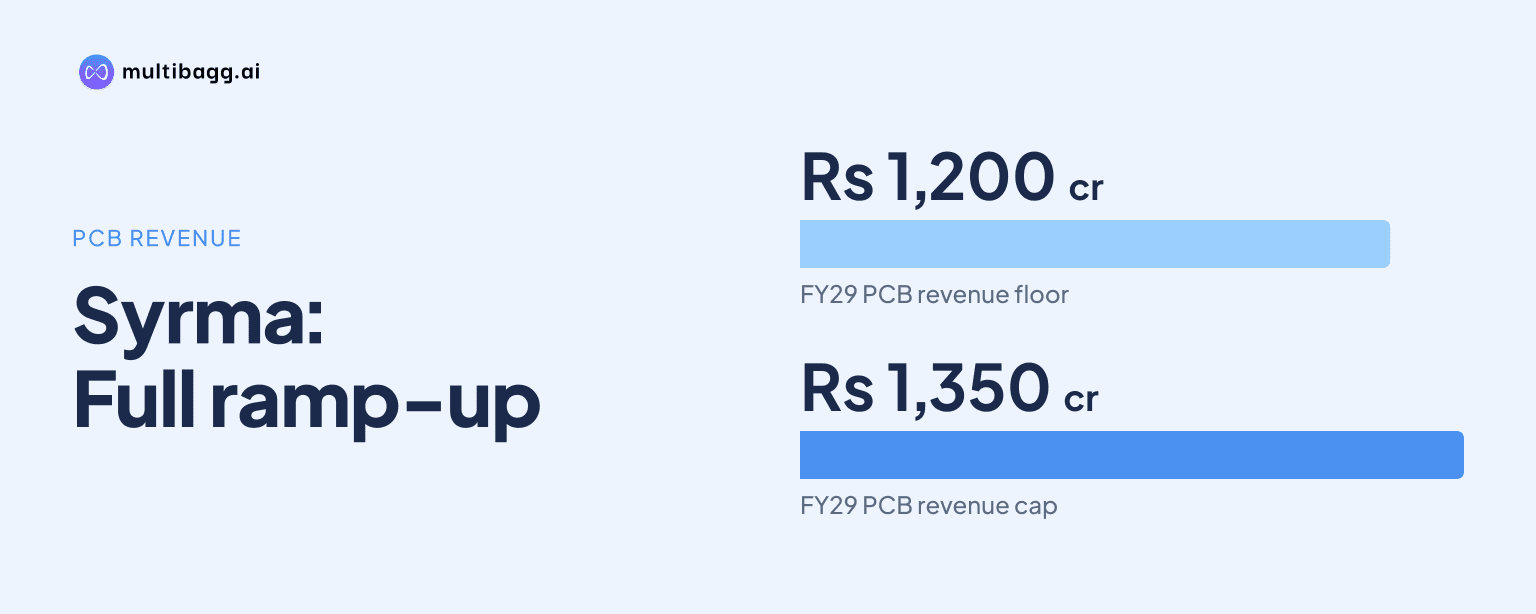
Syrma SGS Technology Limited said its printed circuit board, or PCB, project could generate ₹1,200 crore to ₹1,350 crore of revenue in FY29 if capacity fully ramps in its first year, based on ₹800 crore to ₹900 crore of capital expenditure by March 2028. Management put steady-state EBITDA margin at 15%-18%, excluding production-linked incentive, or PLI, benefits.
Know Syrma SGS Technology inside out
Results, valuation, peers and who's buying, in one view.
What revenue can Syrma’s PCB project generate?
Syrma said the PCB project can generate ₹1,200 crore to ₹1,350 crore of FY29 revenue if it achieves full capacity ramp-up in the first year. Management linked that range to a maximum asset turn of 1.5 times on total project investment of ₹800 crore to ₹900 crore. At 70%-80% capacity utilisation, it estimated lower FY29 revenue of ₹900 crore to ₹1,000 crore.
The initial contribution is expected to be smaller because commercial production in FY27-'28 is expected for only six to seven months. Management indicated PCB revenue of about ₹200 crore to ₹300 crore for that period. It also initially discussed ₹700 crore to ₹800 crore of FY28-'29 revenue on ₹800 crore of investment, before detailing the FY29 utilisation scenarios.
The ₹1,350 crore figure is therefore a full-ramp-up potential rather than an estimate for the plant’s first months of operation. Management’s broader framework was PCB revenue of 1.2-1.25 times investment, with 1.5 times identified as the maximum. The difference between ₹900 crore to ₹1,000 crore and ₹1,200 crore to ₹1,350 crore depends on the utilisation achieved in FY29.
How much will Syrma spend on the PCB project?
Syrma plans PCB-project capital expenditure of ₹800 crore to ₹900 crore by March 2028. Management expects to incur about ₹400 crore to ₹450 crore by the end of the current year and another ₹400 crore to ₹450 crore by the end of the following year. The full FY29 revenue range assumes this investment is completed and the plant reaches its stated utilisation level.
Outside the PCB project, Syrma estimated normal greenfield and brownfield capital expenditure of ₹100 crore to ₹150 crore a year for the next two years. Management separately identified initial capex of about ₹40 crore to ₹50 crore for the Elemaster joint venture, about ₹30 crore for camera modules and up to ₹30 crore to ₹50 crore for the Kaga joint venture.
The PCB project is intended to serve a range of board types. Management said the bulk of output would be two-layer to six-layer PCBs, with some six- to eight-layer products and a smaller volume of boards above eight layers. Syrma also plans a single-layer line for consumer-electronics applications, while saying most PCB consumption is in products below eight layers.
Got a follow-up? Ask IRIS
What PCB margin does Syrma expect at full ramp-up?
Syrma expects a 15%-18% earnings before interest, tax, depreciation and amortisation, or EBITDA, margin at steady state and full capacity ramp-up. Management explicitly said the range excludes PLI incentives. The target therefore applies to the operating economics of the PCB project before any PLI income is included.
Margins may be lower in the opening phase, when management discussed capacity utilisation of around 40%. It nevertheless said it did not expect a profit after tax, or PAT, loss in that period. This distinguishes the 15%-18% steady-state range from the margin outcome during early utilisation.
Management also set out an expected timing for incentive claims. On about ₹400 crore of investment by March 2027, it said Syrma could file for ₹200 crore of capital subsidy by March 2028. For PLI linked to FY27-'28 revenue, management said claims could be filed in July or August 2028, with an estimated further three to six months for recovery.
How will Syrma ramp and sell PCB output?
Syrma intends to supply both internal consumption and external customers, although management expects external customers to account for the bulk of PCB sales over time. It said customer approval requirements are broadly similar whether a PCB is used internally or sold to an outside supplier serving an original equipment manufacturer, such as Suzuki.
Syrma plans to begin with original design manufacturing, or ODM, PCBs in the immediate phase. In this model, Syrma owns the design and does not require the same customer design approval, according to management. The boards would still require testing, regulatory checks and other product approvals before meeting customer specifications.
Management said it expects to power on the PCB plant in March 2027 and start trial production then, with production processes expected to stabilise by the middle of the following year. Only after that stabilisation does Syrma plan to execute a copper clad laminate, or CCL, plant. Management said that if planning starts in the third or fourth quarter of FY28, the CCL plant could be ready around December 2028 and enter series production in FY28-'29.
Conclusion
Syrma has provided a specific range of PCB-project outcomes: ₹800 crore to ₹900 crore of capex by March 2028, FY29 revenue of ₹900 crore to ₹1,000 crore at 70%-80% utilisation, and up to ₹1,350 crore at full ramp-up. Its 15%-18% steady-state EBITDA-margin target excludes PLI, while management expects lower margins during the early period around 40% utilisation.
The next measures to watch are the March 2027 plant power-on, commercial output during the six to seven months of FY27-'28, and progress toward FY29 utilisation levels. Management has also targeted a ₹200 crore capital-subsidy claim on about ₹400 crore of March 2027 investment and plans to consider CCL execution after PCB production stabilises.