










TBO Tek Limited targets growth despite difficult Q3 travel outlook
Key highlights
- TBO Tek reported 16% GTV growth and 27% adjusted EBITDA growth in Q2 FY27.
- The Middle East grew 10% on a constant-currency basis in Q2 FY27 and 20% including currency effects.
- Europe and APAC each delivered growth of more than 30% in Q2 FY27.
- Management expects Q3 FY27 to be difficult because it is seasonally the weakest travel quarter and October disruptions increased cancellations.
powered by IRIS
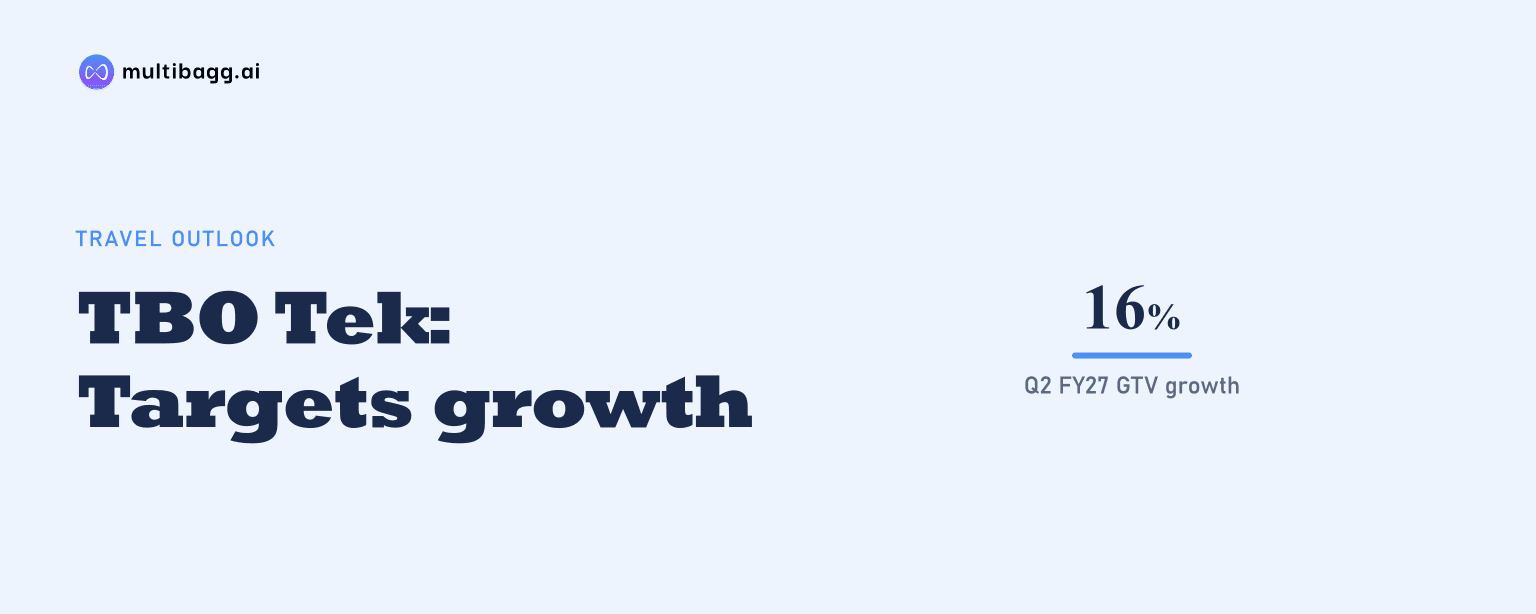
TBO Tek Limited is aiming to preserve year-on-year revenue and profit growth through a difficult Q3 FY27, after Q2 gross transaction value, or GTV, rose 16% and adjusted earnings before interest, tax, depreciation and amortisation, or adjusted EBITDA, increased 27%. Management said Saudi airport attacks and European unrest increased cancellations during October.
Know TBO Tek inside out
Results, valuation, peers and who's buying, in one view.
What disrupted TBO Tek’s travel demand in October?
TBO Tek said October was highly volatile for global travel demand because attacks on Saudi airports hurt both inbound and outbound Saudi travel and caused cancellations of prior bookings. The Middle East, which management described as its most affected market amid the conflict, still recorded 10% growth on a constant-currency basis in Q2 FY27, or 20% including currency effects. Management said the regional market remained below its year-earlier baseline despite that growth.
European leisure travel also faced increased cancellations and some demand reduction after rioting spread across major cities, management said on November 3, 2026. It identified Paris, Madrid, Barcelona and cities in Italy as affected destinations. Europe has become TBO Tek’s largest source market following market-development investment that began in early 2025, making disruption in these leisure destinations relevant to near-term booking demand.
Can TBO Tek maintain growth through a tough Q3?
TBO Tek’s internal objective is to retain year-on-year growth in both top line and bottom line despite the current disruptions. Management expects Q3 FY27 to be difficult because it is historically the weakest quarter for travel, but did not provide a quarterly GTV, revenue or profit forecast. It said this objective would remain its framework even if geopolitical conditions worsen, while acknowledging that the scale and duration of disruption are uncertain.
Management did not compare expected H2 FY27 performance with H1 FY27 because it considered Q4 too distant to assess on November 3. It cited the U.S. election scheduled for the following day as a possible inflection point, with conditions potentially worsening or improving. If travel conditions improve, management expects a quick rebound; if they deteriorate, it is aiming to maintain positive growth in revenue and profit.
Got a follow-up? Ask IRIS
Which regions are offsetting Middle East weakness?
Europe and Asia-Pacific, or APAC, each delivered growth of more than 30% in Q2 FY27, compared with 10% constant-currency growth in the Middle East. Management linked Europe’s expansion, achieved on what it called a fairly large base, to its market-development spending and continued growth in active agents. The different regional results show that Middle East conflict constrained overall travel demand while European and APAC expansion supported growth elsewhere.
Management believes its Middle East performance indicates market-share gains, although it did not disclose an independent market-share measure. It also sees further potential in Europe, APAC and North America because many sales teams are still relatively new, with average tenure of about 15 months, while reaching full order-book potential can take three to four years. Management said organic growth exceeded 50% in certain markets in January and February 2026 before the war began, but did not commit to returning to that rate.
How does seasonality affect TBO Tek’s profit outlook?
TBO Tek said 16% GTV growth in Q2 FY27 translated into 27% adjusted EBITDA growth, marking a second consecutive quarter of operating leverage. Management said Q2 is traditionally its best period because it coincides with the Northern Hemisphere’s high-summer travel season. Higher gross profit in that season flowed through to the bottom line, but management cautioned that the same mechanism can work in reverse when Q3 activity is lower than Q2.
Management said constant-currency selling, general and administrative expenses, or SG&A, grew at a high-single-digit rate and were significantly outpacing top-line growth. While new market development is paused during the disruption, TBO Tek is investing in artificial intelligence and technology tools to automate operational work and improve sales-team effectiveness. Over a two- to eight-quarter period, management expects SG&A investment to be lower than anticipated gross-profit growth, but described that as a broad framework rather than an earnings forecast.
Conclusion
TBO Tek’s Q2 FY27 results show regional expansion and operating leverage despite a difficult travel backdrop: Europe and APAC each grew by more than 30%, the Middle East grew 10% on a constant-currency basis, GTV rose 16% and adjusted EBITDA increased 27%. However, Saudi travel disruption, European unrest, cancellations and elevated air fares have made the seasonally weakest quarter less predictable.
The next issue to watch is whether booking patterns improve after the U.S. election cited by management on the November 3, 2026 call, particularly in Saudi Arabia and major European leisure cities during Q3 FY27. Management’s stated plan is to seek deeper travel-agent penetration, prioritise higher-value transactions and use technology automation while aiming to preserve year-on-year revenue and profit growth.