










Tata Consultancy Services Limited: 29 of 48 analysts buy
Key highlights
- 29 of 48 analysts covering TCS retained buy ratings after Q2 FY27, while 13 rated hold and six rated sell.
- TCS reported Q2 FY27 revenue of $7.6 billion, up 0.5% quarter-on-quarter in constant currency.
- TCS reported Q2 FY27 deal total contract value of $9.6 billion and a book-to-bill ratio of 1.3 times.
- TCS stock was down nearly 29% over 12 months and almost 33% year-to-date, versus a roughly 14% Nifty 50 decline.
powered by IRIS
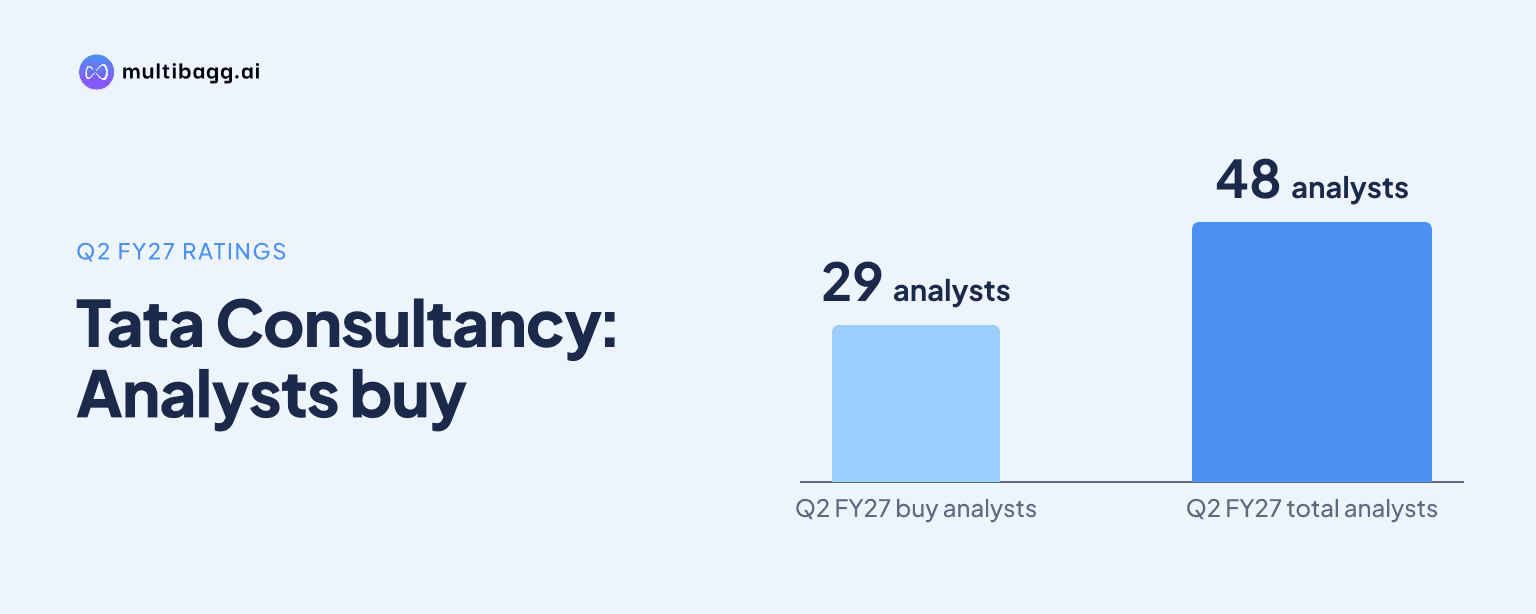
In Q2 FY27, 29 of 48 analysts covering Tata Consultancy Services Limited retained buy ratings, but targets ranging from ₹1,800 to ₹2,630 show sharply different views on its growth conversion and margins. The stock was down nearly 29% over 12 months and almost 33% year-to-date, versus a roughly 14% fall in the Nifty 50.
Why are TCS analysts divided after Q2 FY27?
TCS analysts are divided because broad-based international growth and deal bookings support the medium-term case, while slower discretionary spending, uncertain regional demand and profitability pressure limit near-term confidence. Of the 48 analysts cited after the quarterly results, 29 rated the stock buy, 13 hold and six sell.
The range of published targets reflects this split. Nomura held the highest cited target of ₹2,630 with a buy rating, while Jefferies had an underperform rating and a ₹1,800 target. Citi retained a sell rating with a ₹1,840 target, citing macroeconomic concerns, negative year-on-year forward contract value growth and margins remaining below TCS's aspirational 26-28% band.
What did TCS report in Q2 FY27?
TCS reported US dollar revenue of $7.6 billion in Q2 FY27, up 0.5% quarter-on-quarter in constant currency, while adjusted profit after tax was ₹139 billion, flat sequentially and 7.5% higher year-on-year. Motilal Oswal said the revenue outcome was in line with its estimate, but the profit figure was below its ₹144 billion expectation.
Growth was led by manufacturing, hi-tech and BFSI, which rose 3.1%, 3.1% and 2.5%, respectively, quarter-on-quarter in constant currency. In contrast, regional markets declined 5.8% and the consumer business fell 0.7%. International revenue rose 1.2% quarter-on-quarter in constant currency, supported by the UK, BFSI, manufacturing and technology, while India declined 10.3% following project deferrals.
TCS reported a Q2 deal total contract value of $9.6 billion, up 1.1% quarter-on-quarter but down 4% year-on-year. Its book-to-bill ratio was 1.3 times. The data indicates that deal activity remains meaningful, although the year-on-year decline and slower conversion cycle remain central concerns for investors.
Got a follow-up? Ask IRIS
Can TCS convert deal demand into revenue growth?
TCS can support growth if its pipeline converts as expected and regional markets recover, but brokerages expect discretionary spending and furloughs to restrain the pace of expansion. Cloud adoption and enterprise data analytics continue to underpin the longer-term demand story, while AI-led services traction and transformation engagements are cited as additional supports.
Motilal Oswal said TCS's size, order book, portfolio and exposure to long-duration orders position it to withstand a weaker macro environment. Still, it highlighted slower deal conversion because of economic growth concerns in the US and Europe. Prabhudas Lilladher forecasts a 3.0% organic US dollar revenue CAGR for FY27 to FY29E, showing that the constructive outlook is tempered by modest expected growth.
Geojit raised its FY27E and FY28E revenue estimates by 1.1% to ₹2,93,649 crore and ₹3,05,475 crore, respectively. Its view rests on international demand, client expansion and a transformation-engagement pipeline, but it also identifies execution of these opportunities as essential to the investment case.
What is pressuring TCS margins?
TCS's margins are under pressure from investments in AI capabilities, talent, partnerships and delivery, as well as higher subcontracting costs and expected dilution from the proposed MHP acquisition. Its Q2 EBIT margin was 24%, flat quarter-on-quarter and below Motilal Oswal's 25% estimate.
Geojit reduced its FY27E and FY28E EBITDA estimates by 3.1% and 2.8%, respectively, and cut margin assumptions by 110 basis points and 100 basis points to 26.1% and 26.3%. It expects roughly 50 basis points of dilution from MHP. Other analysts also noted that flat sequential margins despite international revenue growth point to continued reinvestment, deflation and competitive pressure.
Motilal Oswal expects operating margin improvement over the next two quarters, aided by a better employee pyramid and utilisation. That potential improvement is balanced against continued spending on AI and subcontracting, making margins an important measure of whether revenue growth is translating into stronger earnings.
Conclusion
TCS has a sizeable group of buy-rated analysts, supported by international growth, a $9.6 billion quarterly deal total contract value and a long-term enterprise technology demand case. However, the wide target-price range, the stock's recent underperformance and forecasts for restrained organic growth show that investors are weighing these strengths against delayed conversion, discretionary spending weakness and margin costs.
The next areas to watch are pipeline conversion, recovery in regional markets, the pace of discretionary programme ramp-ups and whether margins improve as expected over the next two quarters. Investors will also monitor the effect of AI investment, subcontracting costs and the proposed MHP acquisition on profitability.