










TechD’s Cyber Valley supports larger consolidated-SOC tenders
Key highlights
- TechD says its planned Ahmedabad Cyber Valley spans 60,000 sq ft and will house information-technology, operational-technology and vehicle-security SOC capabilities.
- Management cited consolidated-SOC tenders covering 10-15 banks or about 100 cooperative banks.
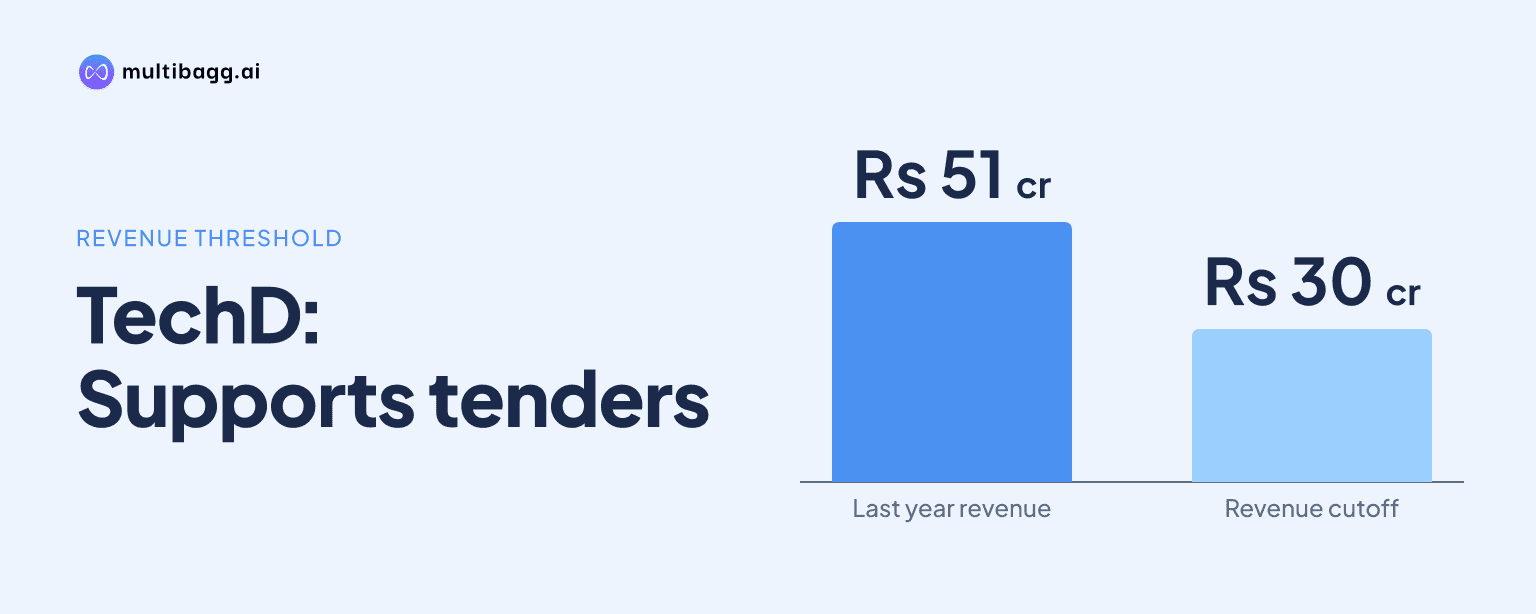
- TechD said nearly Rs 51 crore of revenue last year made it eligible for at least 60% of tenders, versus many exclusions at Rs 30 crore.
- TechD said the Ahmedabad facility was not yet operational when it discussed the tender opportunity.
powered by IRIS
TechD says its planned 60,000-sq-ft Ahmedabad Cyber Valley supports its eligibility for larger consolidated security operations centre, or SOC, tenders, including mandates that could combine 10-15 banks or about 100 cooperative banks under one vendor. At the time of the call, the facility was not operational but was planned to house information-technology, operational-technology and vehicle-security SOC capabilities.
Know TechD Cybersecurity inside out
Results, valuation, peers and who's buying, in one view.
How will TechD’s Cyber Valley change its tender eligibility?
TechD says Cyber Valley is intended to expand its eligibility for tenders requiring dedicated cybersecurity infrastructure. Management said the company was already eligible for several tenders with requirements for a vendor to run a consolidated SOC for 10-15 banks or roughly 100 cooperative banks, even though the Ahmedabad infrastructure had not yet become operational.
The qualification benefit matters because TechD had previously faced financial-eligibility constraints in some public-sector tenders. Management said the company was ineligible for many tenders when annual revenue was Rs 30 crore, but its reported revenue of nearly Rs 51 crore last year made it eligible for at least 60% of tenders. For the remaining 40%, TechD said it seeks to route opportunities through eligible public-sector undertakings.
TechD said it has empanelment relationships with Bharat Sanchar Nigam Limited, National Forensic Sciences University Research and Innovation Council, two unnamed public-sector undertakings and NetCon. Management said these arrangements can allow contracts to be bid through a public-sector entity where TechD does not independently meet technical or pre-qualification criteria. It also said several such bids were either submitted or at final stages.
What security capabilities will TechD put in Cyber Valley?
TechD plans to combine information technology, operational technology and vehicle-security SOC functions at Cyber Valley. A SOC is the operational setup used to monitor and respond to cybersecurity events. Management described the planned Ahmedabad site as its largest SOC and compared the intended visual experience to an operations centre rather than a conventional office.
The planned experience centre is designed to demonstrate cyber incidents and security controls in person. Management said it intends to use a digital twin of a complete city to show how infrastructure can be breached and secured. It also cited planned simulations for operational-technology systems, automotive cybersecurity, the industrial internet of things and the internet of things.
Management illustrated the proposed demonstrations by citing cyber incidents involving CNN, BBC, Ukraine’s nine-hour electricity disruption and Mumbai’s roughly six-hour power outage. These examples were presented as teaching scenarios for visitors, not as TechD customer engagements or as a disclosure of the facility’s current operating activity. The company’s stated aim is to make the risks and its security offerings easier for prospective customers to understand.
Why does TechD want customers to visit the Ahmedabad experience centre?
TechD says the experience centre is meant to move its sales process from remote demonstrations to in-person education and relationship building. Management contrasted its current approach of calls, demonstrations, customer references, quotations and tender bids with a model in which customers visit the Ahmedabad site and view simulated attacks across several technology environments.
Management argued that this could be particularly relevant for chief information security officers, or CISOs, who may have information-technology backgrounds but limited cybersecurity expertise. It estimated that 70 out of 100 CISOs in India had been information-technology personnel or chief information officers without cybersecurity knowledge. That estimate was management’s view, not an independently supplied market statistic.
The commercial mechanism outlined by TechD is longer-term recall rather than a stated conversion target. Management said visitors may remember TechD when a relevant security issue arises at their current or a later organisation, even if they do not immediately award a project. The company described the objective as converting a traditional services sale into a sustainable relationship, but did not disclose a customer-visit target, deal-conversion rate or revenue contribution from the centre.
Got a follow-up? Ask IRIS
Can Cyber Valley help TechD sell larger end-to-end security work?
Cyber Valley may support TechD’s effort to compete for wider security mandates, but management did not state that the facility guarantees contract awards. TechD said many of its top 10 customers use multiple cybersecurity vendors. It is pursuing managed security service provider, or MSSP, work and resource augmentation to increase its role, while customers may separate vulnerability assessment and penetration testing from SOC work under maker-checker controls.
Management said TechD has worked with many top-10 customers for six to seven years and described itself as one of their preferred vendors. The proposed information-technology, operational-technology and vehicle-security mix could help it present a broader operating capability to these accounts. However, the call did not quantify the share of revenue from these customers, the size of the consolidated-SOC opportunities or the number of contracts expected from Cyber Valley.
The company’s wider market-positioning plan also includes Digital Personal Data Protection, or DPDP, work. TechD said it had 27 professionals trained in 27701 and DPDP work, and identified three DPDP revenue streams: managed services, one-time gap assessments, and technology implementation with associated services. Those capabilities are separate from the Cyber Valley plan, though both are aimed at addressing larger cybersecurity requirements.
What should investors infer from TechD’s larger-facility plan?
TechD’s stated case for Cyber Valley is that physical infrastructure can remove some tender-eligibility barriers while making complex information-technology, operational-technology and automotive-security services easier to demonstrate. Its Rs 30 crore to nearly Rs 51 crore revenue progression had already broadened tender access to at least 60%, according to management, and the 60,000-sq-ft facility is intended to extend that positioning into consolidated-SOC mandates.
The evidence disclosed so far is about eligibility, sales presentation and planned capabilities, rather than booked revenue from the site. The facility was not operational when management spoke, and the call provided no opening date, capital-expenditure figure or awarded-contract value tied to Cyber Valley. As a result, the plan indicates a route toward larger ticket sizes but not a disclosed financial outcome.
Conclusion
TechD is using Cyber Valley as a proposed commercial and qualification asset: it combines information-technology, operational-technology and vehicle SOC capabilities with an experience centre, while management says the infrastructure is already relevant to tenders covering 10-15 banks or about 100 cooperative banks. The strategy fits its effort to expand beyond individual service assignments into broader MSSP and end-to-end cybersecurity relationships.
The next items to watch are the facility’s operational start, any disclosed awards from consolidated-SOC tenders and whether TechD quantifies the experience centre’s sales contribution. Investors can also monitor progress on management’s stated tender-access route through public-sector empanelments, especially for the roughly 40% of tenders for which TechD said it does not independently meet eligibility requirements.