










TechD targets Rs 10 lakh annual spend from smaller clients
Key highlights
- TechD aims to raise smaller customers’ annual spend to Rs 10 lakh from Rs 6-7 lakh.
- TechD cited H1 revenue of Rs 39 crore and nearly 650 customers.
- Large-customer concentration declined to around 35% this year from around 44% last year.
- TechD targets product revenue of 10-15% of annual recurring revenue this year.
powered by IRIS
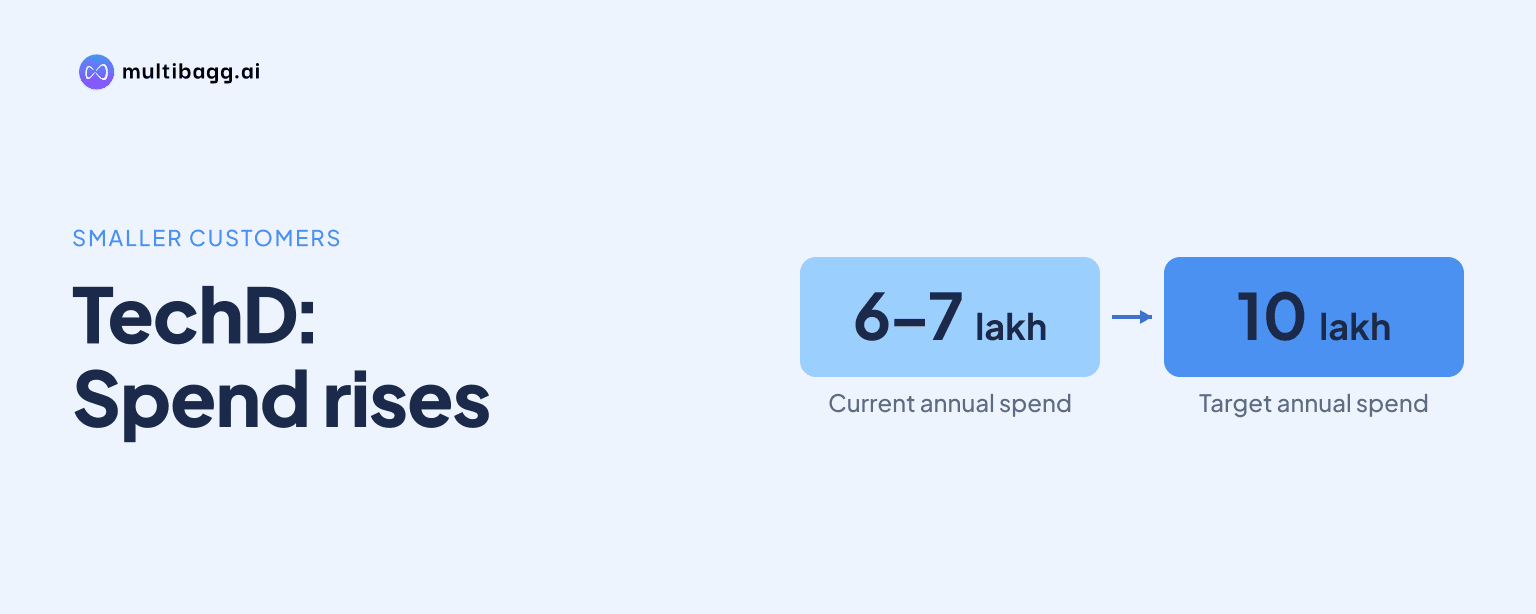
TechD aims to raise annual spending by smaller regulated customers to Rs 10 lakh from Rs 6-7 lakh by converting one-time cybersecurity assignments into managed services and attaching proprietary products. Management outlined the plan after an investor cited H1 revenue of Rs 39 crore and nearly 650 customers, while concentration among major accounts fell to about 35% from around 44% last year.
Know TechD Cybersecurity inside out
Results, valuation, peers and who's buying, in one view.
How much does TechD earn from smaller customers now?
TechD earns about Rs 6-7 lakh annually from many smaller customers, management said in response to a question based on Rs 39 crore of H1 revenue and nearly 650 clients. These accounts include regulated entities such as Securities and Exchange Board of India, or SEBI, brokers, cooperative banks and small and medium-sized businesses, whose cybersecurity work is shaped by regulatory requirements.
The Rs 6-7 lakh figure is a broad ticket-size indication, rather than a standard contract value for every customer. Management said small and medium-sized brokers have less cybersecurity budget and infrastructure than market infrastructure institutions, whose purchase orders can be larger. Rather than rely only on a 5-10% service-price increase, TechD intends to retain smaller clients at similar pricing and add managed work or products.
Customer requirements differ by size and scope. Management said some clients receive full cybersecurity services but operate smaller infrastructure, while larger enterprises may use multiple suppliers. It cited maker-checker practices under which a vendor conducting vulnerability assessment and penetration testing, or VAPT, may not also conduct security operations centre, or SOC, work for the same customer.
How will TechD lift smaller customers’ annual spending?
TechD plans to shift customers from one-time cyber audits, system audits and VAPT assignments into managed security services, then cross-sell products. Management gave the example of a SEBI broker paying Rs 50,000-60,000 for phishing simulations delivered as a service. TechD offers a 15-day proof of concept, or POC, and one campaign free to demonstrate its product-led model.
Management said TechD can initially offer the product at Rs 1.40 lakh to a customer already spending around Rs 70,000 on simulations, then conclude negotiations at Rs 1-1.20 lakh. The client would continue receiving managed support while purchasing the product. Management’s stated aim is to add product revenue and increase the contract value without ending the existing cybersecurity activity.
A second route is Provenance AI, which management described as a supply-chain security platform. It said SEBI has issued guidance related to cyber threats associated with artificial-intelligence tools and the use of AI-native vulnerability-management tools. TechD is conducting POCs with regulated customers and has a meeting scheduled with SEBI concerning the solution and possible empanelment, although management said that process is still at an early stage.
Management also cited a Rs 61 lakh Provenance AI sale to HDFC that included both the platform and management services. The order is much larger than the Rs 6-7 lakh smaller-customer ticket, but it demonstrates the commercial model TechD is pursuing. Management said customers are seeking platforms alongside services, rather than software without operational support.
Got a follow-up? Ask IRIS
Is TechD reducing reliance on its biggest accounts?
TechD said the contribution of its top 10 or top 20 customers, as described on the call, declined to around 35% of revenue this year from around 44% last year. Management did not disclose a rupee figure for either group or clarify whether the two percentages use the same top-10 or top-20 customer definition. The stated change nonetheless indicates a lower share from its largest accounts.
Management said cybersecurity budgets at the enterprise customers it serves are continuing to rise, and those customers are becoming product customers as well. Its plan therefore has two tracks: expand services and product sales at major accounts while raising spending across smaller regulated clients. The call did not quantify how much of the expected Rs 10 lakh smaller-customer spend would come from products versus managed services.
TechD also reported a 98% renewal rate and said it is generating more revenue from existing customer logos. Moving clients from periodic assessments towards managed services could make engagements more continuous, while product sales add another offering within each account. Management did not provide a renewal rate specifically for smaller customers, SEBI-regulated entities or product users.
What products and channels support the upselling plan?
TechD said it has launched four modules, including Human Trust, OT Shield, Provenance AI and Dark Vector, with four further modules planned for H2. It is also preparing Privacy Ops AI, an end-to-end privacy-management product that management said will include India’s Digital Personal Data Protection, or DPDP, requirements, the General Data Protection Regulation, or GDPR, and global privacy regulations. Management expects the product to be running in the current quarter.
Management is targeting product revenue at 10-15% of annual recurring revenue this year. TechD has appointed two distributors and six channel partners, and plans to sell directly to existing customers, through resellers and through managed security service providers, or MSSPs. It said MSSPs can white-label the platform, buy bulk licences with services and use TechD for customer POCs.
DPDP work is another potential source of customer expansion. Management said TechD has 27 professionals trained in ISO 27701 and DPDP-related services, and identified three revenue streams: managed services, one-time gap assessments, and technology implementation with continuing services. It said customers had only recently begun seeking quotations and budgets after the DPDP website and implementation structure became live.
Management also said H2 priorities include operational technology cybersecurity and vehicle cybersecurity, particularly for manufacturing and critical infrastructure. Its infrastructure can serve about 4,000-5,000 customers, compared with the 600-900 customer range referenced by management. That capacity does not establish future customer additions, but it supports the product-and-service distribution plan described on the call.
Conclusion
TechD’s stated monetisation strategy is to keep smaller regulated customers on cybersecurity contracts, convert isolated assignments into managed services and add products such as phishing-simulation tools and Provenance AI. The Rs 10 lakh annual-spend objective would represent an increase from the current Rs 6-7 lakh smaller-customer ticket, while the reported decline in large-account concentration to around 35% points to a broader revenue mix.
The next disclosures to watch are whether Privacy Ops AI becomes operational in the current quarter, whether the four additional modules planned for H2 are launched, and whether POCs convert into paid contracts. Management also expects DPDP-related activity to increase in H2 and said March, April and May could generate substantial demand, but it has not given a separate revenue target for that opportunity.