










Telge Projects cross-selling proof still awaits orders
Key highlights
- Architecture and related design services represented approximately 17% of Telge Projects’ H1 FY27 revenue.
- Edward Farr Architects contributed around Rs 5 crore of Telge Projects’ H1 FY27 revenue after its March 2026 acquisition.
- Telge Projects’ H1 FY27 consolidated revenue rose 105% to Rs 34.2 crore from Rs 16.7 crore in H1 FY26.
- The United States accounted for approximately 80% of Telge Projects’ H1 FY27 revenue.
powered by IRIS
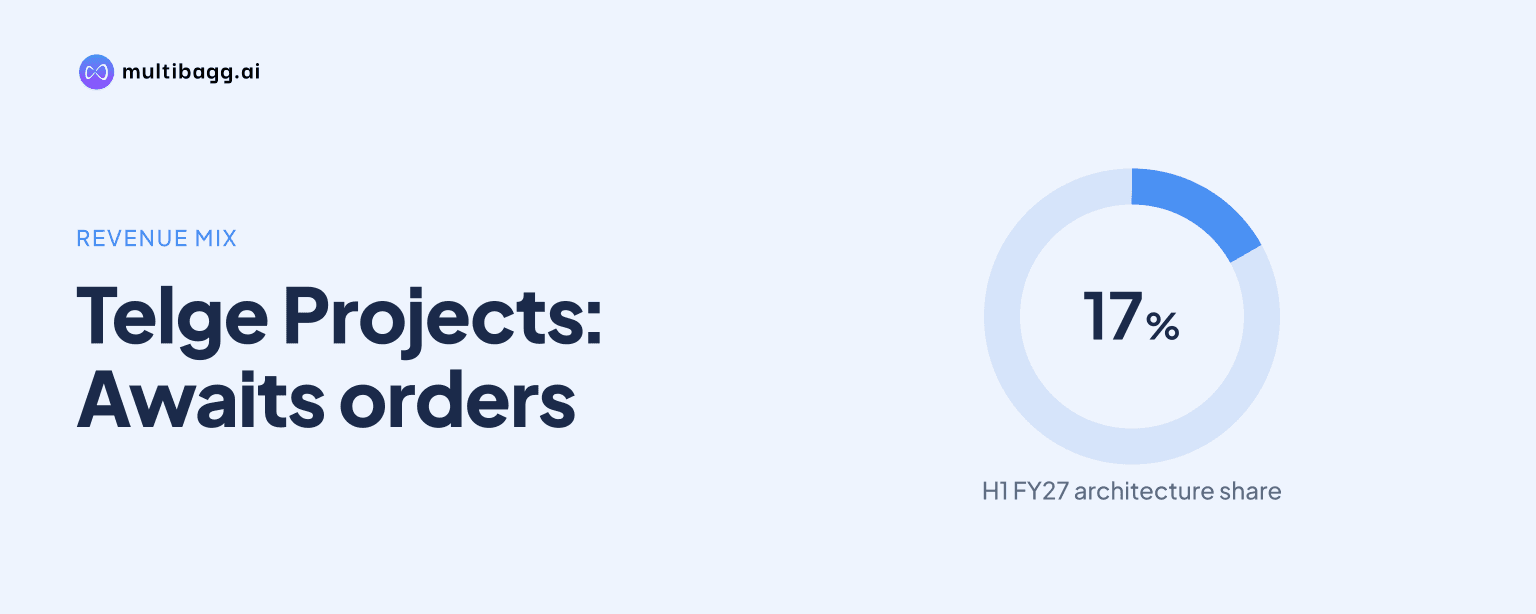
Telge Projects Limited had not yet disclosed cross-selling orders from its architecture-led expansion in H1 FY27, although architecture and related design services made up about 17% of revenue and Edward Farr Architects contributed around Rs 5 crore. Management said the next test is converting added relationships and capabilities into awarded projects, repeat work and profitability.
Know Telge Projects inside out
Results, valuation, peers and who's buying, in one view.
What did the Edward Farr Architects acquisition add to Telge Projects?
Telge Projects acquired Edward Farr Architects in March 2026 to add an established United States architectural practice, planning and design expertise, and access to customers earlier in a project lifecycle. Before that acquisition, Telge Projects primarily supported projects after design decisions through structural steel, precast, building information modelling, or BIM, and fabrication-related engineering services.
The acquisition supports Telge Projects’ plan to operate across architecture and structural engineering, including structural steel and precast and prestressed concrete. Management did not say every customer would use every service. Instead, it said earlier participation could improve its understanding of broader customer requirements and create opportunities to deliver work across more stages of a project.
Telge Projects also appointed a Director of Architecture with more than four decades of experience to support project oversight, customer development and the architectural organisation. Management said integration requires work on team transition, operating processes, and coordination between United States and Indian operations, rather than delivering its full strategic benefit immediately after acquisition.
How much has architecture changed Telge Projects’ revenue mix?
Architecture and related design services accounted for approximately 17% of Telge Projects’ H1 FY27 revenue, marking a change in the group’s service mix after the March 2026 acquisition. Edward Farr Architects contributed around Rs 5 crore of H1 revenue, according to management’s response to an analyst question.
Telge Projects reported consolidated revenue from operations of Rs 34.2 crore in H1 FY27, up 105% from Rs 16.7 crore in H1 FY26. The increase coincided with the enlarged architecture offering and broader North American platform, but management did not quantify the portion of H1 revenue generated by cross-selling between architecture, structural engineering, steel, precast or BIM.
The 17% architecture share demonstrates that Telge Projects has added a material service line, but it does not establish that the acquisition has already generated incremental multi-service customer wins. Management’s own stated priority is to turn the expanded capability set and customer access into actual projects and repeat business.
Has Telge Projects proved cross-selling from its acquisitions?
No, Telge Projects has not disclosed confirmed cross-selling orders or revenue from its acquisitions, and management said commercial conversion remains the immediate priority. It described architectural relationships as potential openings for structural engineering and BIM work, while existing engineering relationships could introduce customers to additional design capabilities.
Telge Projects said its strategy is not to acquire revenue for its own sake. Each acquisition is intended to add capabilities and customer access, after which value is expected to come through integration, cross-selling and disciplined execution. Management said shareholders would ultimately assess the acquisitions by the returns they generate, which is also the standard it intends to use.
The company set out a practical measure for its North American commercial effort: success will be judged by confirmed orders, executed revenue and profitability rather than meetings or quotations. Management said a new customer relationship often progresses from discussion to quotation and a trial assignment before it develops into recurring work, making the conversion cycle a central unresolved issue.
Got a follow-up? Ask IRIS
How do Telge Projects’ United States acquisitions fit together?
Telge Projects said its acquisitions serve distinct roles in building its North American engineering platform. Midwest strengthened SDS2 capability and local United States presence, Draftco added an established local team and a growth platform, Edward Farr Architects added architectural design-stage access, and Wheaton Detailing Services brought industrial relationships and experience.
Wheaton is particularly relevant to Houston and United States Gulf Coast industrial markets, where Telge Projects said it is reconnecting with legacy customers and introducing the broader group service offering. The company did not disclose the number of customers re-engaged after the Wheaton acquisition or any revenue awarded from those discussions.
The United States accounted for approximately 80% of H1 FY27 revenue, placing that market at the centre of the integration plan. Telge Projects added customer-facing leadership and business-development capacity, including a business-development leader with more than 13 years of relevant United States fabrication-industry experience, while seeking closer coordination among inside sales, outside sales, technical proposals and delivery.
Its delivery centres in Pune, Latur and Nashik remain part of that model. Telge Projects said the combination of local United States customer leadership and Indian engineering depth is intended to connect customer requirements with scalable technical delivery across geographies.
Why did Telge Projects’ Q2 profitability moderate?
Telge Projects said Q2 revenue remained broadly consistent with Q1, but Q2 earnings before interest, tax, depreciation and amortisation, or EBITDA, margin moderated to 17.1% as spending on new capacity and integration preceded expected revenue. The company attributed the movement to senior United States leadership hiring, the Edward Farr Architects transition, expanded software licences, and other operating and integration costs.
Employee cost as a proportion of Q2 revenue rose by around 410 basis points, software and subscription costs added around 190 basis points, and other operating and integration expenses added around 130 basis points. A basis point is one-hundredth of a percentage point. Management said these costs were incurred ahead of the revenue it expects new leadership and acquired capabilities to generate.
For H1 FY27, the result moved in the opposite direction from the Q2 margin trend. EBITDA rose 135% to Rs 7 crore, while EBITDA margin expanded 270 basis points to 20.8%. Profit after tax increased 157% to Rs 5 crore, and profit-after-tax margin improved 300 basis points to 14.6%, showing that first-half profitability rose despite the second-quarter investment phase.
What must Telge Projects deliver next to validate its platform?
Telge Projects must convert its broader customer opportunity base into awarded work while completing integration and improving utilisation and productivity. Management identified immediate priorities as deepening relationships with existing customers, cross-selling architecture, steel and precast services, improving sales conversion, and aligning hiring with confirmed work.
The company had almost 95 customers providing work in H1 FY27, including around 28 new customers. Management said those new customers could offer better opportunities and that Telge Projects intends to grow them vertically. It did not disclose the revenue contribution of the 28 additions or the proportion of those relationships connected to acquired businesses.
Telge Projects is also evaluating artificial intelligence-assisted workflows for repetitive tasks, model coordination and checking activities, subject to engineer review. Management said the programme’s benefits must be measured through engineering hours, lower rework, turnaround time and quality before approaches are scaled. It disclosed no specific investment amount for artificial intelligence and said it expects greater clarity on investment in the next financial year.
Conclusion
Telge Projects has expanded beyond post-design engineering into architecture and a wider United States platform, with architecture contributing about 17% of H1 FY27 revenue and Edward Farr Architects adding around Rs 5 crore. The commercial evidence sought by management has not yet been disclosed: confirmed cross-selling orders, executed revenue and recurring profitability from integrating the acquired capabilities and customer relationships.
The next period to watch is H2 FY27, as management said activity has historically been stronger in Q3 and Q4 while cautioning that customer decisions and project timing can change. Management said it expects full-year revenue in the higher Rs 70 crore range and is hopeful of reaching the early Rs 80 crore range if its pipeline develops as expected; it also plans to reduce days sales outstanding from around 77 days to 45 to 50 days.