










Telge Projects Limited Q2 Margin Falls to 17.1% on Costs
Key highlights
- Telge reported a Q2 FY27 EBITDA margin of 17.1% after hiring, software and integration costs rose ahead of related revenue.
- H1 FY27 revenue rose 105% year on year to Rs 34.2 crore, while EBITDA increased 135% to Rs 7.0 crore.
- H1 FY27 employee expense doubled to Rs 15.5 crore and software expense rose to Rs 2.7 crore from Rs 1.1 crore.
- Management expects EBITDA margin above 20% and cited FY27 revenue potential in the higher Rs 70 crore to early Rs 80 crore range.
powered by IRIS
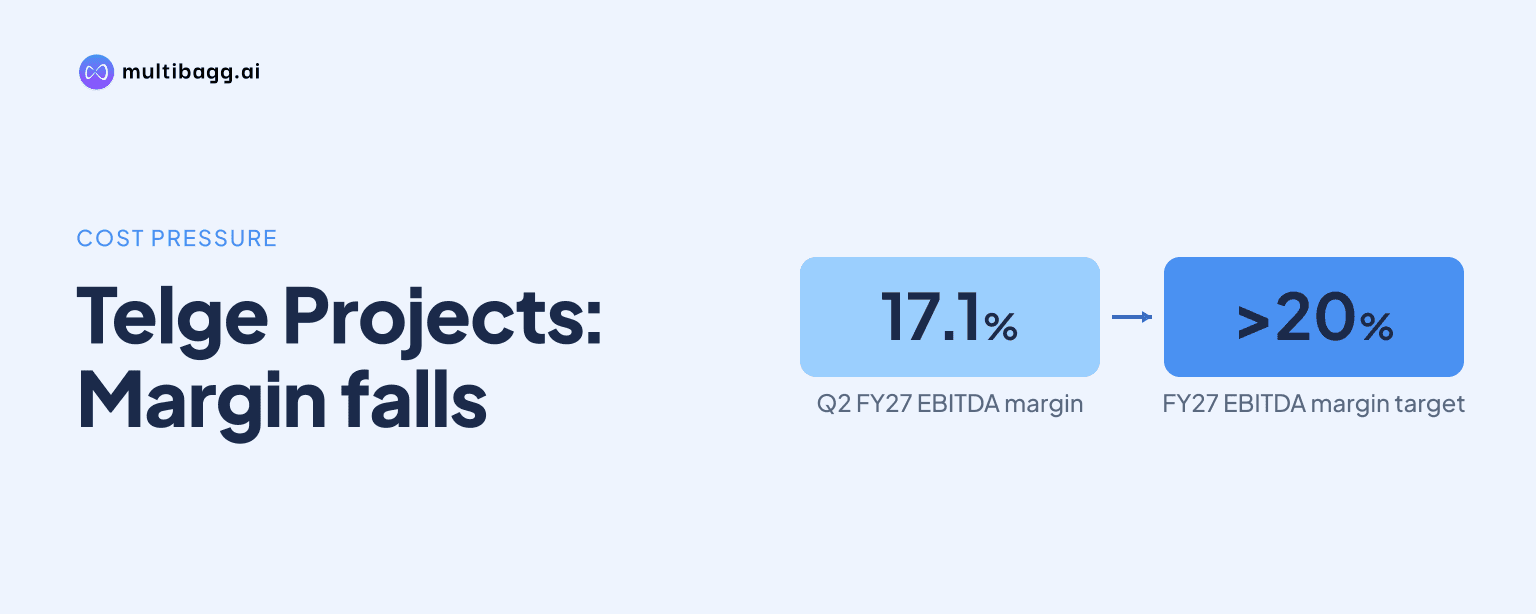
Telge Projects Limited reported a Q2 FY27 earnings before interest, tax, depreciation and amortisation (EBITDA) margin of 17.1%, as US leadership hiring, architecture integration, software licences and operating costs were incurred before related revenue. The margin decline came while H1 FY27 revenue rose 105% year on year to Rs 34.2 crore.
Know Telge Projects inside out
Results, valuation, peers and who's buying, in one view.
Why did Telge’s Q2 EBITDA margin fall to 17.1%?
Telge said Q2 FY27 EBITDA margin moderated to 17.1% because costs rose ahead of commercial opportunities moving through customer approval and project-award cycles. Q2 revenue was broadly in line with Q1, according to management, which attributed the margin change to expenditure rather than a reported sequential reduction in revenue from ongoing work.
Employee cost as a share of revenue increased by about 410 basis points, with one basis point equal to 0.01 percentage point. Telge linked this increase to senior US leadership appointments, the transition of Edward Farr Architects and the development of its US architectural team after the architecture acquisition in March 2026.
Software and subscription costs added about 190 basis points to Q2 cost pressure, while other operating and integration-related expenses added roughly 130 basis points. Management said these costs were incurred before the related capabilities generated revenue and expects operating leverage if new leadership and acquired businesses contribute to order inflow.
Telge said project cycles can take several months, moving from relationship development and quotations to a trial assignment, an award and execution. Its stated priorities after the 17.1% Q2 margin were improving sales conversion, matching hiring with confirmed work, increasing utilisation and managing costs, rather than treating proposals as confirmed revenue.
Which expenses increased during Telge’s H1 FY27 investment phase?
Telge’s H1 FY27 employee expenses doubled to Rs 15.5 crore as it expanded its team and leadership base. Software and subscription expenses increased to Rs 2.7 crore from Rs 1.1 crore, while depreciation rose to Rs 1.1 crore from Rs 30 lakh, which management associated with acquisitions and capacity additions.
Telge’s H1 FY27 EBITDA margin was 20.8%, up 270 basis points year on year, while profit after tax margin rose 300 basis points to 14.6%. The H1 margin exceeded the 17.1% Q2 level, showing that the first-half result included a more favourable margin outcome than the second quarter despite the higher employee and software spending.
Architecture and related design services accounted for about 17% of H1 FY27 revenue. Edward Farr Architects contributed about Rs 5 crore of H1 revenue, but management said structural engineering remains the main business expected to improve EBITDA margins, while the architecture operation is still being stabilised and integrated.
Got a follow-up? Ask IRIS
How is Telge converting US expansion into orders and revenue?
Telge is seeking to convert expanded US customer access into awarded projects through integration and cross-selling. The United States generated about 80% of H1 FY27 revenue, and Telge added business-development leadership with US fabrication-industry connections, including a professional with more than 13 years of relevant experience.
Telge said Midwest expanded its SDS2 capability and local US presence, Draftco added an established local team, Edward Farr Architects provided architectural design capability and Wheaton Detailing Services added industrial relationships in Houston and the US Gulf Coast. Management said the measure of these acquisitions will be returns from integration, customer access and cross-selling rather than acquired revenue alone.
The company had about 95 customers providing work in H1 FY27, including about 28 new customers. Telge also reported an order book of Rs 14 crore and said it added roughly Rs 5 crore to Rs 6 crore of projects each month during the prior year, while cautioning that customer decisions and timing can change.
Telge’s global workforce stood at about 305 people, comprising about 25 in the US and 280 in India across Pune, Latur and Nashik. Nearly 40 people worked at Nashik, where management plans to add staff, while the company is also assessing AI-assisted workflows for repetitive work, model coordination and checking with engineer review.
What are Telge’s margin, revenue and cash-conversion plans?
Telge expects margins to improve from the Q2 FY27 level because management said most major investments planned for the financial year have already been made. In response to an investor question, management said it expected EBITDA margin to remain above 20%, while linking the outcome to project conversion, employee utilisation, execution and cost discipline.
Management said it made software arrangements in H1 FY27 through block deals with software vendors, and Wheaton brought some existing licences into the group. Telge said it does not expect major additional software costs from the current setup, although licence costs can rise when operational capacity and manpower increase.
For FY27, management cited a revenue range in the higher Rs 70 crore range, with potential to reach the early Rs 80 crore range if the pipeline meets expectations. It said H1 FY27 represented nearly 45% of its annual target and that Q3 and Q4 are usually better than Q1 and Q2, but did not classify pipeline opportunities as confirmed revenue.
Working capital remains a separate execution priority. An analyst cited operating cash flow of Rs 1.2 crore against EBITDA of Rs 7.1 crore and working-capital absorption of Rs 4.4 crore; management said it was focused on receivables collection and aimed to reduce days sales outstanding from about 77 days to 45 to 50 days.
Conclusion
Telge’s 17.1% Q2 FY27 EBITDA margin reflected the timing of spending on US leadership, architecture integration, software and operating capacity relative to revenue conversion. H1 FY27 revenue of Rs 34.2 crore and EBITDA of Rs 7.0 crore indicate that profit grew faster than revenue over six months, but the Q2 result shows that future margin delivery depends on utilisation, order awards and disciplined spending.
The next indicators are Q3 and Q4 order conversion, progress integrating Edward Farr Architects and movement in days sales outstanding toward the 45-to-50-day target. Management also said an MEP acquisition is on hold until at least the end of March 2027, while it expects greater clarity on dedicated AI investment in the next financial year.