










Telge plans architecture-led entry before detailing work
Key highlights
- Architecture & BIM Services accounted for 17% of Telge’s H1 FY27 service portfolio mix.
- Structural Steel & BIM Services represented 73% of Telge’s H1 FY27 service mix, versus 10% for Precast Solutions.
- Telge’s Steel Detailing Department has 223 team members, compared with 36 in Precast Detailing.
- Telge reported Rs 34.2 crore of revenue from operations in H1 FY27, after Rs 40.2 crore in FY26.
powered by IRIS
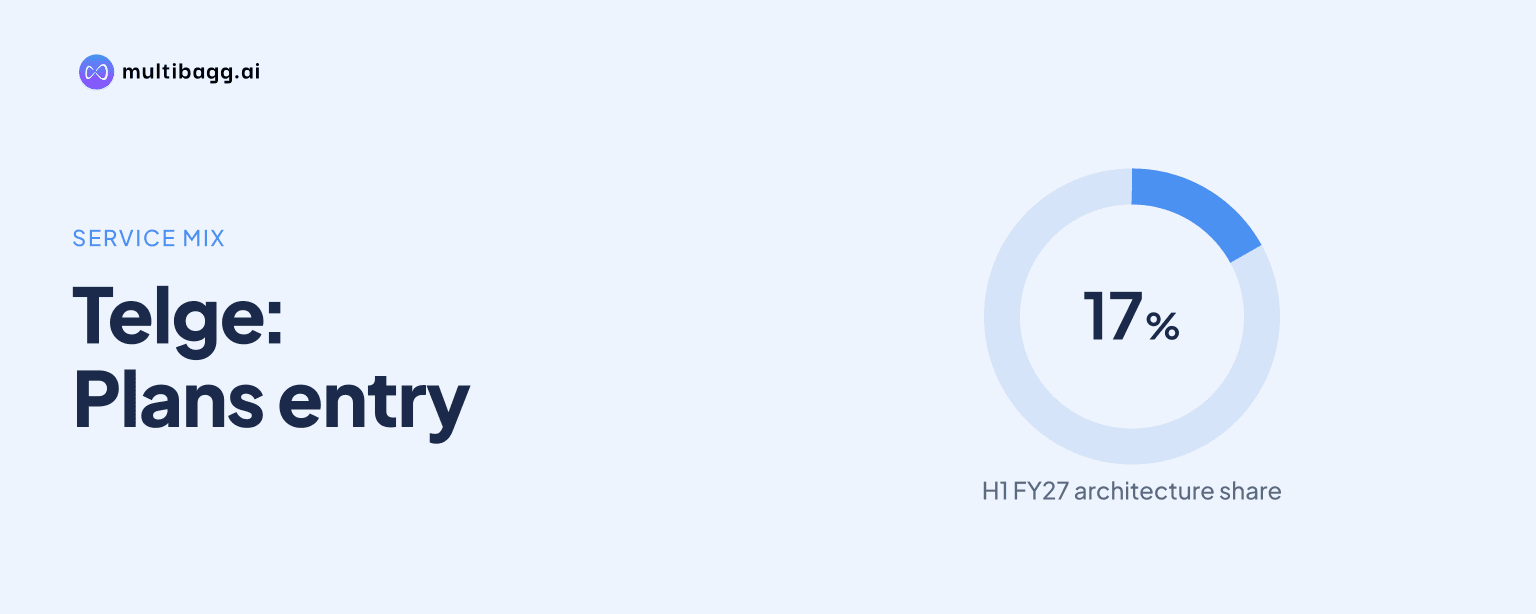
Telge Projects plans to use architecture-led design work to enter projects before fabrication detailing and cross-sell related services; Architecture & BIM Services represented 17% of its H1 FY27 portfolio, while Structural Steel & BIM Services accounted for 73%. Its delivery map connects concept work and construction documents with a later detailing route.
Know Telge Projects inside out
Results, valuation, peers and who's buying, in one view.
How does Telge enter projects before detailing work?
Telge intends to enter projects through a five-stage design and BIM pathway before fabrication detailing begins. The route serves owners, developers, architects and general contractors, starting with client requirements, site inputs and feasibility, then progressing through design development, BIM coordination, construction documents and hand-off to construction.
At the hand-off stage, Telge releases models and documents for fabrication and identifies this point as entry into its second delivery pathway. Its architecture offering covers five services: master planning and concept design, architectural design and development, interior architecture and space planning, architectural BIM and construction documentation, and design coordination and construction support.
Which services can Telge cross-sell from architecture?
Telge plans to add structural engineering, BIM, detailing and material take-offs, or MTO, after an architecture engagement, under its stated model of one client using multiple services. Management describes the sequence as acquiring capability and client access, integrating delivery and cross-selling, with the intended result of higher revenue per relationship.
The available follow-on work spans two construction frameworks. Structural steel services include engineering and design support, 3D modelling, connection design, fabrication and erection detailing, and MTO support; precast and prestressed concrete work includes engineering, component and connection detailing, reinforcement and prestressing detailing, shop drawings and production support.
Structural Steel & BIM Services remained Telge’s largest reported H1 FY27 category at 73%, compared with 17% for Architecture & BIM Services and 10% for Precast Solutions. The presentation therefore shows architecture as a smaller current service category, while placing it earlier in the stated project-execution sequence; it does not disclose cross-sell revenue or the number of clients using more than one service.
How do Telge’s two delivery pathways connect?
Telge connects the two pathways by using design-stage work to produce the information needed for fabrication. The design and BIM route includes architectural and structural design, integrated-model coordination, clash detection and multi-disciplinary review, before drawing sets, specifications and MTO are prepared for permit or tender use.
The fabrication and detailing route serves steel fabricators, precasters and erectors through five stages: scope and estimate, award and kick-off, modelling and detailing, approval, and release. Telge uses Tekla Structures, SDS2 and Autodesk Revit for shop drawings and erection plans, and the release package includes fabrication files; the presentation calls design-stage engagement a natural entry point into detailing but gives no conversion rate.
Got a follow-up? Ask IRIS
What delivery capacity supports Telge’s construction frameworks?
Structural steel is Telge’s dominant framework, with a dedicated Steel Detailing Department of 223 team members, described as roughly three-fourths of the total detailing workforce. That staffing concentration corresponds with Structural Steel & BIM Services making up 73% of the H1 FY27 portfolio, although the presentation does not say that workforce and service-mix measures use the same basis.
Precast concrete has a dedicated 36-member Precast Detailing Department, 187 fewer people than the steel department, and Precast Solutions represented 10% of H1 FY27 mix. Telge states that this team holds ISO 9001:2015 accreditation for 3D modelling and detailing of precast structures, covering a separate concrete-based framework from steel.
Telge also reports 305 employees, three India delivery centres in Latur, Pune and Nashik, and four acquired businesses in U.S. structural engineering and architecture. Management’s planned actions are to integrate the four businesses, cross-sell design, BIM and detailing, shift more acquired work to India, and evaluate mechanical, electrical and plumbing services.
How did Telge build the architecture-led platform?
Telge’s timeline shows a move from steel and precast detailing for fabricators in 2018 to architecture and planning capability in 2026. The company began with 10 engineers in 2018, established a U.S. subsidiary in 2023 for direct client engagement, and invested in Midwest Detailing in January 2024 and Draftco in December 2024.
The 2026 expansion added Edward Farr Architects in March and Wheaton Detailing Services in August, alongside expansion in Nashik. Revenue from operations rose from Rs 7.4 crore in FY23 to Rs 40.2 crore in FY26, while H1 FY27 revenue was Rs 34.2 crore; the presentation cites about 75% compound annual growth from FY23 to FY26, but FY23 is standalone whereas FY24 through H1 FY27 are consolidated.
Conclusion
Telge’s architecture plan is built around entering at concept and design stages, then offering structural engineering, BIM, MTO and fabrication detailing as projects progress. The current mix still centres on Structural Steel & BIM Services at 73% in H1 FY27, compared with 17% for Architecture & BIM Services, and the 223-member steel team remains much larger than the 36-member precast team.
The next item to watch is management’s planned integration of four acquired businesses and its ability to cross-sell design, BIM and detailing across their client relationships. Telge also plans to shift more acquired work to India and evaluate mechanical, electrical and plumbing services, but the presentation gives no timetable, revenue target or quantified cross-sell measure for those actions.