










Telge Projects EBITDA margin declines to 20.8% in H1 FY27
Key highlights
- Telge Projects’ EBITDA margin declined from 32.2% in FY25 to 20.8% in H1 FY27.
- Telge Projects’ working-capital days increased from 85 in FY25 to 121 in FY26.
- Telge Projects reported Rs 6.822 crore of working-capital cash use in FY26.
- Telge Projects’ trade receivables increased to Rs 14.63 crore at Sep-26 from Rs 11.917 crore at Mar-26.
powered by IRIS
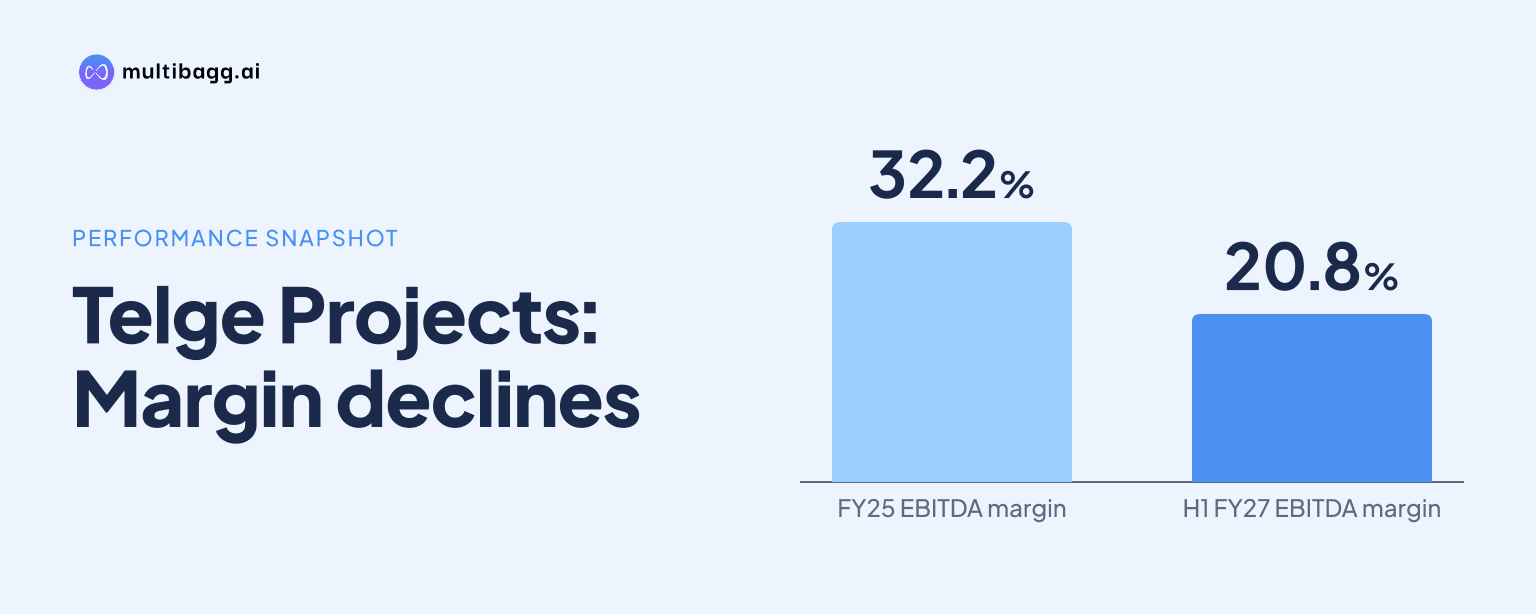
Telge Projects Limited reported a 20.8% EBITDA margin in H1 FY27, down from 32.2% in FY25, while working-capital days rose to 121 in FY26 from 85 in FY25. Revenue reached Rs 34.243 crore in H1 FY27, but higher operating costs and working-capital use constrained cash conversion.
Know Telge Projects inside out
Results, valuation, peers and who's buying, in one view.
Why did Telge Projects’ EBITDA margin decline?
Telge Projects’ EBITDA margin fell by 11.4 percentage points from 32.2% in FY25 to 20.8% in H1 FY27, after declining to 22.4% in FY26. EBITDA rose from Rs 8.24 crore in FY25 to Rs 9.02 crore in FY26, whereas revenue increased from Rs 25.612 crore to Rs 40.21 crore over the same full-year comparison.
Telge Projects’ employee expenses increased from Rs 8.956 crore in FY25 to Rs 18.119 crore in FY26, while other expenses rose from Rs 8.415 crore to Rs 13.071 crore. In H1 FY27, employee expenses were Rs 15.537 crore, other expenses were Rs 8.936 crore and software and subscription expenses were Rs 2.651 crore. The presentation does not assign a specific cause to the margin decline.
How did Telge Projects’ revenue and profit change?
Telge Projects’ revenue increased from Rs 12.411 crore in FY24 to Rs 40.21 crore in FY26, while profit after tax, or PAT, rose from Rs 2.657 crore to Rs 6.274 crore. Revenue more than doubled in FY25, increasing by Rs 13.201 crore, and expanded by a further Rs 14.598 crore in FY26.
Telge Projects’ PAT margin moved from 21.4% in FY24 to 21.2% in FY25, 15.6% in FY26 and 14.6% in H1 FY27. H1 FY27 PAT was Rs 4.983 crore and earnings before interest and tax, or EBIT, was Rs 6.409 crore, with an 18.7% EBIT margin compared with 32.6% in FY25.
Depreciation increased from Rs 44.5 lakh in FY25 to Rs 77 lakh in FY26 and Rs 1.115 crore in H1 FY27. Finance cost declined from Rs 1.315 crore in FY25 to Rs 81 lakh in FY26 and Rs 2.9 lakh in H1 FY27, but PAT margin nevertheless declined across those periods.
How did working capital affect Telge Projects’ operating cash?
Telge Projects’ working-capital days rose from 73 in FY24 to 85 in FY25 and 121 in FY26. Changes in working capital used Rs 6.822 crore in FY26, compared with Rs 3.723 crore in FY25, reducing cash generated from operations to Rs 2.757 crore from Rs 4.932 crore.
Telge Projects reported Rs 9.58 crore of operating profit before working-capital changes in FY26, but net cash from operating activities was Rs 79.6 lakh after the working-capital movement and Rs 1.962 crore of direct taxes paid. In the Sep-26 period, operating profit before working-capital changes was Rs 7.175 crore, working capital used Rs 4.439 crore and net operating cash was Rs 1.249 crore.
Trade receivables increased from Rs 11.917 crore at Mar-26 to Rs 14.63 crore at Sep-26. Cash and bank balances decreased from Rs 22.492 crore to Rs 20.17 crore, while other current assets fell from Rs 8.722 crore to Rs 7.932 crore; total current assets were Rs 43.763 crore at Mar-26 and Rs 43.952 crore at Sep-26.
Got a follow-up? Ask IRIS
What happened to Telge Projects’ returns and funding?
Telge Projects’ return on equity, or ROE, declined from 47% in FY25 to 15% in FY26, while return on capital employed, or ROCE, declined from 45% to 18%. The higher FY26 working-capital-days figure of 121 coincided with revenue of Rs 40.21 crore, versus 85 days and Rs 25.612 crore of revenue in FY25.
Total equity increased from Rs 42.837 crore at Mar-26 to Rs 43.913 crore at Sep-26. Long-term borrowings fell from Rs 5.745 crore to Rs 5.158 crore, short-term borrowings decreased from Rs 3.715 crore to Rs 1.322 crore, and total current liabilities declined from Rs 11.671 crore to Rs 7.148 crore.
Telge Projects recorded a Rs 3.009 crore financing cash outflow in the Sep-26 period, compared with a Rs 23.126 crore financing cash inflow in Mar-26. Net cash and cash equivalents decreased by Rs 2.322 crore in Sep-26, whereas the Mar-26 cash-flow statement recorded a Rs 20.967 crore increase.
What is Telge Projects planning next?
Telge Projects says it is expanding from steel detailing into architecture, building information modelling, or BIM, and adjacent services to become an integrated architecture, engineering and BIM platform. Management states that earlier participation in design-stage engineering and BIM coordination is intended to improve project visibility and value capture.
Telge Projects identifies North America as its next growth engine and says acquisitions have strengthened local client access alongside India-based delivery capabilities. The presentation gives no revenue, margin or cash-flow target for that expansion, and provides no timetable for its evaluated phased build-out of mechanical, electrical and plumbing, or MEP, disciplines.
Telge Projects also says automation, digital workflows and artificial intelligence-enabled engineering can reduce dependence on linear manpower growth and improve delivery productivity. That stated mechanism is relevant to H1 FY27 employee expenses of Rs 15.537 crore, although the presentation gives no quantified savings, implementation date or expected EBITDA-margin outcome.
Conclusion
Telge Projects paired revenue growth from Rs 12.411 crore in FY24 to Rs 40.21 crore in FY26 with lower operating and net margins. EBITDA margin declined to 22.4% in FY26 and 20.8% in H1 FY27, while FY26 working-capital days reached 121 and a Rs 6.822 crore working-capital outflow limited operating cash generation.
The next reported evidence will be whether Telge Projects’ architecture, BIM and North American expansion changes its expense and cash-flow pattern. Management identifies automation and earlier project-lifecycle participation as operating mechanisms, but the presentation leaves the timing, spending requirement and financial targets for these initiatives unresolved.