










Tenneco Clean Air India Q2 VAR up 32%, PAT up 15% as costs rise
Key highlights
- Tenneco Clean Air India’s Q2 FY27 value-added revenue rose 32.2% to Rs 1,522.9 crore.
- Q2 FY27 PAT increased 15% to Rs 173.4 crore, while EBITDA increased 28.7% to Rs 261.6 crore.
- Advanced Ride Technologies Q2 FY27 value-added revenue grew 37.8% to Rs 801 crore, versus 26.6% growth for Clean Air and Powertrain Solutions.
- The H1 FY27 lifetime order book was approximately Rs 16,500 crore, covering more than 100% of the FY30 revenue target.
powered by IRIS
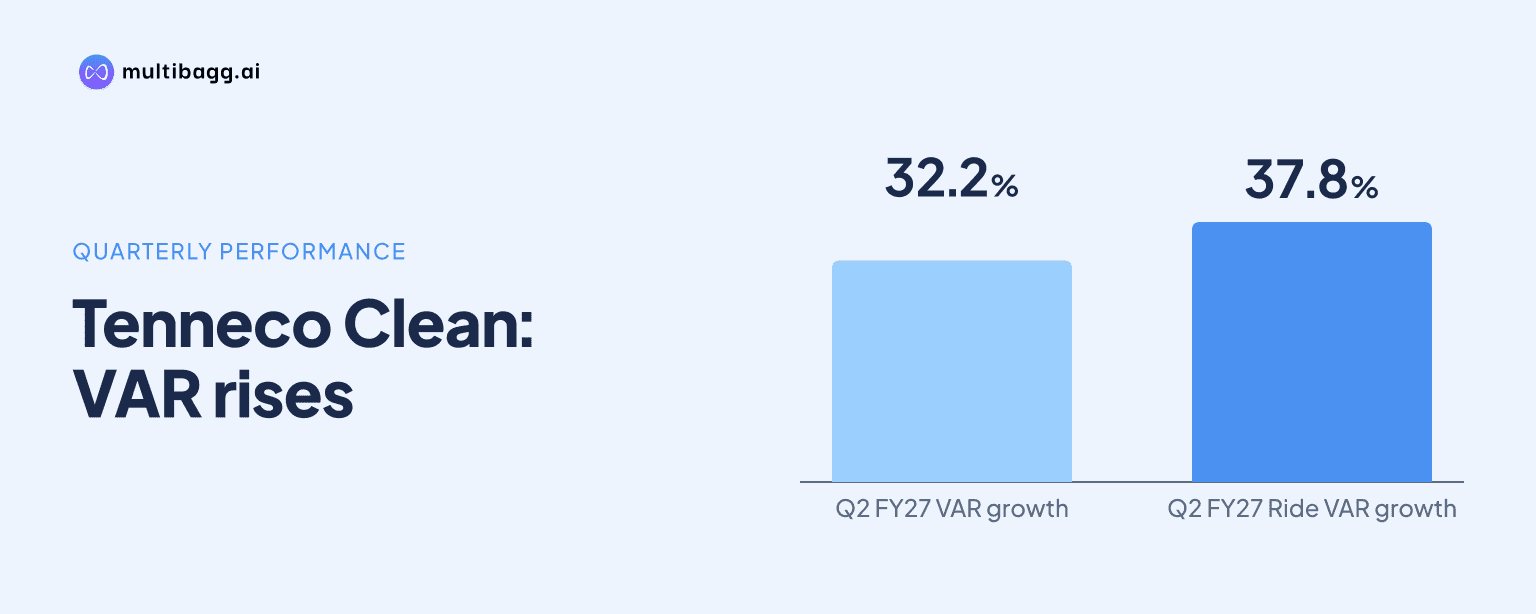
Tenneco Clean Air India Limited increased value-added revenue by 32.2% year on year to Rs 1,522.9 crore in Q2 FY27, while profit after tax rose 15% to Rs 173.4 crore as commodity inflation, wage increases, currency weakness, premium freight and listed-company costs reduced the conversion of sales growth into profit.
Know Tenneco Clean Air India inside out
Results, valuation, peers and who's buying, in one view.
Why did Tenneco Clean Air India’s profit grow more slowly than revenue?
Tenneco Clean Air India’s profit grew more slowly because its cost base rose while the prior-year first half included a one-off interest-income benefit. Value-added revenue, or VAR, excludes pass-through substrate costs and rose 32.2% in Q2 FY27, whereas earnings before interest, tax, depreciation and amortisation, or EBITDA, increased 28.7% to Rs 261.6 crore and profit after tax, or PAT, increased 15% to Rs 173.4 crore.
Management identified commodity cost inflation linked to the geopolitical environment, higher minimum wages in a couple of states, a weaker currency, premium freight and the cost of operating as a publicly listed company as profitability pressures. Commercial recoveries from customers, productivity improvements and cost management partly offset those items, but Q2 FY27 EBITDA margin was 17.2% of VAR.
The H1 FY27 PAT comparison also had a higher base than EBITDA because H1 FY26 included approximately Rs 25.4 crore of post-tax interest income from the Motocare entity sale. Tenneco Clean Air India said H1 FY27 PAT would have grown in line with EBITDA without that non-recurring item; reported H1 PAT rose 6.2% to Rs 338.6 crore, compared with 14.1% EBITDA growth to Rs 508.5 crore.
How did Tenneco Clean Air India perform in Q2 and H1 FY27?
Tenneco Clean Air India recorded faster growth in Q2 than in the first half across both revenue from operations and VAR. Q2 FY27 revenue from operations rose 34.2% year on year to Rs 1,718.3 crore, while H1 FY27 revenue rose 27.2% to Rs 3,263.1 crore; the difference reflects a quicker quarterly growth rate rather than a change in the company’s reporting metric.
Tenneco Clean Air India’s Q2 EBITDA margin of 17.2% was below its H1 FY27 margin of 17.5% on VAR. Management did not quantify the effect of each input cost, but its explanation links the gap between 32.2% Q2 VAR growth and 15% PAT growth to commodity, labour, currency, freight and public-company cost pressures.
Which Tenneco Clean Air India segment grew faster in Q2 FY27?
Tenneco Clean Air India’s Advanced Ride Technologies segment grew faster than Clean Air and Powertrain Solutions in both Q2 and H1 FY27. Advanced Ride Technologies generated Q2 FY27 VAR of Rs 801 crore, up 37.8% year on year, compared with Rs 721.8 crore and 26.6% growth for Clean Air and Powertrain Solutions.
Management attributed Advanced Ride Technologies’ Q2 performance to production volumes, new-programme ramp-ups and increased content on customer platforms. During the quarter, Tenneco Clean Air India began production for the three-door Thar suspension programme, secured two next-generation models with an existing Japanese passenger-vehicle original equipment manufacturer, or OEM, and added three platforms with a Vietnamese OEM.
Clean Air and Powertrain Solutions grew more slowly, with H1 FY27 VAR up 17.8% to Rs 1,384.3 crore versus 32.9% growth in Advanced Ride Technologies. The company cited volume growth and programme ramp-ups, including a hot-end commercial-vehicle exhaust programme for buses, a compressed natural gas cold-end assembly programme and a spark-plug award from a European passenger-vehicle manufacturer.
Got a follow-up? Ask IRIS
Can Tenneco Clean Air India recover the cost pressures?
Tenneco Clean Air India can seek recovery of some steel-price increases through OEM arrangements, although management gave no timeline for recovering non-indexed costs. Management said indexed steel recoveries can lag by about one quarter, while costs for lube oil, plastic and rubber are subject to customer negotiations; it said it had recovered part of those non-indexed costs.
The timing of additional recovery remains unresolved because management said discussions with customers were still under way. An analyst cited a decline in the subsidiary’s margin from 14% to 11.6% during the quarter, and management attributed the pressure mainly to higher steel and non-steel commodity prices following the Middle East situation rather than committing to a margin-recovery date.
Tenneco Clean Air India reported a negative 22-day cash conversion cycle in H1 FY27, alongside a debt-free balance sheet and net cash position. Management said this working-capital structure allows it to fund capital expenditure and growth requirements through internal accruals while it pursues commercial recoveries and productivity actions.
What supports Tenneco Clean Air India’s FY30 growth plan?
Tenneco Clean Air India reported a lifetime order book of approximately Rs 16,500 crore at the end of H1 FY27, which management said covered more than 100% of its FY30 revenue target. Exports represented approximately Rs 875 crore of that order book and provided 50% coverage of the company’s FY30 export-revenue target.
Management is adding capacity against those commitments through a new Clean Air manufacturing facility in West India, requiring investment of approximately Rs 45 crore. The company said the facility would add 12% to 14% hot-end capacity, while it continues to invest in capacity expansion, localisation and engineering capabilities.
Tenneco Clean Air India also reported market-share gains in its served markets. Management cited a 59% share in commercial-truck clean-air solutions in H1 FY27, up from 58% in FY26 and 57% in FY25, while passenger-vehicle shock absorbers and struts held approximately 55% share, compared with 48% about a year and a half earlier.
Conclusion
Tenneco Clean Air India delivered broad Q2 FY27 growth, with VAR up 32.2% and Advanced Ride Technologies growing 37.8%, but PAT increased 15% as costs rose faster than profit. The H1 comparison was further affected by Rs 25.4 crore of one-off post-tax interest income recognised in H1 FY26, which management said raised the earlier PAT base.
The next items to watch are customer negotiations over non-indexed commodity costs, for which management gave no recovery timetable, and execution of the Rs 16,500 crore lifetime order book. Management also plans the West India Clean Air plant, which it expects to add 12% to 14% hot-end capacity.