










Tenneco Clean Air India Q2 VAR Rises 32.2% to ₹1,523 Crore
Key highlights
- Tenneco Clean Air India's Q2 FY27 value-added revenue rose 32.2% year-on-year to ₹1,522.90 crore.
- Q2 FY27 consolidated revenue from operations increased 34.2% to ₹1,718.34 crore, while profit after tax rose 15.0% to ₹173.36 crore.
- The lifetime order book stood near ₹16,500 crore and covered more than 100% of the FY2030 revenue target.
- Export orders were ₹875 crore, or about 5-6% of the total order book, amid softness in Western markets.
powered by IRIS
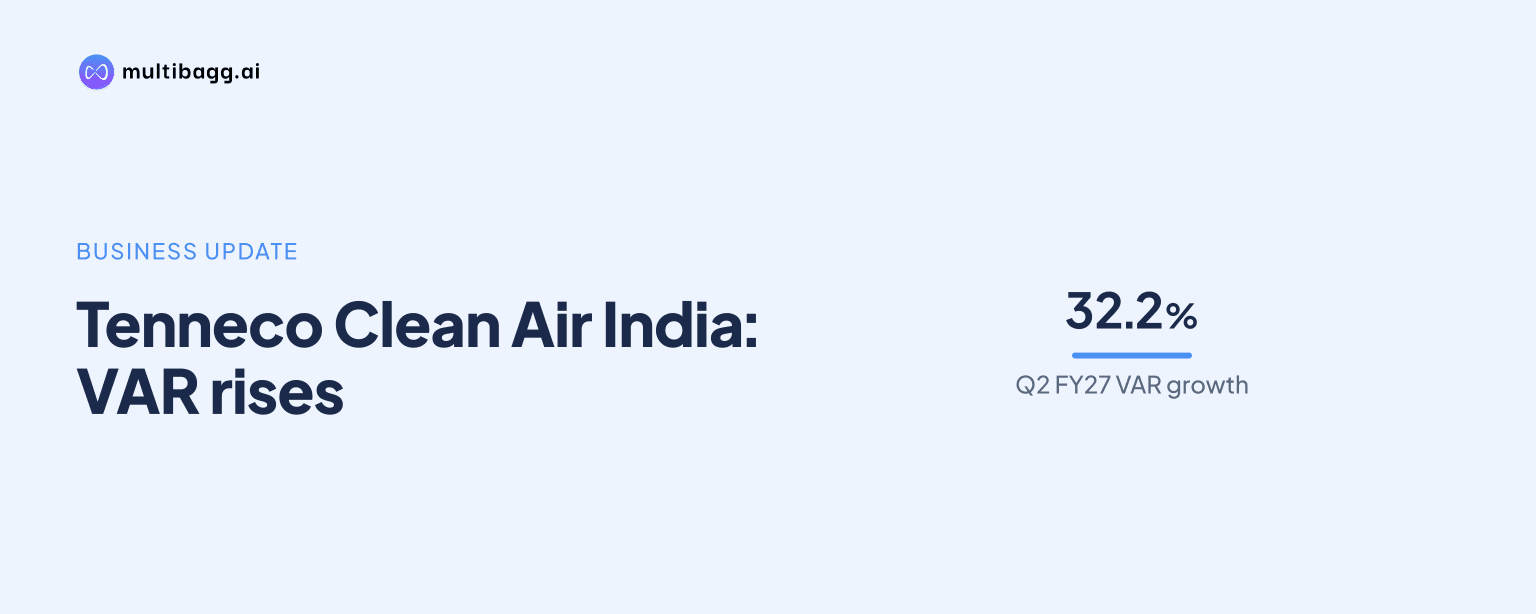
Tenneco Clean Air India Ltd reported value-added revenue of ₹1,523 crore in Q2 FY27, up 32.2% year-on-year, supported by 25.4% volume growth, while its lifetime order book rose to about ₹16,500 crore. The result shows strong demand and customer-program momentum, although commodity inflation reduced the EBITDA margin on value-added revenue to 17.2%.
Know Tenneco Clean Air India inside out
Results, valuation, peers and who's buying, in one view.
What drove Tenneco Clean Air India's Q2 FY27 revenue growth?
Tenneco Clean Air India's Q2 FY27 growth was driven primarily by higher production volumes, customer wins, market-share gains and technology launches. Consolidated revenue from operations increased 34.2% year-on-year to ₹1,718.34 crore for the quarter ended September 30, 2026. Value-added revenue, or VAR, rose 32.2% to ₹1,522.90 crore.
Management said volume growth was 25.4% during the quarter. The company operates in clean air and powertrain-related automotive components, and its quarterly performance reflected broad-based growth across these businesses. Q2 EBITDA increased 20.7% year-on-year to ₹261.60 crore, while consolidated profit after tax rose 15.0% to ₹173.36 crore.
The half-year figures also showed continued expansion. H1 FY27 revenue from operations grew 27.2% to ₹3,263.09 crore, and VAR rose 25.3% to ₹2,904.40 crore. H1 EBITDA grew 14.1% to ₹508.50 crore, while net profit increased 6.2% to ₹338.59 crore.
The company stated that PAT growth was affected by a one-time interest-income benefit recorded in the prior-year period, which created a higher comparison base. Excluding that one-time income, management indicated PAT grew 20.4% in Q2 and 15.4% in H1.
How did commodity inflation affect Tenneco Clean Air India's margins?
Commodity inflation reduced Tenneco Clean Air India's profitability growth relative to its revenue growth. EBITDA margin on VAR declined by 165 basis points year-on-year to 17.2% in Q2 FY27, even as EBITDA rose in absolute terms. For H1 FY27, the EBITDA margin on VAR was 17.5%, down 172 basis points year-on-year.
Chief Financial Officer Mahendra Chhabra attributed the margin compression to inflationary headwinds, particularly higher costs for steel, lube oil, plastic and rubber. These materials are relevant inputs for the company's automotive component operations, making raw-material pricing an important factor in quarterly profitability.
The reported EBITDA margin based on revenue from operations was 15.2% for Q2 FY27, compared with the 17.2% measure based on VAR. The difference reflects the use of two different revenue bases. The company also reported that its standalone and consolidated interim results were subject to limited review, with auditors reporting no matter indicating material misstatement or disclosure non-compliance.
Got a follow-up? Ask IRIS
What does the ₹16,500 crore order book indicate?
Tenneco Clean Air India's approximately ₹16,500 crore lifetime order book provides more than 100% coverage of its FY2030 revenue target, according to management. This order book gives the company stated revenue visibility across its clean air and powertrain businesses and supports management's view of a healthy double-digit growth trajectory through FY2030.
The order book includes domestic and export programmes. Its scale is significant compared with current revenue, but it represents lifetime programme value rather than revenue that will be booked in a single year. The timing of revenue recognition will depend on production schedules and the execution of customer programmes.
Export orders stood at ₹875 crore, or roughly 5-6% of the total order book. Management said this export order book had declined because of softness in Western markets and geopolitical uncertainty. The lower export component means the order pipeline is principally linked to domestic automotive demand and India-focused customer programmes.
Management did not provide a specific growth forecast for FY27. It said it expects Clean Air and Powertrain growth across domestic and export markets, while noting the current uncertainty affecting overseas demand.
Where is Tenneco Clean Air India expanding manufacturing capacity?
Tenneco Clean Air India is expanding capacity through new plants in North and West India to support its order book and customer requirements. Chief Executive Officer Arvind Chandra said the first clean air plant is in North India and is intended to serve Maruti, Mahindra and other customers.
The company also has an ART suspension plant in West India. Its newest clean air plant is in West India, close to the manufacturing centre of gravity for Mahindra and Tata. The company announced an investment of about ₹45 crore for the new West India manufacturing plant.
FY27 capital expenditure guidance remains ₹350 crore to ₹450 crore. Tenneco Clean Air India had invested close to ₹120 crore by the end of September 2026, and management said spending was on track against its stated guidance. Capacity additions are relevant because order-book conversion requires manufacturing infrastructure near customer production locations.
For investors, the combination of a debt-free balance sheet, rising volumes and planned capacity investment provides the operating context for the FY2030 target. At the same time, margin recovery will remain tied to input-cost conditions and the company's ability to manage commodity inflation.
Conclusion
Tenneco Clean Air India delivered strong Q2 FY27 revenue and volume growth, with VAR rising 32.2% to ₹1,522.90 crore and revenue from operations increasing 34.2% to ₹1,718.34 crore. The ₹16,500 crore lifetime order book supports management's FY2030 revenue ambition, but lower export orders and margin pressure from steel, oil, plastic and rubber costs remain material factors.
The next points to watch are progress on FY27 capital expenditure of ₹350 crore to ₹450 crore, ramp-up at the new North and West India facilities, and whether input-cost conditions allow EBITDA margins to improve. Investors will also monitor the export order book, which was ₹875 crore at the end of the reported period.