










Tenneco export book drops to Rs 875 crore as launches stall
Key highlights
- Tenneco confirmed a Rs 875 crore lifetime export order book in Q2 FY 2027.
- Exports represented 14%-20% of Tenneco’s Rs 12,400 crore order book at FY 2026-end.
- Tenneco said exports accounted for about 7% of Q2 FY 2027 revenue.
- Tenneco reported Q2 FY 2027 revenue from operations of Rs 1,718.3 crore, up 34.2% year on year.
powered by IRIS
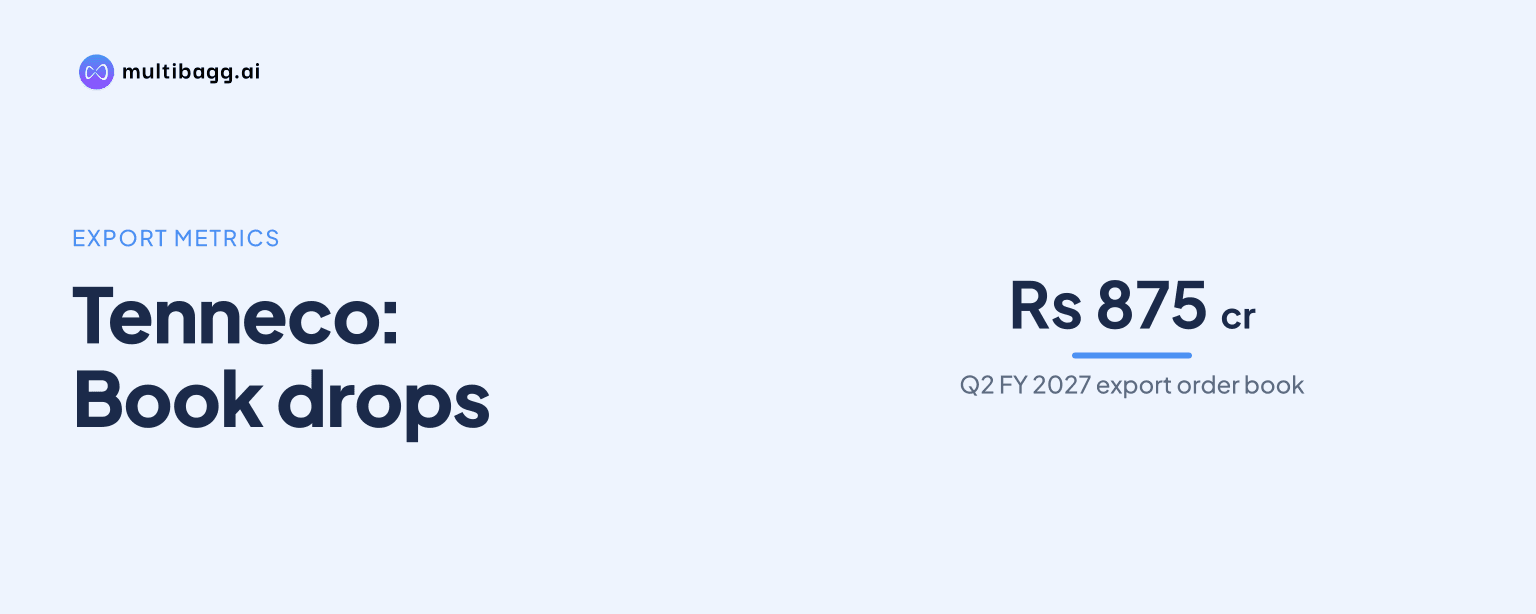
Tenneco India’s lifetime export order book was Rs 875 crore in Q2 FY 2027, down from exports representing 14%-20% of its Rs 12,400 crore order book at FY 2026-end, after some Western customer production launches were delayed or cancelled. Management cited softer Western vehicle demand, Chinese competition, tariff uncertainty and higher oil and freight costs.
Know Tenneco Clean Air India inside out
Results, valuation, peers and who's buying, in one view.
Why did Tenneco’s export order book fall?
Tenneco said the export order book fell because vehicle markets in Western Europe and the Americas weakened, affecting supplies to third-party original equipment manufacturers, or OEMs, and shipments to Tenneco operations in the US and Europe. Management cited gross domestic product contraction and stopped vehicle deliveries in markets including Germany, France, the UK and the US.
Management said Chinese vehicle exports had increased competitive pressure and slowed production at Western OEMs. At FY 2026-end, exports represented 14%-20% of Tenneco’s Rs 12,400 crore order book; in Q2 FY 2027, management confirmed a lifetime export order book of Rs 875 crore. The disclosures use different measures, export share at FY 2026-end and lifetime revenue in Q2 FY 2027, but management described the current export position as lower.
The analyst estimated that exports were about 5%-6% of a Rs 15,000 crore order-book base in Q2 FY 2027, but management did not confirm that total order-book figure. Tenneco instead confirmed only the Rs 875 crore lifetime revenue amount, making a precise percentage comparison unsupported by the call.
Which Tenneco export launches were delayed or cancelled?
Tenneco said certain start-of-production, or SOP, launches were delayed or cancelled because customer business cases had become less certain. Management linked this to war-related disruption, tariffs, increased freight costs and higher oil prices, which it said had worsened the economics of some previously planned export programmes.
The company did not disclose the affected customers, products, programme values or cancellation dates. It said its export operations cover Clean Air and Powertrain products and suspension systems supplied to outside OEMs as well as Tenneco entities in the US and Europe, so the Rs 875 crore figure represents lifetime revenue across the export order book rather than quarterly export sales.
Tariff uncertainty was a distinct element of management’s explanation. Arvind Chandra referred to US tariff uncertainty, including a mid-September threat of a 100% tariff on India related to Russian oil purchases. He said uncertainty over tariffs, oil prices and freight rates had unsettled OEMs and made export decisions less predictable.
How much revenue does Tenneco generate from exports?
Tenneco said exports accounted for about 7% of revenue in the current quarter, Q2 FY 2027. The company reported revenue from operations of Rs 1,718.3 crore for the quarter, up 34.2% year on year, but did not disclose export revenue in rupees.
Value-added revenue, or VAR, rose 32.2% year on year to Rs 1,522.9 crore in Q2 FY 2027. VAR excludes pass-through substrate costs. In H1 FY 2027, revenue from operations increased 27.2% to Rs 3,263.1 crore and VAR rose 25.3% to Rs 2,904.4 crore, indicating that overall growth continued while the export order book contracted.
Management said the export percentage also appears lower because domestic order intake has been substantially stronger. The finance chief said Tenneco’s “big book” business covered more than 100% of its FY 2030 revenue plan, supported by domestic and export programmes, without disclosing how much of that coverage came from exports.
Got a follow-up? Ask IRIS
What is Tenneco’s longer-term export plan?
Tenneco did not provide an export-order target, export-revenue forecast or recovery timetable for Q2 FY 2027. Management said it viewed the current weakness as cyclical and based its longer-term export case on India’s labour-cost advantage, technology alignment and Western OEM interest in increasing sourcing from India.
Management cited Clean Air and Powertrain systems sold to Indian customers including Mahindra and Tata, alongside DaVinci and semi-active suspension products, as technologies that can also be supplied in Europe and the US. It described the export opportunity as a long-term journey, rather than saying delayed or cancelled Q2 FY 2027 programmes would be restored.
In Clean Air and Powertrain, Tenneco said it had completed a successful Euro 7 proof of concept with a leading Western truck OEM in Europe. Management said it was Euro 7-ready before Bharat Stage VII, which it said is scheduled for 2029 in passenger vehicles, 2030 in light commercial vehicles and 2031 in heavy commercial vehicles; it did not disclose a production contract from the proof of concept.
Which costs and investments affect Tenneco’s export outlook?
Tenneco said Q2 FY 2027 profitability was affected by commodity inflation, currency weakness and premium freight, which were also factors in weaker export business cases. Earnings before interest, tax, depreciation and amortisation, or EBITDA, rose 28.7% year on year to Rs 261.6 crore, while EBITDA margin was 17.2% of VAR.
For H1 FY 2027, EBITDA increased 14.1% to Rs 508.5 crore and the EBITDA margin was 17.5% of VAR. Management said steel recoveries from OEMs can lag by about one quarter, while recovery discussions continue for non-indexed lube oil, plastic and rubber costs. It did not commit to a date for recovery of those costs.
Tenneco is continuing domestic capacity investment despite the export slowdown. It announced a new Clean Air plant in West India with investment of about Rs 45 crore, expected to add 12%-14% capacity for hot ends. Management retained FY 2027 capital-expenditure guidance of Rs 350 crore to Rs 450 crore and said it had invested close to Rs 120 crore by September-end.
Conclusion
Tenneco’s Rs 875 crore lifetime export order book shows that Western-market disruption has reduced its export pipeline, even as company-wide revenue rose 34.2% year on year to Rs 1,718.3 crore in Q2 FY 2027. Domestic demand, existing programme ramp-ups and both operating segments supported reported growth while exports accounted for about 7% of quarterly revenue.
The next disclosed markers are progress on the delayed or cancelled SOP launches, outcomes from freight, tariff and customer-cost discussions, and any production award following the Euro 7 proof of concept. Management’s FY 2027 capital-spending target of Rs 350 crore to Rs 450 crore, including the West India Clean Air plant’s planned 12%-14% hot-end capacity addition, is also a stated execution milestone.