










Thomas Scott H1 FY27 profit rises 43% as Q2 EBITDA margin falls
Key highlights
- Thomas Scott’s H1 FY27 revenue increased 30.6% to Rs 144.7 crore.
- Thomas Scott’s H1 FY27 PAT rose 42.7% to Rs 11.7 crore.
- Thomas Scott’s Q2 FY27 EBITDA margin fell 163 basis points year on year to 13.31%.
- Thomas Scott’s Q2 FY27 licensed-brands revenue reached Rs 49.3 crore, up from Rs 32.5 crore.
powered by IRIS
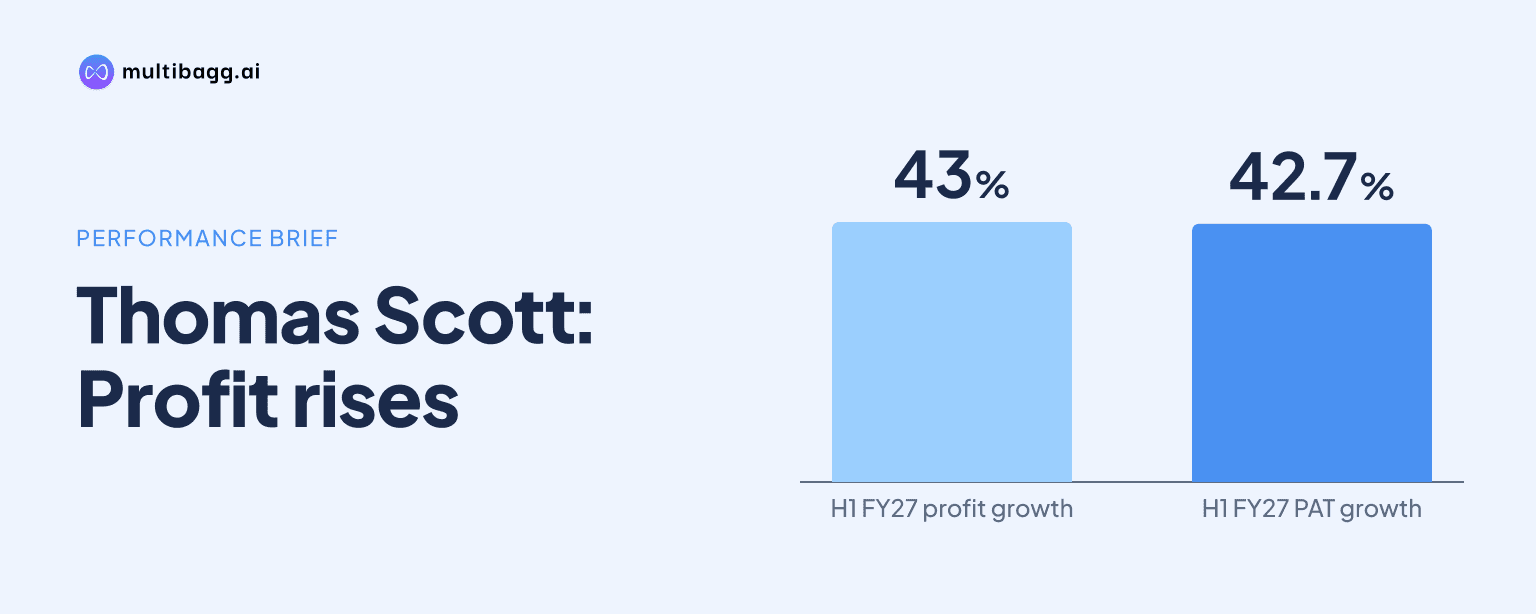
Thomas Scott raised first-half financial year 2027 (H1 FY27) revenue 30.6% to Rs 144.7 crore and profit after tax (PAT) 42.7% to Rs 11.7 crore, while second-quarter FY27 (Q2 FY27) earnings before interest, tax, depreciation and amortisation (EBITDA) margin fell 163 basis points year on year to 13.31%.
Know Thomas Scott India inside out
Results, valuation, peers and who's buying, in one view.
How did Thomas Scott perform in H1 FY27?
Thomas Scott reported H1 FY27 revenue from operations of Rs 144.7 crore, compared with Rs 110.8 crore in H1 FY26, while EBITDA rose 31.0% to Rs 19 crore from Rs 14.5 crore. Profit before tax increased 20.0% to Rs 15 crore, and PAT rose 42.7% to Rs 11.7 crore from Rs 8.2 crore.
Taxes were Rs 3.3 crore in H1 FY27, down 23.3% from Rs 4.3 crore a year earlier, while finance cost increased from Rs 0.9 crore to Rs 2.3 crore and depreciation rose from Rs 1.2 crore to Rs 1.7 crore. Diluted earnings per share increased 38.9% to Rs 7.97.
Thomas Scott’s half-year EBITDA margin moved to 13.13% in H1 FY27 from 13.09% in H1 FY26, an increase of four basis points. PAT margin rose 69 basis points to 8.09% from 7.40%; one basis point equals one-hundredth of a percentage point.
Which Thomas Scott business vertical drove Q2 revenue?
Thomas Scott’s business-to-consumer (B2C) licensed-brands business was the largest reported contributor to Q2 FY27 revenue growth, with revenue of Rs 49.3 crore versus Rs 32.5 crore in Q2 FY26. The Rs 16.8 crore increase exceeded the Rs 6 crore increase in own-brand revenue, while business-to-business (B2B) revenue declined by Rs 0.8 crore.
Licensed brands also led the H1 comparison, producing Rs 87 crore in H1 FY27 against Rs 65.5 crore in H1 FY26. Own brands generated Rs 52.1 crore, up from Rs 39.9 crore, while B2B revenue rose to Rs 5.6 crore from Rs 5.4 crore.
Thomas Scott said womenswear was a growing contributor to its product portfolio in Q2 FY27, but did not disclose category revenue. The company also initiated export operations for its international-brand portfolio and said it had laid groundwork for initial export orders, with plans to progressively scale international operations over coming quarters.
Got a follow-up? Ask IRIS
Why did Thomas Scott’s Q2 EBITDA margin decline?
Thomas Scott’s Q2 FY27 EBITDA margin was 13.31%, compared with 14.94% in Q2 FY26, as operating expenses rose 41.3% while revenue increased 38.7%. Revenue reached Rs 78.9 crore from Rs 56.9 crore, operating expenses rose to Rs 68.4 crore from Rs 48.4 crore, and EBITDA increased to Rs 10.5 crore from Rs 8.5 crore.
The year-on-year margin change differed from the sequential comparison. Q2 FY27 revenue was 19.9% above Q1 FY27 revenue of Rs 65.8 crore, and EBITDA was 22.1% higher than Rs 8.6 crore, lifting EBITDA margin by 24 basis points from 13.07% in Q1 FY27.
Below EBITDA, depreciation rose 66.7% year on year to Rs 1 crore in Q2 FY27, and finance cost increased 133.3% to Rs 1.4 crore. PAT increased 34.0% to Rs 6.3 crore from Rs 4.7 crore, alongside a 30.8% decline in taxes to Rs 1.8 crore; PAT margin was 7.98%, down 28 basis points year on year.
What is Thomas Scott planning after H1 FY27?
Thomas Scott plans to use e-commerce as the primary sales channel for its own brand and apply a high-width, low-depth product strategy of trend-focused designs with limited initial quantities. Its operating model specifies product launches in 15 to 45 days and initial inventory of 100 to 120 units per design, followed by demand-driven restocking.
For licensed and other brands, Thomas Scott plans further association with international brands, additional licensed-brand arrangements with e-commerce platforms, and expansion of categories including kidswear and handbags. The plan also includes using data insights to capture seasonal demand, including winterwear, after the company described Dussehra and Diwali sale-event performance in Q2 FY27 as encouraging.
Thomas Scott plans internal pilots of thread.ai and catalog.ai, followed by further technology work on pricing strategies, regionalisation and replenishment. It also plans to explore external technology pilots and a monetisation strategy, while its B2B plan focuses on selective long-run premium orders, including exports, and longstanding clients.
Conclusion
Thomas Scott’s H1 FY27 results combined 30.6% revenue growth, 31.0% EBITDA growth and 42.7% PAT growth, while half-year EBITDA margin was 13.13%, four basis points above H1 FY26. In Q2 FY27, licensed brands generated Rs 49.3 crore of revenue, own brands generated Rs 27.6 crore and B2B generated Rs 2 crore, while quarterly EBITDA margin was 13.31%.
The next reported developments to watch are the planned scaling of international-brand export operations, the use of e-commerce and new categories such as kidswear and handbags, and the internal pilots of thread.ai and catalog.ai. Management also plans to explore external technology users and a monetisation strategy, but the presentation gives no financial target for that initiative.