










Thomas Scott licensed brands led FY26 revenue growth
Key highlights
- Thomas Scott’s licensed and other brands generated Rs 148.4 crore in FY26, up Rs 51.6 crore from FY25.
- Licensed and other brands contributed about 62% of Thomas Scott’s Rs 239.6 crore FY26 B2C revenue.
- Other-brand SKUs rose to 42,114 in FY26 from 17,555 in FY25.
- Thomas Scott reported fulfilment costs of Rs 18 per unit in H1-FY27, compared with Rs 24 per unit in FY24.
powered by IRIS
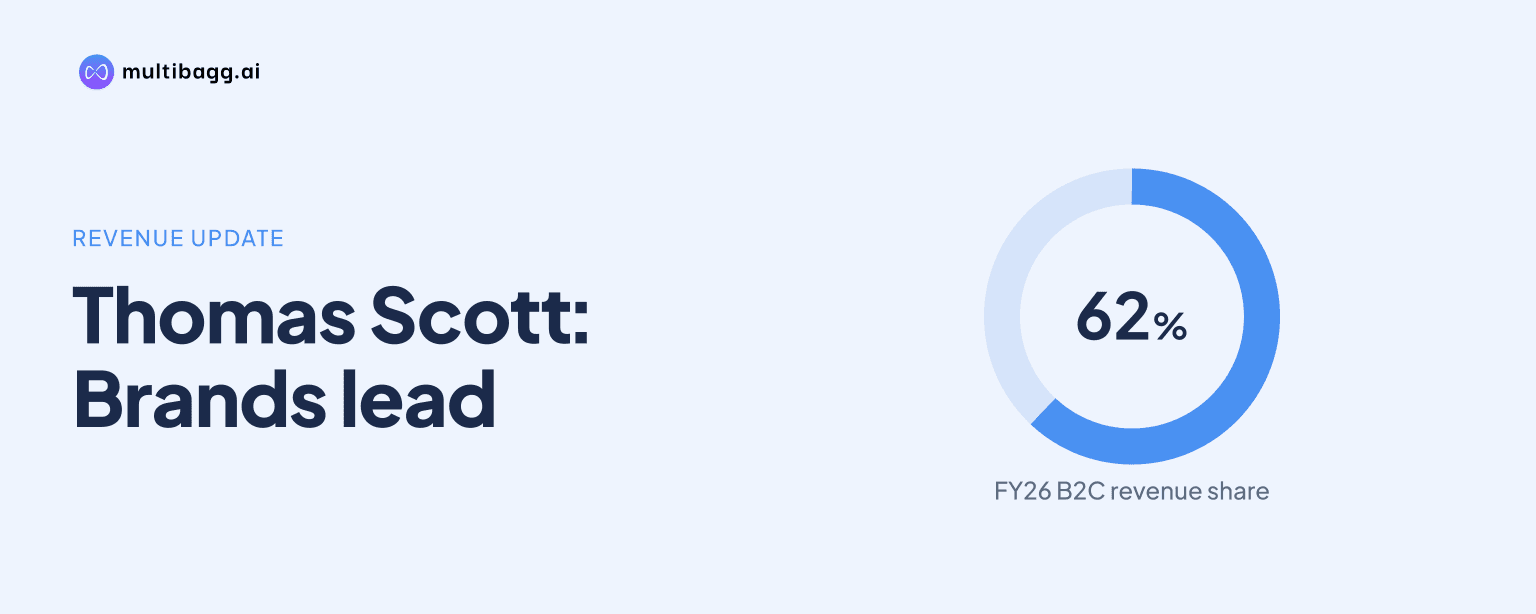
Thomas Scott’s licensed and other brands generated Rs 148.4 crore in FY26, making this its largest reported revenue stream and adding Rs 51.6 crore from FY25. The segment exceeded Thomas Scott’s Rs 91.2 crore own-brand business and Rs 15.3 crore business-to-business, or B2B, contract-manufacturing revenue.
Know Thomas Scott India inside out
Results, valuation, peers and who's buying, in one view.
How did Thomas Scott’s licensed brands perform in FY26?
Thomas Scott’s licensed and other brands reported FY26 revenue of Rs 148.4 crore, compared with Rs 96.8 crore in FY25 and Rs 44.2 crore in FY24. The Rs 51.6 crore FY26 increase was larger than the Rs 35 crore increase in the own brand and the Rs 7.3 crore increase in contract manufacturing.
The segment’s revenue growth moderated from FY25, when revenue increased by Rs 52.6 crore from FY24, but FY26 still set the highest reported annual level. Licensed and other brands generated more than three times their FY24 revenue by FY26, while the own brand rose from Rs 34.8 crore to Rs 91.2 crore over the same two-year period.
In H1-FY27, licensed and other brands generated Rs 87 crore, ahead of Rs 52.1 crore from the own brand and Rs 5.6 crore from B2B contract manufacturing. As H1-FY27 is a half-year period, the presentation does not provide a directly comparable full-year FY27 figure or an annual revenue target for the segment.
Why are licensed brands Thomas Scott’s largest B2C business?
Licensed and other brands were Thomas Scott’s largest business-to-consumer, or B2C, revenue stream in FY26, generating Rs 148.4 crore out of total B2C revenue of Rs 239.6 crore. The own brand accounted for the remaining Rs 91.2 crore, meaning licensed and other brands contributed about 62% of reported B2C revenue.
Across all three revenue streams, Thomas Scott reported FY26 revenue of Rs 254.9 crore. Licensed and other brands represented about 58% of that amount, compared with about 36% for the own brand and about 6% for contract manufacturing. This marked a shift from a model in which B2B manufacturing is a core capability but no longer the largest disclosed revenue stream.
The difference between the B2C segments widened across the reported periods. Licensed and other brands were Rs 9.4 crore ahead of the own brand in FY24, Rs 40.6 crore ahead in FY25 and Rs 57.2 crore ahead in FY26. In H1-FY27, the gap was Rs 34.9 crore, with licensed and other brands contributing about 63% of B2C revenue of Rs 139.1 crore.
Got a follow-up? Ask IRIS
How does Thomas Scott operate its licensed-brand model?
Thomas Scott says it operates the licensed-brand business as an integrated chain spanning design, raw-material sourcing, manufacturing and distribution. The products are sold exclusively on e-commerce platforms, and the company identifies Myntra, Ajio and Namshi as platform partners while naming Nautica, Aeropostale and FCUK among its global labels.
Thomas Scott collects marketplace data and applies analytics and keywords to identify fashion trends and demand-supply gaps before designs and products are finalised. It then manufactures the goods and sends inventory to either its warehouses or local marketplace hubs. Management says technology and analytics are used to keep finished-goods inventory at minimal levels.
The presentation describes rapid product launches of 15 to 45 days and initial inventory of 100 to 120 units per design. Thomas Scott also cites demand-driven restocking and fulfilment-centre optimisation, mechanisms intended to link production and replenishment to marketplace demand signals.
The portfolio displayed in the presentation includes Malt & Harbour, Mr. Bowberd, The Invictus Loom Co., Nautica, Anōnik, Here&Now, Buda Jeans Co., Aeropostale, FCUK, Seventy Five, Robert Wood and sztori. Thomas Scott aims to add licensed brands through further e-commerce-platform arrangements, but does not disclose a numerical target for additions.
What operating measures accompany Thomas Scott’s licensed-brand expansion?
Thomas Scott increased other-brand stock-keeping units, or SKUs, to 42,114 in FY26 from 17,555 in FY25 and 9,105 in FY24. The other-brand assortment was larger than the own-brand assortment in every reported period, including FY26, when it was 42,114 SKUs versus 29,994.
Other-brand SKUs reached 56,664 in H1-FY27, an increase of 14,550 from FY26, while own-brand SKUs increased by 8,761 to 38,755. The presentation does not disclose revenue per SKU, inventory turns, returns or segment-specific profitability, so the relationship between the broader assortment and segment economics is not quantified.
Reported fulfilment costs declined to Rs 18 per unit in H1-FY27 from Rs 19 per unit in FY25 and FY26 and Rs 24 per unit in FY24. This is a company-level measure rather than a licensed-brand measure. The H1-FY27 revenue split by category was 76% mens apparel, 17% womens apparel, 5% womens accessories and 2% others, without a segment-level split for licensed labels.
Conclusion
Thomas Scott’s figures show licensed and other brands as the largest reported revenue engine in FY26, both by total revenue and by annual increase. The segment generated Rs 148.4 crore, compared with Rs 91.2 crore from the own brand and Rs 15.3 crore from contract manufacturing, supported by marketplace partnerships, licensed labels and a larger SKU base than the own-brand portfolio.
The next development to watch is whether H1-FY27 revenue of Rs 87 crore translates into continued full-year expansion, as Thomas Scott has not disclosed an annual target. Management’s plan is to premiumise the portfolio through international-brand associations, secure further licensing arrangements with e-commerce platforms, and build on early progress in kidswear, handbags and seasonal categories such as winterwear.