










Tilaknagar Industries Ltd. targets 16–18% EBITDA margin by FY29
Key highlights
- Tilaknagar Industries targets a 16–18% EBITDA margin for its combined business by FY29.
- TI expects FY27 volume growth in the high-single-digit to low-double-digit range, with revenue growth 200–250 basis points higher.
- TI expects mid-teen volume growth in FY28–FY30, with revenue growth more than 300 basis points ahead of volume growth.
- TI has committed Rs 22 crore for a 30% fully diluted stake in Bodega tequila maker Black Tiger Distilleries.
powered by IRIS
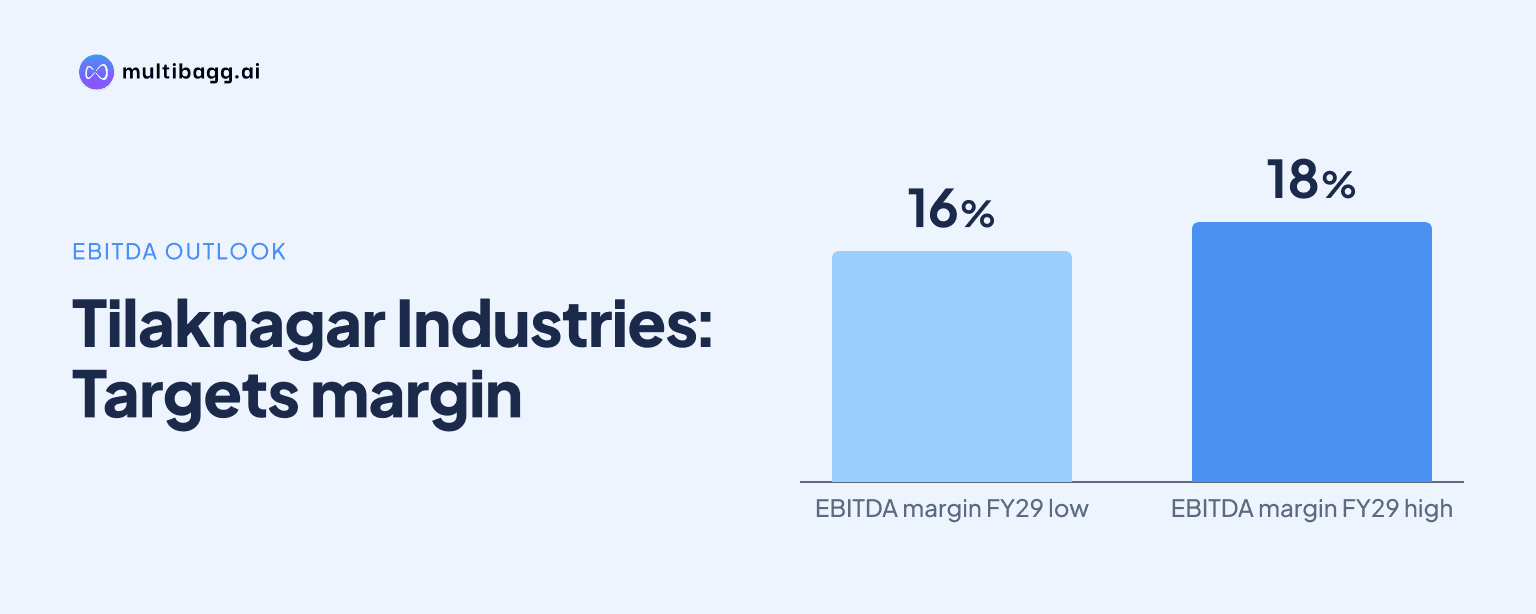
Tilaknagar Industries Ltd. is targeting an earnings before interest, tax, depreciation and amortisation (EBITDA) margin of 16–18% for its combined business by FY29. Management’s plan combines high-single- to double-digit volume growth, revenue growth ahead of volumes, premium launches, luxury distribution and planned manufacturing expansion to support supply.
Know Tilaknagar Industries inside out
Results, valuation, peers and who's buying, in one view.
How does TI plan to reach its FY29 EBITDA-margin target?
TI plans to target a 16–18% EBITDA margin by FY29 by growing revenue faster than volume and adding new products to its existing brands. Management describes FY27 as an integration and consolidation phase, before an accelerated growth phase in FY28–FY30 and double-digit volume growth from FY31 onwards.
The growth framework calls for high-single-digit to low-double-digit volume growth in FY27, with revenue growth 200–250 basis points above volume growth. In FY28–FY30, TI expects mid-teen volume growth and revenue growth more than 300 basis points ahead of volume growth. A basis point is one-hundredth of a percentage point, making the revenue target dependent on factors beyond volume growth alone.
The FY29 target is for the combined business, not for a particular brand or category. TI does not disclose a current EBITDA-margin baseline, interim margin milestones, or a quantified contribution from Imperial Blue, Seven Islands, Monarch or planned launches. The 16–18% figure is therefore management’s stated target rather than a reported outcome.
How will TI use Imperial Blue distribution for growth?
TI plans to cross-leverage brand and distribution capabilities across the combined business, including Imperial Blue. Its stated priorities are to maintain market share in stronghold markets, regain share in states where Imperial Blue was strong, enter new domestic and international markets, and expand its manufacturing footprint for supply-side safety.
The company also intends to use its pan-India distribution footprint to launch products across premium price points. TI does not specify the number of additional states, outlets or overseas markets in this plan, but it identifies manufacturing expansion as a planned response to the supply requirements created by wider distribution.
FY27 is based on current brands, while FY28–FY30 incorporates current brands and new launches. TI says launches planned from FY28 onwards will address white spaces in prestige and higher segments. Its portfolio places Imperial Blue and Imperial Black in the deluxe or prestige whisky segment, alongside Mansion House Brandy and Blue Lagoon gin.
Which luxury brands will TI expand?
TI identifies Seven Islands Pure Malt Whisky, Monarch Legacy Edition Brandy, Samsara Gin, Amara Vodka, Sitara rum, House:Pour Picante and Bodega tequila within its luxury and super-premium portfolio. The company’s category grid shows industry labels of about 11 million for luxury and super-premium, compared with about 100 million each for premium or semi-premium and deluxe or prestige, and about 240 million for regular products.
Seven Islands is TI’s most specific luxury rollout. The pure malt whisky launched in November 2025, and TI plans a phased expansion into more than 10 states as well as all key luxury markets in India during FY27. The presentation also shows an unlabeled progression from fewer than 500 in 2025 to about 1,400 in 2026 and more than 10,000 by 2030E, without defining the measure.
TI plans to expand Monarch into high-potential markets in FY27 and FY28 after establishing the 100% grape brandy in a few luxury markets. It also intends to deepen Monarch distribution in existing states and use Seven Islands and SSL distribution in non-brandy high-potential markets. Under its usership agreement, TI plans to expand SSL-owned brands across select Indian states and international markets.
Got a follow-up? Ask IRIS
What role will new categories play in TI’s strategy?
TI’s strategy spans whisky, brandy, rum, vodka, gin and tequila or agave across regular through luxury price tiers. It identifies organic brown-spirit luxury brands and provenance plays as long-term margin-expansion contributors, while describing high-volume, wide-distribution brands as cash cows and cocktail-focused products as an at-home consumption play.
Tequila is a new category within that portfolio. TI has committed Rs 22 crore for a 30% fully diluted stake in Black Tiger Distilleries, maker of Bodega Suprema No. 5: Rs 6 crore in the first tranche and Rs 16 crore on or before 12 months from that tranche. Bodega includes Blanco, Reposado and Añejo expressions and is presented in TI’s luxury and super-premium range.
Management says India’s tequila market grew at about a 60% compound annual growth rate from 2020 to 2025. It describes Bodega as a 100% Blue Weber Agave tequila at an accessible premium price point, supported by Productos Finos De Agave as manufacturer and Mansha Group as alcoholic-beverage distributor. TI does not provide a sales, volume or profit target for Bodega.
What could affect TI’s FY29 margin plan?
TI has identified packing-material inflation and a rise in extra-neutral alcohol, or ENA, prices as near-term pressures. Its supply-chain executive said packing-material prices had been under significant pressure over the preceding six months, creating short-term gross-margin stress, while ENA prices jumped at the end of the current quarter.
Management attributed the ENA increase to higher power and grain costs and delayed rains. TI says it is pursuing supply-chain efficiencies and innovations to mitigate inflationary pressures over the short to medium term, but it does not quantify the cost increase, expected savings or timing of the mitigation. Execution also depends on market-share retention, expansion in former Imperial Blue markets and sufficient manufacturing capacity.
Conclusion
TI’s FY29 EBITDA-margin target combines its scale brands with a push into premium and luxury products. The change from FY27’s 200–250-basis-point revenue premium over volume growth to more than 300 basis points in FY28–FY30 shows management expects new launches, distribution leverage and portfolio mix to have a larger role after the integration phase.
The next disclosed milestones are Seven Islands’ expansion into key luxury markets in FY27, Monarch’s high-potential-market expansion in FY27 and FY28, and prestige-and-above launches from FY28 onwards. Management’s planned manufacturing expansion and efforts to manage packing-material and ENA costs will also be relevant to progress toward the FY29 target.