










Tilaknagar Industries holds 14.3% margin despite Rs 25 crore hit
Key highlights
- Tilaknagar Industries reported Q2 FY27 net revenue of Rs 1,035 crore, up 173% year on year.
- Tilaknagar Industries recorded Q2 FY27 EBITDA of Rs 148 crore and a 14.3% EBITDA margin.
- Management estimated input inflation reduced Tilaknagar Industries' profitability by about Rs 25 crore in both Q1 and Q2 FY27.
- Tilaknagar Industries' subsidy-adjusted gross margin was 41.8% in Q2 FY27, versus 42.1% in Q1 FY27.
powered by IRIS
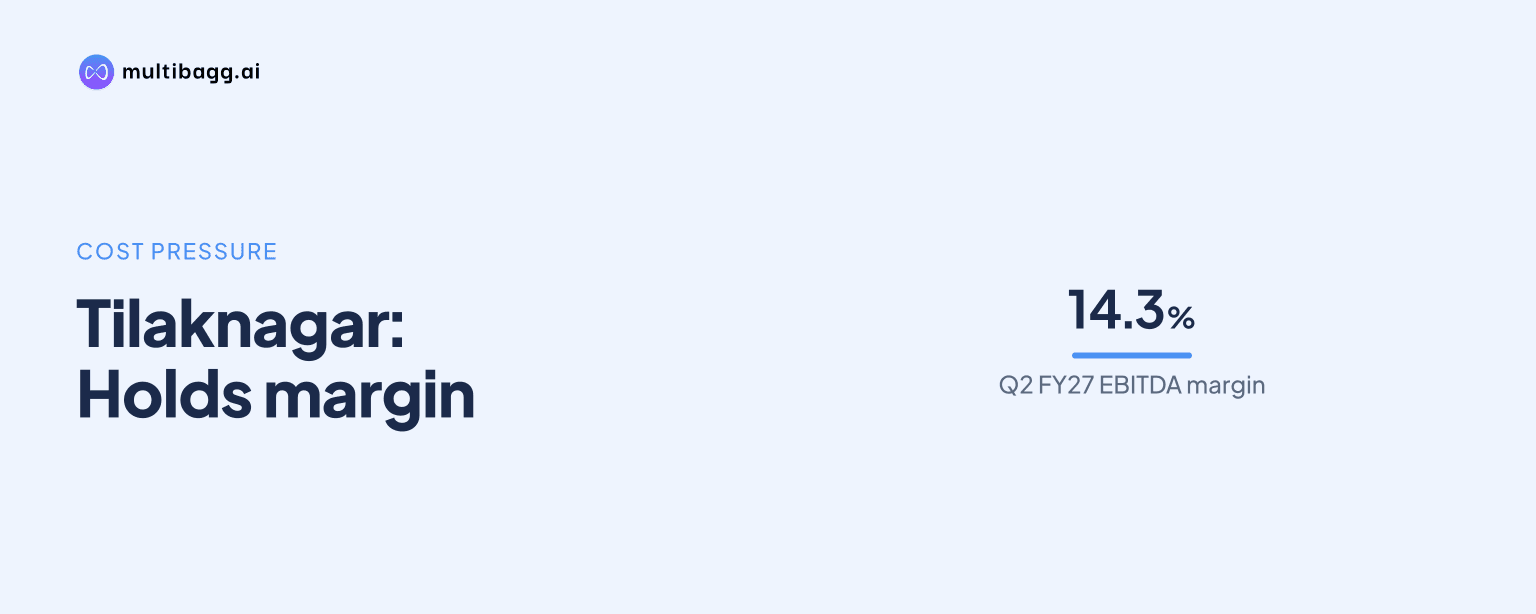
Tilaknagar Industries Limited reported a 14.3% earnings before interest, tax, depreciation and amortisation (EBITDA) margin in Q2 FY27 despite management estimating that inflation reduced quarterly profitability by about Rs 25 crore. Net revenue rose 173% year on year to Rs 1,035 crore, while management estimated that EBITDA margin would have been approximately 16.5% without inflationary pressure.
Know Tilaknagar Industries inside out
Results, valuation, peers and who's buying, in one view.
How much did input inflation affect Tilaknagar Industries in Q2 FY27?
Tilaknagar Industries said input inflation had a net impact of about Rs 25 crore in Q2 FY27, the same quarterly amount management cited for Q1 FY27. In response to an analyst question, management estimated the gross-margin effect at about 2.5% compared with the period before the West Asia crisis, using Q4 FY26 as the reference point.
Glass and other packaging inputs created cost pressure over the past two quarters, according to management. Extra neutral alcohol, or ENA, also began to show inflation at the end of Q2 FY27 as fuel and grain costs increased. Management said ENA prices had been subdued in Q1 and Q2, but exit rates had increased significantly and ENA could remain elevated in the near term.
The pressure was reflected in gross profit adjusted for subsidy, which was Rs 432 crore in Q2 FY27, or 41.8% of revenue, compared with a 42.1% margin in Q1 FY27. Management said the Q2 gross margin would have been closer to 44% without inflation. Advertising and promotion reinvestment increased by 61 basis points from Q1 FY27 ahead of the festive season; one basis point equals one-hundredth of a percentage point.
What were Tilaknagar Industries' Q2 FY27 revenue and profit figures?
Tilaknagar Industries reported net revenue of Rs 1,035 crore in Q2 FY27, up 173% year on year, and EBITDA of Rs 148 crore, up 146% year on year. The resulting 14.3% EBITDA margin was lower than the growth rate in revenue, amid inflation in packaging and the emerging rise in ENA costs.
Adjusted for subsidy, revenue was Rs 1,033 crore and EBITDA was Rs 146 crore, resulting in a 14.1% margin for the combined business. Management estimated that the subsidy-adjusted EBITDA margin would have been about 16.5% excluding inflationary pressures, compared with the reported 14.1% measure.
Profit after tax, adjusted for exceptional items and acquisition-related amortisation, was Rs 68 crore, up 30% year on year, with a 6.6% margin. On a subsidy-adjusted basis, profit after tax was Rs 66 crore, up 26% year on year, and the margin was 6.4%. Management estimated that this margin would have been approximately 9% without the effects of inflation and subsidy.
Tilaknagar Industries also incurred Rs 11 crore of exceptional expense in Q2 FY27, predominantly from TSMA fees and integration-related costs. Management said exceptional costs related to the transition had reduced significantly in Q2 FY27 and should remain at the same level over the next two quarters.
Why did Tilaknagar Industries' revenue growth not lift margin further?
Tilaknagar Industries' margin did not rise further because input-cost inflation and higher brand spending offset part of the operating benefit from revenue growth. Overall volumes increased 160% year on year and 2% quarter on quarter in Q2 FY27, but net sales realisation, or NSR, declined 0.75% sequentially to Rs 1,174 per case from Rs 1,183 per case in Q1 FY27.
Management attributed the sequential NSR decline to changes in state mix and brand mix. The year-on-year comparison was more favourable: Q2 FY27 NSR was 3.2% above Rs 1,138 per case in Q2 FY26. For H1 FY27, NSR rose 4.2% to Rs 1,179 per case from Rs 1,131 in H1 FY26.
Management said quarterly volume growth was largely flat because Q1 FY27 included higher primary sales in states that had exited TSMA in Q4 FY26 or were planned to exit in June 2026. It expects primary and secondary sales to converge over the full year, while also noting that dispatches late in a quarter can affect reported primary sales under Indian Accounting Standards, or Ind AS.
Management expects NSR growth to be supported by favourable state mix, price increases and new launches planned from FY28 onwards. Those measures have not yet produced a stated financial contribution in Q2 FY27, when the company reported a 14.3% EBITDA margin and Rs 1,174 NSR per case.
Got a follow-up? Ask IRIS
What is Tilaknagar Industries' margin recovery plan?
Tilaknagar Industries maintained management guidance for a 16% to 18% EBITDA margin on the combined business by FY29, with management citing an upward bias within that range. The planned drivers are premiumisation, packaging and process optimisation, supply-chain efficiencies, operating leverage and economies of scale.
The FY29 range remains forward-looking management guidance rather than a reported result. In H1 FY27, management said margins were under pressure, while Q2 FY27 produced a 14.3% reported EBITDA margin and a 14.1% subsidy-adjusted EBITDA margin.
For FY27, management retained guidance for high-single-digit to low-double-digit volume growth in the combined business. Beyond FY27, it maintained guidance for mid-teen volume growth and mid-to-high-teen revenue growth over the next couple of years, including new launches planned from FY28 onwards.
Management also said the final remaining state under TSMA would transition towards the end of FY27. Tilaknagar Industries aims to use the pan-India distribution of Imperial Blue Whisky and Mansion House Brandy to expand its luxury and premium portfolio, including strategic investment brands, although the call did not quantify the potential margin effect.
Which operating developments could affect Tilaknagar Industries' margins next?
Tilaknagar Industries' distribution and market-share gains could support the premiumisation plan, although management did not quantify their effect on EBITDA. Imperial Blue Whisky secondary volume grew 8.5% quarter on quarter in Q2 FY27, while Mansion House Brandy secondary volume increased 7.1%, contributing to a 100-basis-point market-share gain for Imperial Blue and a 70-basis-point gain for Tilaknagar Industries in the Prestige & Above segment.
Imperial Blue was launched in Kerala in October 2026, and management said Tamil Nadu would follow. Tilaknagar Industries also relaunched Mansion House Brandy in Daman and Diu using Imperial Blue distribution, launched Madira Rum in Uttarakhand, and introduced Imperial Black in Uttar Pradesh and Meghalaya during Q2 FY27.
In Karnataka, Imperial Blue recorded its highest-ever quarterly volumes, with market share exceeding 40% after a 900-basis-point quarter-on-quarter increase. Mansion House Brandy was the highest-selling brandy in Karnataka in September 2026. In Tamil Nadu, Mansion House Reserve Brandy recorded more than 25% quarter-on-quarter growth and 50% year-on-year growth in September 2026, which management linked to changes in ordering practices.
Tilaknagar Industries agreed to invest Rs 22 crore for a 30% stake in Black Tiger Distilleries, maker of Bodega Suprema No. 5 tequila. It had invested Rs 6 crore in Q2 FY27 and plans to invest another Rs 16 crore over the following 12 months. The brand was available in Maharashtra, Karnataka, Goa and Delhi at the time of the call.
Conclusion
Tilaknagar Industries preserved a 14.3% EBITDA margin while net revenue increased 173% year on year to Rs 1,035 crore, but management's Rs 25 crore estimate of the quarterly inflation burden shows that sales growth alone did not offset higher glass, packaging and ENA costs. The subsidy-adjusted gross margin declined 30 basis points sequentially to 41.8%, while NSR fell 0.75% from Q1 FY27 because of state and brand mix.
The next indicators are ENA pricing, the planned transition of the final TSMA state by the end of FY27, and management's progress toward reducing net debt below its March 2026 level by March 2027. As of September 30, 2026, Tilaknagar Industries reported gross debt of Rs 2,202 crore and net debt of Rs 2,074 crore, while management continued to target net debt to EBITDA below 1.0 times by FY29.