










Titagarh targets freight revenue share of 30-40% by FY30
Key highlights
- Titagarh targets freight rail revenue share of 30-40% in FY30E, versus an estimated 93% in FY25.
- Passenger Rail Segment revenue reached Rs 300.18 crore, or 38.84% of revenue, in Q2 FY27.
- Titagarh targets metro-coach capacity of 500 by FY30E and 384 Vande Bharat coaches in FY30.
- The forged-wheels joint venture had 300 trial wheels under inspection and planned commercial production from December 2026.
powered by IRIS
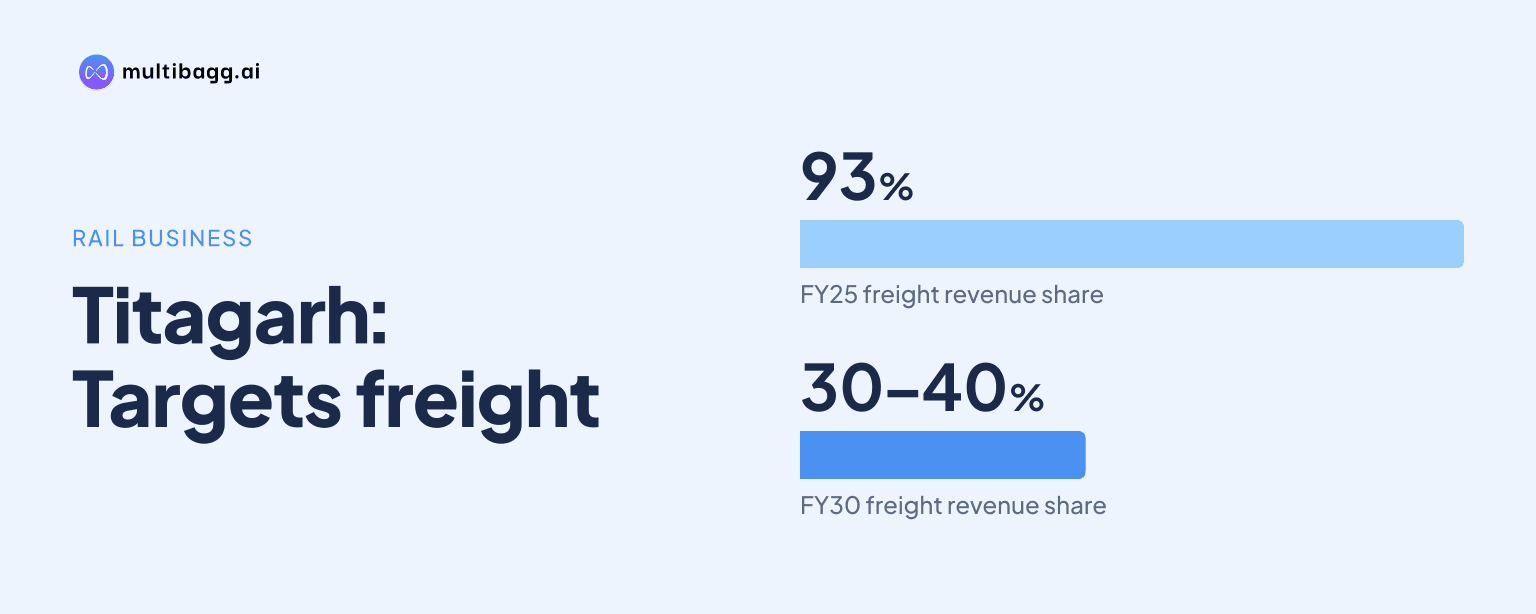
Titagarh Rail Systems Limited plans to reduce freight rail’s revenue share to 30-40% by FY30 from an estimated 93% in FY25, supported by metro, Vande Bharat, propulsion and forged-wheel expansion. Its roadmap pairs these forward-looking targets with reported Q2 FY27 Passenger Rail Segment revenue of Rs 300.18 crore, or 38.84% of revenue.
Know Titagarh Rail Systems inside out
Results, valuation, peers and who's buying, in one view.
How will Titagarh change its revenue mix by FY30?
Titagarh targets freight rail revenue at 30-40% of total revenue by FY30, compared with an estimated 93% in FY25. The company’s stated vision is to move from a leading wagon maker to a full-spectrum rail mobility company spanning metro, Vande Bharat, propulsion, forged wheels, high-speed rail and maritime activities.
The transition is planned in stages. The roadmap shows freight rail’s revenue share at 83% in FY26, 61% in Q2 FY27, and 40-50% in FY28E before the FY30E range. FY25 and FY26 are labelled actuals, while FY27E through FY30E are targets in Titagarh’s strategic plan, rather than reported outcomes.
Reported Q2 FY27 revenue shows the mix moving toward passenger rail. Passenger Rail Segment revenue accounted for 38.84% of revenue, compared with 31.26% in Q1 FY27 and 15.50% in Q2 FY26. Freight Rail Segment revenue remained larger at 61.16% of Q2 FY27 revenue, but this was below 68.74% in the preceding quarter and 84.50% a year earlier.
What did Q2 FY27 show about Titagarh’s mix transition?
Q2 FY27 showed Passenger Rail Segment revenue rising while Freight Rail Segment revenue fell from both the preceding quarter and the year-earlier period. Passenger Rail Segment revenue was Rs 300.18 crore, compared with Rs 229.75 crore in Q1 FY27 and Rs 122.21 crore in Q2 FY26. Freight Rail Segment revenue was Rs 472.63 crore, compared with Rs 505.31 crore and Rs 666.11 crore, respectively.
Titagarh invoiced 51 metro cars in Q2 FY27, a 325% year-on-year increase and a 70% quarter-on-quarter increase. Passenger rail revenue reached Rs 300 crore, which the company described as its highest-ever quarter, up 146% year-on-year and 31% quarter-on-quarter. Wagon dispatches were 1,155, versus 1,872 in Q2 FY26 and 1,284 in Q1 FY27.
Earnings before interest and tax, or EBIT, were Rs 102.24 crore in Q2 FY27, compared with Rs 95.37 crore in Q1 FY27 and Rs 91.88 crore in Q2 FY26. EBIT margin was 13.23%, against 12.97% in Q1 FY27 and 11.66% a year earlier. Passenger Rail Segment EBIT was Rs 50.29 crore, nearly matching Freight Rail Segment EBIT of Rs 51.95 crore.
What production milestones does Titagarh have for metro and Vande Bharat?
Titagarh targets metro-coach production of about 200 in FY27E, 275 in FY28E and capacity for 500 by FY30E. This follows production of 12 metro coaches in FY25 and 63 in FY26. The Q2 FY27 scorecard gives a narrower FY27 target of 200-220 metro coaches and an FY28 range of about 275-300.
For Vande Bharat sleeper coaches, Titagarh plans a prototype ready for testing by Q4 FY27, followed by 192 coaches in FY28 and 384 in FY30. The Q2 FY27 scorecard said the prototype remained on track for testing in Q4 FY27. These are programme milestones rather than reported deliveries, as the roadmap records no Vande Bharat coach production in FY25 or FY26.
Propulsion is another planned contributor to the broader mix. Titagarh lists a prototype for FY27E, limited-series production for FY28E and full production, including internal use, by FY30E. Its scorecard also records a Vande Bharat maintenance joint-venture agreement with BHEL signed on 15 September 2026 and a memorandum of understanding with Siemens.
Got a follow-up? Ask IRIS
Why does Titagarh still retain a large freight rail business?
Titagarh retains freight leadership as a strategic pillar, targeting a 23-25% market share and installed capacity of 12,000 wagons a year. The company reported a 4,955-wagon order from Indian Railways and a 9,144-wagon order book in Q2 FY27. It said the installed capacity had been achieved multiple times at 1,000 wagons a month.
The operating run rate was about 400 wagons a month at the time of the presentation, against a target of 1,000 a month by Q4. Titagarh said the ramp-up to full capacity is gated by the pace of Indian Railways tender issuance, rather than manufacturing capability. Tender issuance is therefore a disclosed condition for converting capacity and the order book into production.
The company cites national freight targets as demand context rather than as company guidance. Indian Railways currently loads about 1.6 billion tonnes and targets 3 billion tonnes by FY2030, while the national wagon fleet is expected to rise from 3 lakh in FY2022 to 6 lakh by FY2030. Titagarh said about 1 lakh wagons have been purchased so far, leaving a cited gap of 2 lakh wagons against that fleet target.
What role will forged wheels and high-speed rail play?
Titagarh’s 49% forged-wheels joint venture is targeted to move from 20,000-25,000 wheels in FY27E to about 80,000 in FY28E and about 2.05 lakh a year in FY30E. Separately, the Q2 FY27 scorecard describes a plant objective of 2.28 lakh wheels a year and says 300 trial wheels were under Indian Railways inspection, with commercial production planned from December 2026. The presentation therefore contains two different long-term annual wheel figures.
High-speed rail is a longer-dated entry target in the FY30E roadmap. Titagarh cites a planned Indian high-speed rail network of about 4,000 kilometres, total investment of Rs 16 lakh crore and FY27 railways capital expenditure of Rs 2.78 lakh crore. It identifies in-house train control and monitoring systems for 750-volt and 25-kilovolt applications, stainless-steel car bodies, an ABB partnership for converters and traction motors, and Research Designs and Standards Organisation-certified propulsion as its positioning for rolling-stock opportunities.
Conclusion
Titagarh’s Q2 FY27 figures show a material movement toward passenger rail: Passenger Rail Segment revenue reached Rs 300.18 crore and 38.84% of revenue, compared with 15.50% a year earlier. Its FY30 roadmap extends that direction through targets for 500 metro-coach capacity, 384 Vande Bharat coaches and freight rail revenue share of 30-40%.
The next disclosed milestones are Vande Bharat prototype testing targeted for Q4 FY27, commercial forged-wheel production planned from December 2026, and wagon output ramp-up toward 1,000 a month. Investors will also need to monitor Indian Railways tender issuance, which Titagarh identifies as the gate to using its 12,000-wagon annual installed capacity, and the differing FY30 wheel-capacity figures of about 2.05 lakh and 2.28 lakh a year.