










TRSL passenger rail revenue hits Rs 300.18 crore in Q2 FY27
Key highlights
- TRSL reported record PRS revenue of Rs 300.18 crore in Q2 FY27, up 146% year on year.
- TRSL invoiced 51 metro cars in Q2 FY27, up 325% year on year and 70% quarter on quarter.
- PRS accounted for 39% of TRSL revenue in Q2 FY27, compared with 16% a year earlier.
- TRSL reported about Rs 10,801 crore of passenger rail orders, representing 72.39% of its rail-systems order book.
powered by IRIS
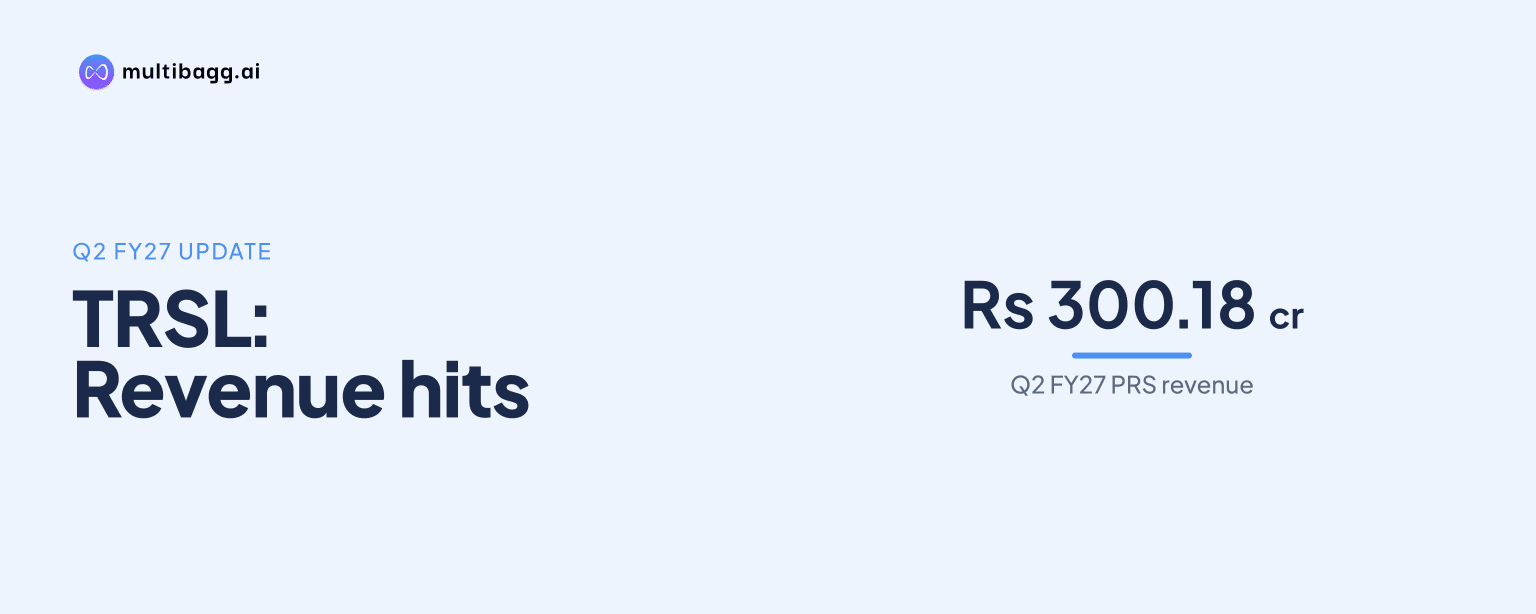
Titagarh Rail Systems Limited (TRSL) reported record Passenger Rail Systems (PRS) revenue of Rs 300.18 crore in Q2 FY27, up 146% year on year, after invoicing 51 metro cars. PRS accounted for 39% of TRSL revenue, compared with 16% a year earlier, and reported a 16.75% earnings before interest and tax (EBIT) margin.
Know Titagarh Rail Systems inside out
Results, valuation, peers and who's buying, in one view.
How much did TRSL passenger rail revenue grow?
TRSL’s PRS revenue reached Rs 300.18 crore in Q2 FY27, compared with Rs 122.21 crore in Q2 FY26 and Rs 229.75 crore in Q1 FY27. The company described the Q2 FY27 result as its highest-ever quarterly PRS revenue, reporting growth of 146% year on year and 31% quarter on quarter.
The quarterly series shows PRS revenue moved above Rs 200 crore in Q1 FY27 before increasing by a further Rs 70.43 crore in Q2 FY27. The Q2 FY27 figure was more than double the Rs 122.21 crore reported in the corresponding quarter of FY26, marking a change in the scale of reported passenger-rail billings.
The presentation identifies the Q2 FY27 outcome as a PRS result rather than a group-wide revenue measure. It lists passenger rail systems separately from freight rail systems and shipbuilding and maritime systems, while the Rs 300.18 crore figure is specifically labelled PRS revenue.
What drove TRSL’s Q2 FY27 passenger rail increase?
TRSL invoiced 51 metro cars in Q2 FY27, a count the company said was 325% higher year on year and 70% higher quarter on quarter. Metro-car invoicing is the operating metric presented alongside the Rs 300.18 crore PRS revenue result, linking the quarterly increase to passenger rolling-stock billings.
TRSL has targeted about 200 metro coaches in FY27, compared with 63 shown for FY26 in the presentation. The 51 metro cars invoiced in Q2 FY27 therefore represent part of a higher planned annual output level, although the company did not disclose a quarterly delivery schedule for the FY27 target.
TRSL also signed a memorandum of understanding with Siemens to jointly evaluate international metro rolling-stock opportunities on a case-by-case basis. The presentation does not attach an order-book amount, contract value or revenue contribution to this arrangement, so it is not presented as a contributor to Q2 FY27 PRS revenue.
How did PRS change TRSL’s revenue mix and margin?
PRS accounted for 39% of TRSL revenue in Q2 FY27, versus 16% a year earlier and 31% in the preceding quarter. Passenger rail therefore represented a larger disclosed portion of quarterly revenue in Q2 FY27 than in either Q2 FY26 or Q1 FY27.
PRS reported an EBIT margin of 16.75% in Q2 FY27, compared with 11.44% year on year and 14.66% quarter on quarter. The margin rose by 5.31 percentage points from Q2 FY26 and by 2.09 percentage points from Q1 FY27 as PRS revenue increased to Rs 300.18 crore.
The presentation provides the 16.75% figure as a PRS segment margin and does not show a rupee EBIT total for the segment on this page. Together, the 39% revenue share and the margin comparison show that PRS had a larger reported role in TRSL’s Q2 FY27 business mix than in the two comparison periods.
Got a follow-up? Ask IRIS
What passenger rail work supports TRSL’s pipeline?
TRSL’s standalone order book, including wholly owned subsidiaries, was about Rs 15,369 crore, including about Rs 10,801 crore for passenger rail systems. Passenger rail represented 72.39% of the Rs 14,920 crore combined freight and passenger rail-systems order book, while freight rail systems accounted for about Rs 4,119 crore, or 27.61%.
The order-book composition differs from the Q2 FY27 revenue mix: PRS supplied 39% of revenue but represented 72.39% of the disclosed rail-systems order book. Shipbuilding and maritime systems, through wholly owned Titagarh Naval Systems Limited, added about Rs 449 crore to bring TRSL’s order book including wholly owned subsidiaries to about Rs 15,369 crore.
TRSL and Bharat Heavy Electricals Limited (BHEL) signed an agreement on 15 September 2026 to incorporate a 50:50 joint venture with equal governance rights. The joint venture is intended to provide comprehensive maintenance for 80 Vande Bharat sleeper trainsets for 35 years, with an initial paid-up capital of Rs 50 lakh and planned depots at Shakur Basti in Delhi and Jogeshwari in Mumbai.
TRSL stated that its share of the Vande Bharat maintenance joint venture order book would be about Rs 7,000 crore. Separately, the presentation shows about Rs 6,326 crore of order book for the forged-wheel manufacturing joint venture with RKFL, taking TRSL’s disclosed order-book share in joint ventures to about Rs 13,326 crore and total order book including that share to about Rs 28,695 crore.
TRSL said its Vande Bharat sleeper prototype was on track to be ready for testing by Q4 FY27. Under the disclosed work split, TRSL has a 51% role covering car-body fabrication, coach assembly and interiors, while BHEL has a 49% role covering propulsion for the 16-car, 160-kilometres-per-hour, KAVACH-compliant sleeper trainset.
Management’s disclosed production plan calls for a ramp-up to 192 coaches in FY28 and 384 coaches in FY30. TRSL also commenced a design centre in Lucknow, adding to engineering centres in Kolkata, Hyderabad and Bangalore; the company said the Lucknow location is close to the headquarters of Indian Railways’ design and standards organisation.
Conclusion
TRSL’s Q2 FY27 PRS performance combined record revenue of Rs 300.18 crore, 51 metro cars invoiced and a 16.75% EBIT margin. Compared with Rs 122.21 crore of PRS revenue, a 16% revenue share and an 11.44% margin in Q2 FY26, the quarter showed higher passenger-rail billings, a larger disclosed revenue contribution and a higher reported segment margin.
The next disclosed markers are TRSL’s target of about 200 metro coaches in FY27, testing of the Vande Bharat sleeper prototype by Q4 FY27, and the planned ramp to 192 coaches in FY28 and 384 coaches in FY30. Progress on those plans and on the 35-year maintenance joint venture for 80 Vande Bharat sleeper trainsets will show how the about Rs 10,801 crore passenger-rail order book converts into subsequent revenue.