










Titagarh Rail Systems begins wheel trials, targets FY27 supply
Key highlights
- Titagarh Rail Systems produced 300 trial forged wheels at its Chennai plant, and Indian Railways is inspecting them.
- The Titagarh Rail Systems joint venture plans partial production of 2,000–3,000 wheels a month from November or December 2026.
- Titagarh Rail Systems expects FY27 supplies of about 20,000–25,000 wheels and targets 4,000–5,000 wheels a month in Q4 FY27.
- The two-phase project is estimated at Rs 2,181 crore, with Rs 532.65 crore of equity infused by September 30, 2026.
powered by IRIS
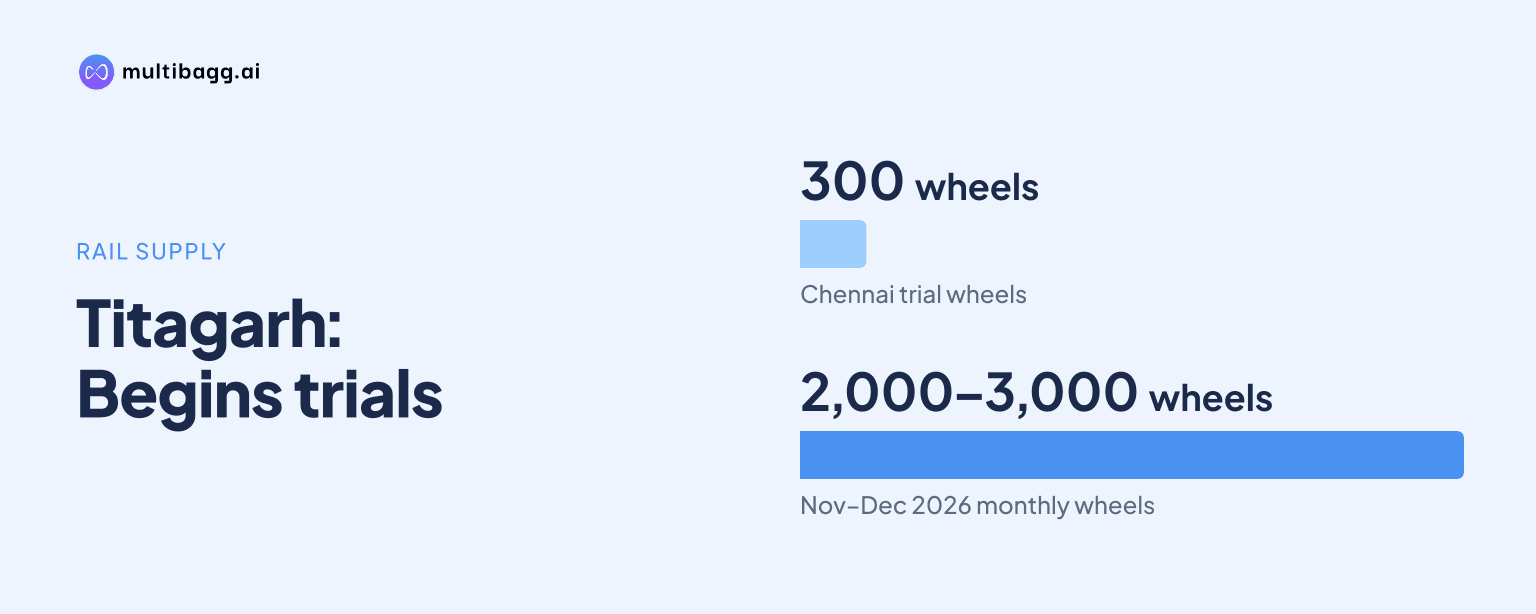
Titagarh Rail Systems Limited has begun trial production at its Chennai forged-wheel joint venture, where 300 wheels are under Indian Railways inspection, and it plans partial output from November or December 2026 before supplying about 20,000–25,000 wheels in FY27. The venture had received Rs 532.65 crore of aggregate equity by September 30, 2026.
Know Titagarh Rail Systems inside out
Results, valuation, peers and who's buying, in one view.
What is Titagarh Rail Systems' wheel project timetable?
Titagarh Rail Systems says trial production has started at the Chennai, Tamil Nadu plant, with partial production planned from November or December 2026. The company also says commercial production will commence shortly, while its more specific operating timetable calls for 2,000–3,000 wheels a month in the initial partial-production period and 4,000–5,000 wheels a month in the fourth quarter of FY27.
The project is being developed through a joint venture with Ramkrishna Forgings Limited after the Titagarh Rail Systems and Ramkrishna Forgings consortium received a letter of acceptance, or LOA, to manufacture and supply forged wheels for Indian Railways. Titagarh Rail Systems holds a 49% stake in the joint venture, so the wheel operation is not a wholly owned production asset.
The stated FY27 supply expectation of about 20,000–25,000 wheels is below the plant's planned annual capacity of 228,000 wheels. The progression from 300 trial wheels to partial output in November or December 2026 and then to the Q4 FY27 monthly rate is the disclosed route from validation to initial deliveries.
How much wheel capacity is the joint venture building?
The joint venture plans a forged-wheel manufacturing plant with annual capacity of 228,000 wheels. Titagarh Rail Systems describes the proposed Indian facility as Asia's second-largest manufacturing plant of its kind, while the FY27 supply plan represents an initial ramp-up volume rather than the eventual rated capacity.
The difference between the initial production plan and the planned full capacity is set out below. Monthly figures refer to production plans, while the FY27 figure is the stated expected supply volume.
The 300 trial wheels have been produced and are under inspection by Indian Railways. That inspection is the immediate operational step before the planned move to a 2,000–3,000-wheel monthly range, and the presentation does not give a date for reaching the full 228,000-wheel annual capacity.
Got a follow-up? Ask IRIS
How is Titagarh Rail Systems funding the wheel project?
The forged-wheel project has an estimated total cost of about Rs 2,181 crore across two phases and is to be funded through a mix of debt and equity. By September 30, 2026, the two joint-venture partners had together infused Rs 532.65 crore of equity into the venture.
The disclosed figures distinguish the Rs 2,181 crore two-phase project cost from the Rs 532.65 crore equity already injected. Titagarh Rail Systems does not disclose the debt amount, final debt-to-equity allocation, borrowing terms or each partner's individual contribution to the aggregate equity infusion.
The two-phase structure also lacks a disclosed phase-by-phase schedule. The presentation identifies the Chennai plant's initial ramp and the 228,000-wheel annual capacity, but does not provide separate capital allocations, commissioning dates or capacity figures for phase one and phase two.
What must happen before wheel supplies increase?
Indian Railways' inspection and approval of the 300 trial wheels are the immediate disclosed steps before the planned supply ramp. Titagarh Rail Systems says approval is expected shortly, but it does not provide a fixed approval date or state that any trial wheel has already been approved for commercial dispatch.
Following trial approval, Titagarh Rail Systems plans to progress from 2,000–3,000 wheels a month in November or December 2026 to 4,000–5,000 wheels a month in Q4 FY27. The planned monthly run rate would therefore increase by 2,000 wheels at both the low and high ends of the stated ranges.
The FY27 target of about 20,000–25,000 supplied wheels depends on the transition from trials to partial production. The presentation identifies Indian Railways as the inspection authority and the customer under the LOA-backed project, but does not disclose wheel pricing, FY27 revenue, or the volume approved for dispatch.
Conclusion
Titagarh Rail Systems has taken its forged-wheel joint venture into operational validation, producing 300 trial wheels at Chennai while targeting initial production in November or December 2026. The project combines a planned 228,000-wheel annual capacity with a two-phase cost estimate of Rs 2,181 crore and aggregate equity infusion of Rs 532.65 crore as of September 30, 2026.
The next disclosed milestones are Indian Railways' approval of the 300 trial wheels, partial output of 2,000–3,000 wheels a month, and a planned increase to 4,000–5,000 wheels a month in Q4 FY27. Titagarh Rail Systems' stated FY27 supply target of about 20,000–25,000 wheels will indicate whether the initial ramp proceeds to plan.