










Titagarh targets 1,000 monthly wagons as tenders govern ramp
Key highlights
- Titagarh says it has installed capacity for 12,000 freight wagons a year, or 1,000 a month.
- Titagarh reported an outstanding freight-wagon order book of 9,144 wagons, including a 4,955-wagon Indian Railways order.
- Titagarh targets 1,000 wagon output a month by Q4, conditional on new tender issuance.
- Titagarh cites a remaining National Rail Plan wagon-fleet gap of 2 lakh units by FY2030.
powered by IRIS
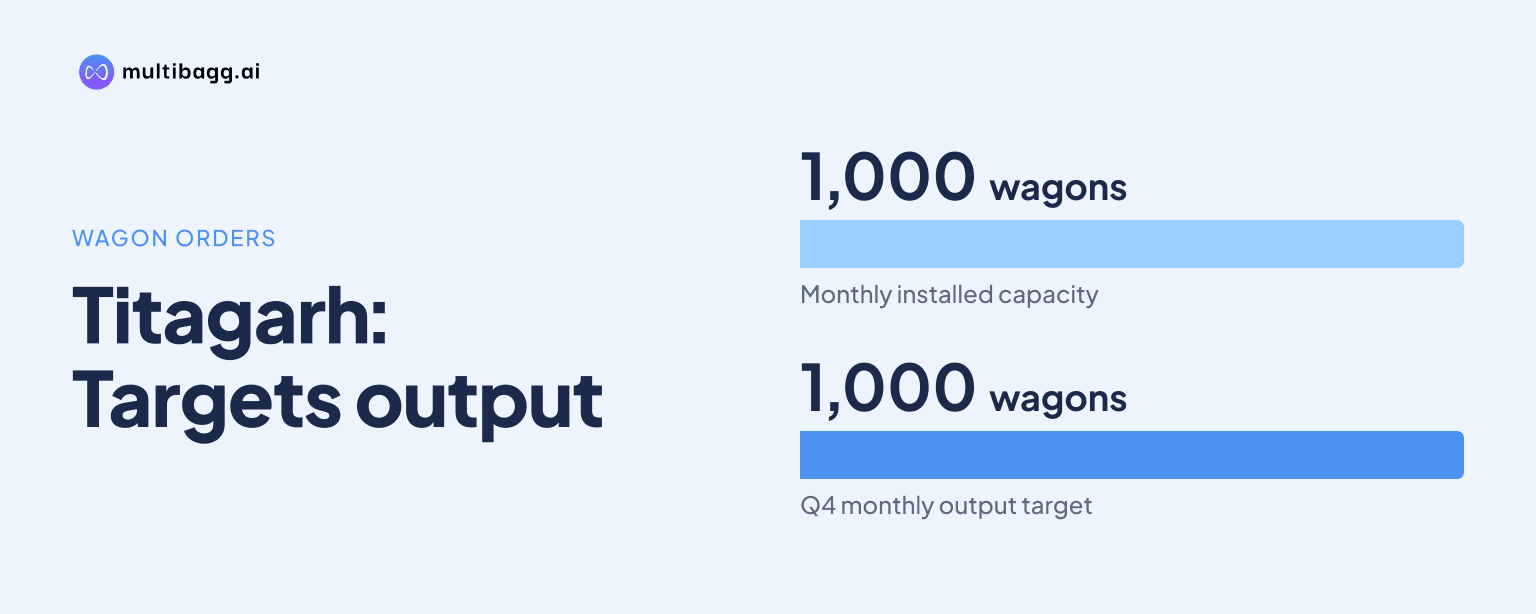
Titagarh Rail Systems Limited says it is targeting 1,000 freight wagons a month by Q4, supported by installed capacity of 12,000 wagons a year, but contingent on Indian Railways issuing new tenders. Its presentation lists a 9,144-wagon outstanding order book and identifies tender pace, rather than manufacturing capability, as the gate to a full-capacity ramp.
Know Titagarh Rail Systems inside out
Results, valuation, peers and who's buying, in one view.
Why does Titagarh say tender issuance limits wagon output?
Titagarh says the constraint on returning to full wagon-production capacity is the pace of Indian Railways tender issuance rather than manufacturing capability. The company states that it has installed capacity for 12,000 wagons a year, equivalent to 1,000 a month, and says that this level has been achieved multiple times. Its stated target is to reach 1,000 wagons a month by Q4.
The distinction matters because capacity does not itself create production volume without fresh awards. Titagarh’s presentation says its planned ramp-up depends on receiving new orders, while identifying Indian Railways tenders as the gate for full-capacity utilisation. The company therefore presents the 1,000-wagon monthly target as an operational ramp contingent on order flow, not as a firm dispatch commitment independent of tenders.
The presentation lists current dispatches at about 400 a month, alongside figures of 1,155 in Q1 and 1,280 in Q2 on the freight outlook slide. A separate Q2 FY27 financial-highlights slide reports 1,155 wagons dispatched, compared with 1,284 in Q1 FY27 and 1,872 in Q2 FY26. The supplied presentation does not reconcile the 1,280 Q2 figure on the outlook slide with the 1,155 Q2 dispatch figure in the financial highlights.
What wagon capacity and production target has Titagarh disclosed?
Titagarh has disclosed installed freight-wagon capacity of 12,000 wagons per annum and a Q4 target of 1,000 wagons per month. The annual capacity and monthly figure are arithmetically aligned, and the company says this operating level has been reached multiple times. Its strategic scorecard also identifies 12,000 wagons a year as the capacity underpinning its freight-leadership plan.
The company’s freight strategy targets a 23% to 25% market share, although the presentation does not specify a target year for that share. In the same scorecard, Titagarh classifies its freight-leadership progress as “On track,” citing a 4,955-wagon Indian Railways order and a 9,144-wagon order book. These disclosed orders provide the near-term workload behind the stated capacity base.
One line on the outlook slide says “Planned ramp up to 10000 / month with the receipt of new orders.” That wording conflicts with the same slide’s 12,000-wagon annual capacity and 1,000-a-month target, and the presentation gives no explanation of what the 10,000 figure measures. The stated and internally consistent operating objective is the 1,000-wagon monthly level by Q4, subject to new tender issuance.
Got a follow-up? Ask IRIS
How large is Titagarh’s freight order book?
Titagarh reports an outstanding freight order book of 9,144 wagons, including a 4,955-wagon Indian Railways order cited in its Q2 FY27 strategic scorecard. At the disclosed installed capacity of 12,000 wagons annually, the order book represents less than a full year of output at maximum capacity, although the presentation does not provide delivery timing or a split between customers.
The company’s financial results show that freight remained its larger revenue segment in Q2 FY27, but its contribution fell from earlier periods as passenger rail expanded. Freight Rail Segment revenue was Rs 472.63 crore in Q2 FY27, down from Rs 505.31 crore in Q1 FY27 and Rs 666.11 crore in Q2 FY26. Its share of total revenue was 61.16% in Q2 FY27, compared with 68.74% in Q1 FY27 and 84.50% a year earlier.
This mix change occurred while Passenger Rail Segment revenue reached Rs 300.18 crore in Q2 FY27, versus Rs 229.75 crore in Q1 FY27 and Rs 122.21 crore in Q2 FY26. For the freight outlook, the relevant point is that Titagarh still identifies wagons as a strategic leadership area, with capacity of 12,000 annually and 9,144 wagons in the disclosed order book, even as passenger rail represented 38.84% of Q2 FY27 revenue.
What demand assumptions underpin Titagarh’s freight outlook?
Titagarh bases its freight-demand case on Indian Railways increasing freight loading from about 1.6 billion tonnes currently to 3 billion tonnes by FY2030. The company also says rail’s freight market share must rise from about 25% to a 40% target to service infrastructure investment and support the planned increase in traffic.
The presentation identifies more than Rs 20 lakh crore of rail infrastructure investment over the past 10 years, including dedicated freight corridors and a Siemens locomotive contract. Titagarh links that investment to the need for higher rail freight movement. This is the company’s demand rationale, rather than an order forecast or a disclosed schedule for tender releases.
A further assumption is a shift in logistics economics. Titagarh says national logistics costs of about 14% are targeted to decline to 9%, and characterises a move toward rail as necessary to achieve that outcome. It also points to a policy allowing special-purpose wagon design and ownership, with leasing, private wagon ownership and private freight terminals encouraged to bring non-conventional commodities onto rail.
The largest quantified fleet requirement in the presentation is the National Rail Plan gap. Titagarh says the wagon fleet is expected to grow from 3 lakh in FY2022 to 6 lakh by FY2030, while only about 1 lakh wagons have been bought so far. On those figures, it identifies a remaining delta of 2 lakh wagons, which is the basis for its statement that structural demand drivers remain intact.
Conclusion
Titagarh’s stated position is that its freight-wagon manufacturing base is already sufficient for 1,000 wagons a month, or 12,000 a year, and that the issue is tender timing rather than factory capability. The 9,144-wagon order book, 4,955-wagon Indian Railways order and projected 2-lakh-wagon national fleet gap support the company’s demand framework, while reported dispatch figures show output below the stated capacity level.
The next point to watch is whether Indian Railways issues tenders and whether Titagarh meets its Q4 target of 1,000 wagons a month. The company has made that ramp conditional on new orders, while its presentation gives no tender calendar, delivery schedule for the 9,144-wagon order book, or explanation for the differing Q2 figures of 1,280 and 1,155 wagons.