










V-Guard expects H2 volume growth to moderate to mid-teens
Key highlights
- V-Guard expects second-half volume growth in the mid-teens, below first-half growth.
- An analyst cited more than 20% Q2 volume growth excluding the Wires business.
- V-Guard said its current pricing gap was 3% to 4% and recent category price increases ranged from 6% to 12%.
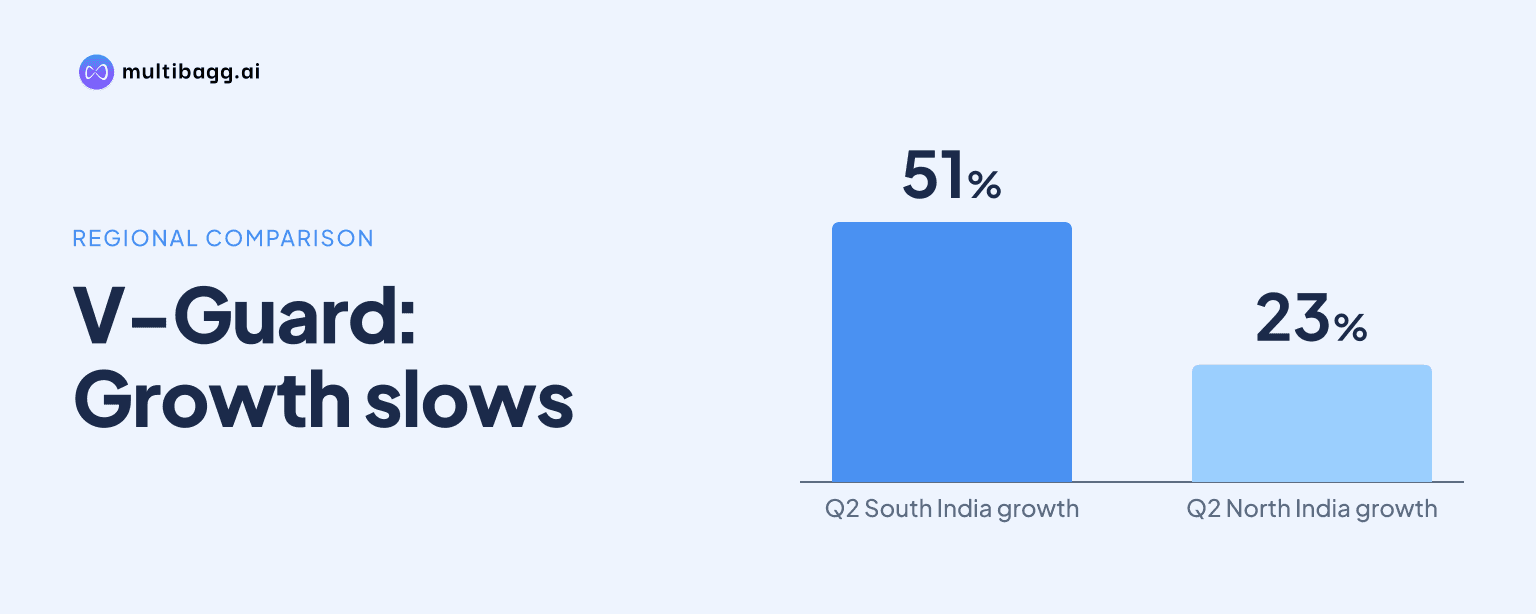
- An analyst cited 51% growth in South India versus 23% in North India in the quarter, with weather and solar-market coverage contributing to the gap.
powered by IRIS
V-Guard expects second-half volume growth to moderate to the mid-teens, below its unusually strong first half, because the comparable second half of the prior year was stronger even as summer-linked categories continue to support demand. Management gave the range after discussing more than 20% Q2 volume growth excluding Wires.
Know V-Guard Industries inside out
Results, valuation, peers and who's buying, in one view.
What volume growth does V-Guard expect in the second half?
V-Guard expects second-half volume growth to be in the mid-teens, and management said this will be lower than first-half growth. The outlook was provided in response to an analyst’s question on whether volume growth could remain around the more than 20% level seen in Q2 excluding the Wires business. Management did not give a separate numerical second-half forecast for Wires, Consumer Durables or Electronics.
The basis for moderation is the comparison period rather than a stated broad demand slowdown. Management said the first half of the prior year had a very low base, while growth in the prior-year second half was better. That makes the growth comparison tougher in the current second half. Sudarshan Kasturi separately said H2 growth would be lower but should remain good, before Mithun K. Chittilappilly described a mid-teens volume outcome.
Revenue growth need not move in line with volume growth because V-Guard is also implementing price increases. Ramachandran V. said the company remains optimistic about sustaining growth momentum in upcoming quarters partly because price increases are occurring. This distinction matters because the mid-teens indication is explicitly a volume view, not a revenue-growth target.
Why will growth differ between V-Guard’s business segments?
V-Guard said second-half demand will vary across Wires, Consumer Durables and the rest of its portfolio because each has different underlying drivers. In Wires, offtake can be influenced by copper-price movements, which can lead distributors to increase or reduce stocking. Management therefore did not treat the Wires business as having the same demand pattern as consumer-facing categories.
Consumer Durables require closer monitoring, according to management. An extended summer had lifted demand for summer categories in the latest quarter and was expected to help the current quarter as well. V-Guard said the remainder of the portfolio should continue to grow, but it did not offer category-level volume targets for the second half.
The Inverter and Battery business grew faster than Stabilizers during the reported quarter, management said. It attributed the relative outperformance to power outages and a mismatch between electricity supply and demand in parts of the country. Stabilizers also grew, supported chiefly by air-conditioner stabilizer sales during warm weather in southern India.
Is channel inventory supporting V-Guard’s H2 demand outlook?
V-Guard said channel inventory was normal and that it saw no inventory pressure at the time of the call. Ramachandran V. linked this position to good underlying sales velocity across categories, rather than to a build-up of inventory in the channel. Management said it was seeing good offtake while preparing for the Diwali period in October and November.
The summer selling cycle had not yet begun, management said, with sell-in typically starting in the last week of December or during the following month. That timing means the second-half outlook includes both the festive period and the start of pre-summer channel activity. Management expressed confidence in sustaining growth momentum in upcoming quarters, but did not quantify summer orders or channel inventory in days or weeks.
An analyst cited 51% growth in South India in the quarter, compared with 23% in North India, and management attributed the difference primarily to weather and market coverage. An extremely strong and extended southern summer left channel inventory low at the end of Q1, while intermittent rainfall weakened summer-product sales in northern and eastern markets. Solar Power Systems also had wider market presence in the South, adding to the difference.
Got a follow-up? Ask IRIS
How could V-Guard’s price increases affect volume growth?
V-Guard is raising prices while forecasting mid-teen second-half volume growth, because management said the cost gap still required action. Mithun K. Chittilappilly said the company had a 3% to 4% pricing gap as of the day before the call, with material prices continuing to move up and down. V-Guard therefore needed at least a 3% to 4% increase to cover that then-current gap.
Recent price increases varied by category from 6% to 12%, according to Sudarshan Kasturi. An analyst referred to a blended 10% increase excluding Wires, while management noted that full pass-through was still incomplete. V-Guard said it was taking the current round of increases across categories because input-cost increases over the preceding 9 to 10 months were too large to absorb.
Pricing creates an important uncertainty around demand because the analyst’s question specifically asked whether sharp increases could reduce volumes. Management’s answer did not give a quantified price-elasticity estimate. Instead, it separated the portfolio into Wires, Consumer Durables and other categories, maintained that second-half volume growth should moderate to the mid-teens, and cited the stronger prior-year H2 base as the main reason for slower growth.
Which V-Guard products and weather factors could shape demand next?
V-Guard said a hot and dry environment has historically benefited several of its categories. Mithun K. Chittilappilly said lower rainfall can reduce the water table and lift demand for pumps and motors, while higher temperatures and power cuts can support Inverter, Battery and air-conditioner Stabilizer sales. Management’s view was that these tailwinds outweighed drought-related headwinds for its current product portfolio.
Solar Power Systems remain an early-stage contributor rather than a large disclosed business. Management said the category adds something to overall growth, but was not yet very large and would be better discussed after capabilities and capacity take shape. V-Guard’s solar offering includes branded panels, inverters, distribution boards and boxes, while system integrators handle customized brackets and installation work.
Other new-category initiatives are being introduced gradually. Lighting had been in the market for only 3 to 4 months, with only about 40% to 50% of planned stock-keeping units, or SKUs, launched. Management targeted April or May to complete the portfolio and expand within southern markets. Sunflame’s product refresh had partly landed, with more planned over the next 6 to 12 months, which management said should support stronger growth than its historical pace.
Conclusion
V-Guard’s mid-teens second-half volume outlook signals a planned moderation from an unusually strong first half, not a management forecast of falling demand. The central comparison is with a low prior-year H1 base versus a better prior-year H2 base. Demand conditions, normal channel inventory, summer-linked categories and price-led revenue support are the factors management cited alongside that slower volume range.
The next indicators are the Diwali offtake period, the start of summer sell-in around late December or the following month, and the effectiveness of the current 3% to 4% pricing action against changing material costs. Management also plans a gradual Lighting expansion by April or May and expects further Sunflame product refreshes over the next 6 to 12 months.