










V-Guard Says a Further 3%-4% Pricing Is Needed to Cover Input Costs
Key highlights
- V-Guard said a minimum 3%-4% additional price increase was needed to cover its latest commodity-cost gap.
- V-Guard said earlier price increases largely ranged from 6% to 12% across categories.
- V-Guard said Cable volumes were flat while pricing growth was close to 40%.
- V-Guard said second-half volume growth could moderate to the mid-teens.
powered by IRIS
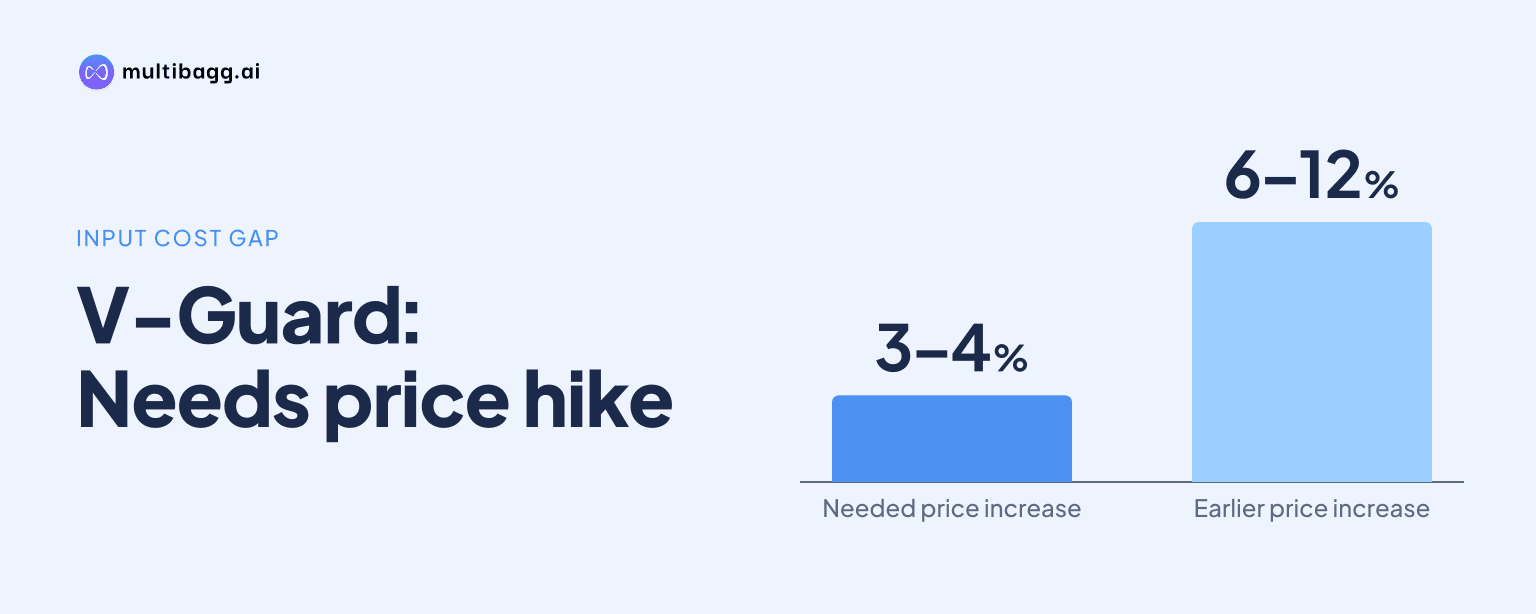
V-Guard said in the second quarter (Q2) of financial year 2026 (FY26) that it needed a minimum further 3%-4% price increase to cover commodity-cost inflation, despite earlier category increases of 6%-12%. Management said the unresolved gap was affecting gross margin and it was taking another round of price increases across categories.
Know V-Guard Industries inside out
Results, valuation, peers and who's buying, in one view.
Why does V-Guard still need a 3%-4% price hike?
V-Guard still needs a minimum 3%-4% price increase because the price actions already taken have not fully offset input-cost inflation. Mithun K. Chittilappilly said the 3%-4% gap was the position “as on yesterday,” while some materials were still moving up and down. That means the required increase could change with commodity prices rather than being a fixed final number.
Management said the scale of cost inflation over the preceding nine to 10 months was too large for a producer to absorb. V-Guard is therefore taking the current round of increases across categories, rather than limiting action to a particular product line. Sudarshan Kasturi said category-level price increases had ranged largely from 6% to 12%, showing that the earlier pricing response was not uniform across the portfolio.
The company framed the policy as necessary to run a healthy business, but did not quantify the timing or category split of the new 3%-4% increase. Its comments distinguish between prices already implemented, which ranged from 6% to 12%, and the additional increase needed to cover the latest input-cost position.
How did V-Guard's pricing gap change during Q2 FY26?
V-Guard's stated pricing gap widened from 2%-3% earlier in the discussion to 3%-4% by the time management described the latest position. In response to a question on October hikes, management first said 2%-3% of pricing was yet to be passed through and that gross-margin impact was around that range. It later said the gap stood at 3%-4% as of the prior day.
The movement reflects further input-cost increases during September and October, according to Ramachandran V. He said the prior quarter had a roughly 3% gross-margin gap versus plan, of which 1 percentage point was due to product mix and 2 percentage points came from the lag in transmitting higher costs through prices. The earlier 2% transmission lag therefore did not remain static as commodities rose further.
The comparison indicates that product mix and price transmission were separate margin factors. Management described Q2 mix as historically less favourable than Q1, while its planned market price increases were intended to neutralise the input-cost effect. It did not state that price increases would eliminate the mix-related portion of the earlier 3% gap.
Got a follow-up? Ask IRIS
Which V-Guard categories have seen pricing-led growth?
V-Guard said Cables experienced almost 40% pricing growth while volumes were flat, making that category principally price-led. The comment came after management described Electricals growth and illustrates how commodity-linked pricing can dominate reported sales growth in a cable business when volumes do not rise.
Outside Wires, V-Guard said its other categories combined delivered 10% price growth and 25% volume growth. This contrast with Cables matters because the broader portfolio's growth had a larger volume contribution, whereas commodity-driven pricing had the greater role in Cables. The company did not provide a separate volume figure for Wires in that exchange.
The company's pricing actions also sit alongside stronger demand in selected power-related products. V-Guard said Inverter and Battery grew faster than Stabilizers, helped by power outages and a mismatch between power supply and demand in some parts of the country. Stabilizer sales also grew, with air-conditioner stabilizers benefiting from warm weather in southern India during Q2 FY26.
What could V-Guard's new price increases mean for demand and margin?
V-Guard expects price increases to help sustain revenue growth, but management expects volume growth in the second half to be lower than in the first half. Mithun K. Chittilappilly said second-half volume growth could be in the mid-teens, compared with more than 20% volume growth excluding Wires cited by the analyst for the quarter. Management attributed some moderation to a stronger second-half base in the prior year.
Demand sensitivity will differ by segment, according to Ramachandran V. In Wires, offtake can be affected by copper-price movements because distributors may increase or reduce stocking. In Consumer Durables, management said it remained watchful even though extended summer conditions were continuing to support summer categories in the current quarter.
On gross margin, management said it would land price increases in the market during the quarter to neutralise the latest input-cost impact. An analyst referred to an aspired gross-margin range of 35%-36%, but management did not confirm a timetable for reaching that range. Instead, it said commodity prices could move either way depending on the geopolitical environment, requiring continuous pricing action.
V-Guard said channel inventory was normal, with no pressure visible at the time of the call. Management said underlying velocity had been good across categories and that it was preparing for Diwali in October and November, while summer-season sell-in would typically begin in the last week of December or during the following month. Those conditions provide the context in which the company will test whether higher prices affect offtake.
Conclusion
V-Guard's key message is that earlier increases of 6%-12% have not fully caught up with commodity costs: its latest estimate calls for a further 3%-4% rise. The margin effect has come from both price-transmission lag and, in the earlier quarter, a 1 percentage point adverse mix effect within a 3% gap versus plan. Pricing-led Cables growth and volume-led growth in other categories show that the effect varies materially across the portfolio.
The next point to watch is the implementation of the current category-wide pricing round and whether commodity costs continue to rise or ease. Management expects second-half volume growth to moderate to the mid-teens, while it prepares for Diwali demand in October and November and expects summer sell-in to start around late December or the following month.