










V-Guard expands rooftop solar but remains in early stage
Key highlights
- V-Guard said 75% of rooftop-solar sales are residential systems sized from 3 kilowatt to 10 kilowatt.
- V-Guard plans to enter northern and some eastern rooftop-solar markets after initially selling mainly in the South.
- V-Guard said it is not manufacturing for rooftop solar yet and did not disclose solar revenue or margins.
- V-Guard's Electronics segment grew 60% year on year in Q2 FY27, with Solar Power Products leading growth.
powered by IRIS
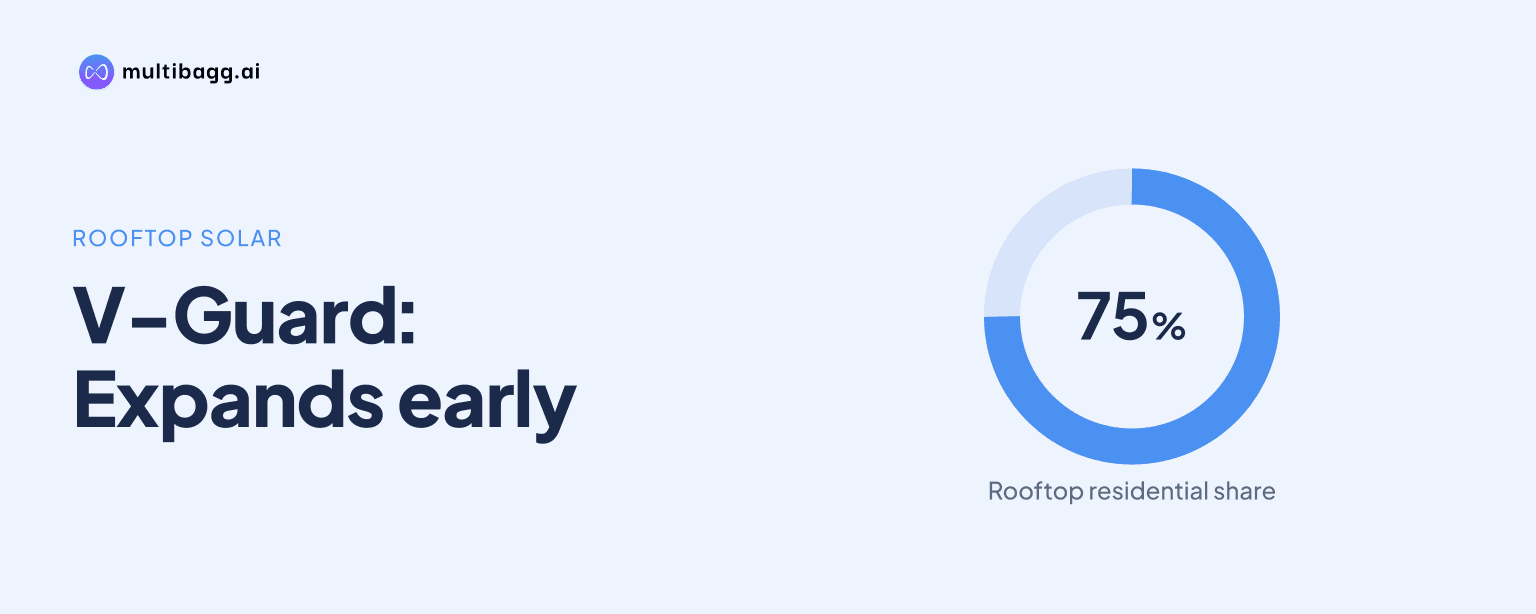
For the quarter ended September 30, 2026, V-Guard Industries Limited said 75% of its rooftop-solar sales were residential systems sized 3 kilowatt to 10 kilowatt, while it prepared to extend a still-nascent, non-manufacturing business from southern markets into northern and some eastern markets.
Know V-Guard Industries inside out
Results, valuation, peers and who's buying, in one view.
How is V-Guard expanding rooftop solar beyond South?
V-Guard is extending rooftop-solar sales beyond its mainly southern-market base into northern and some eastern markets, although management did not specify launch dates. On the October 30, 2026 earnings call for the second quarter of fiscal year 2027 (Q2 FY27), management described solar as a new category it is still seeding and said its broader market presence remains concentrated in the South.
The regional comparison helps explain the current starting point. South India recorded 51% growth in Q2 FY27, compared with 23% in the North, with management attributing the gap primarily to an extended summer and low channel inventory after the first quarter. It also said wider availability of Solar Power Systems in southern markets was a secondary contributor to the regional difference.
Management cited government subsidies and policy support for shifting residential energy consumption to solar as supportive conditions for the category. However, V-Guard did not set a revenue target, market-share objective or timetable for the northern and eastern expansion, saying only that those entries would happen soon.
What does V-Guard sell in a rooftop-solar system?
V-Guard sells a branded residential solar solution, not merely a single component, and said 75% of its solar sales involve systems from 3 kilowatt to 10 kilowatt. Management identified V-Guard-branded solar panels, inverters, distribution boards and boxes as part of the household rooftop offering.
The company does not make the customised mounting brackets used in each rooftop installation. That work is handled by system integrators, whose role reflects the site-specific nature of household installations in the 3 kilowatt to 10 kilowatt range. V-Guard said the branded equipment is sold as a complete solution even though the installer undertakes the rooftop fitting work.
The product proposition is linked to V-Guard's existing Inverter and Battery business. In Q2 FY27, management said both Solar Power Products and Inverter and Battery performed well, while power outages in parts of the country, following higher power requirements, supported demand for inverters and batteries.
Why does V-Guard use system integrators for rooftop solar?
V-Guard primarily sells solar equipment to system integrators that install systems at residential households, rather than supplying government bodies, independent power producers or large consumers. The model concentrates the company on the household segment, where 75% of its sales are in the 3 kilowatt to 10 kilowatt system range.
Management said V-Guard has used system integrators for Solar Water Heaters for the past 22 years. That experience does not quantify rooftop-solar scale, but management presented it as an established installer-led route to market for products that require on-site design and fitting.
V-Guard said its ability to compete rests on electronics and power-storage expertise developed through Inverter and Battery, as well as investments in distribution and go-to-market infrastructure. Management contrasted that position with buying and trading products, while cautioning that the rooftop business remains emerging and will develop over time.
Got a follow-up? Ask IRIS
What financial impact did solar have in Q2 FY27?
V-Guard did not disclose solar revenue, profit or margin for Q2 FY27, but said Solar Power Products led growth in the Electronics segment, whose revenue rose 60% year on year (YoY). Management also said solar added something to overall growth, while describing the business as not yet very large for V-Guard.
The Electronics segment grew faster than consolidated revenue, which increased 38.2% YoY to Rs 1,853 crore in Q2 FY27. Consolidated profit after tax was Rs 112 crore, up 71% YoY from Rs 65 crore. Those figures do not isolate solar's contribution from stabilisers, uninterruptible power supply systems, inverters or batteries within Electronics.
Management declined requests for product-wise solar revenue and said it was too premature to discuss margins. It indicated that a more meaningful discussion of the business could come around a year later, when its capabilities and capacities have had time to fall into place.
Does rooftop solar change V-Guard's working capital or manufacturing model?
V-Guard said rooftop solar does not materially change its working-capital profile because it is a residential business sold through system integrators, rather than a business-to-business supply model. Management said working capital was broadly similar to the rest of V-Guard, consistent with its focus on 3 kilowatt to 10 kilowatt household systems that account for 75% of sales.
V-Guard is not manufacturing for the rooftop-solar business yet. Management said it was working on various dimensions of the opportunity but did not disclose any manufacturing plan, capital expenditure, sourcing arrangement or capacity target as of the Q2 FY27 call.
The absence of financial and manufacturing disclosure is consistent with management's description of solar as nascent. While the company has cited its existing Electronics infrastructure and its 22-year Solar Water Heater installer network, it has not said whether future development will involve in-house production or additional third-party sourcing.
Conclusion
V-Guard's rooftop-solar strategy is a branded, residential and installer-led extension of its Electronics and power-storage operations. The 75% concentration of sales in 3 kilowatt to 10 kilowatt systems defines the household focus, while Solar Power Products leading the Electronics segment's 60% YoY growth shows the category contributed to momentum without establishing its separate financial scale.
The next issue to watch is execution beyond the South, where growth was 51% in Q2 FY27 versus 23% in the North. Management has not provided a solar revenue, margin, capacity or manufacturing target, but said it may be better able to discuss the business around a year later as capabilities and capacities develop.