










Venky's says feed inflation requires higher poultry prices
Key highlights
- Venky's said poultry input costs have risen 35%-40%, requiring a higher long-term chicken and egg price benchmark.
- Q2 FY27 broiler-bird realization was Rs 108.57 per kg, versus Rs 71.27 per kg in Q2 FY26.
- Q2 FY27 broiler-bird production cost was about Rs 104-Rs 105 per kg, while management put the current cost at around Rs 110 per kg.
- Venky's said bajra was Rs 3-Rs 4 per kg cheaper than maize in key consumption regions.
powered by IRIS
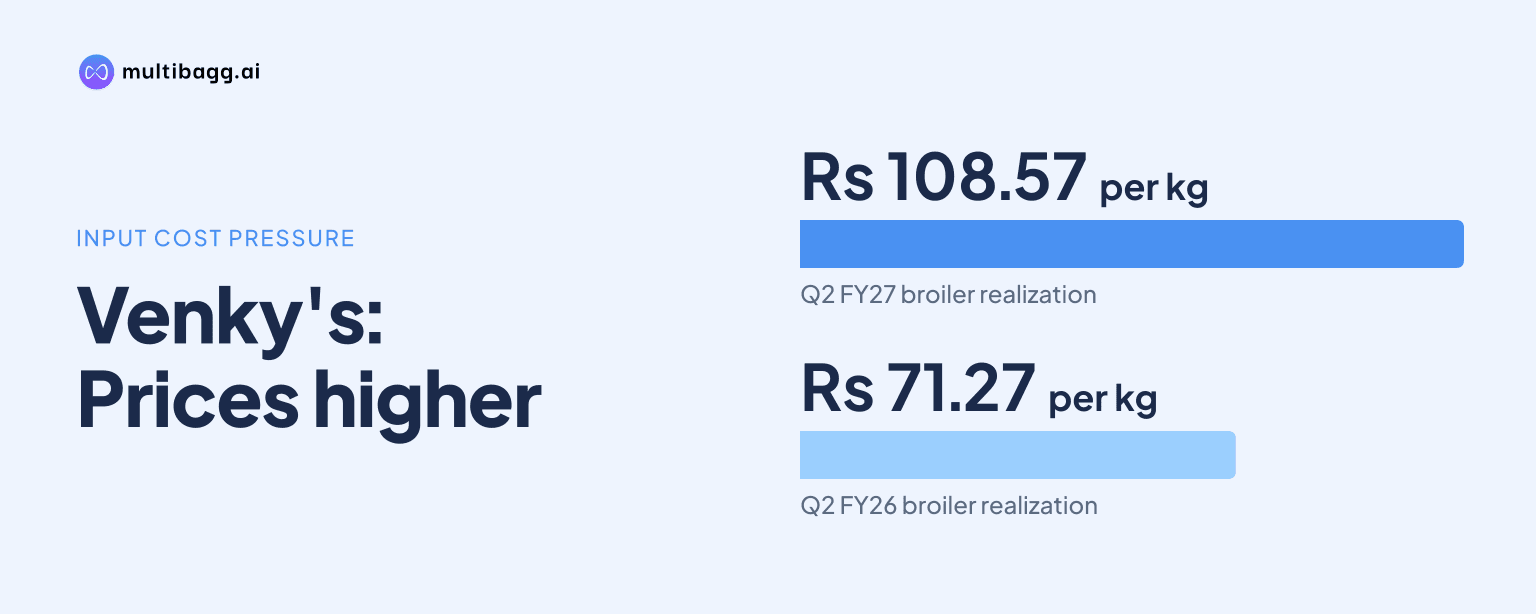
Venky's (India) Limited said on its Q2 FY27 call that chicken and egg prices need a higher long-term benchmark because poultry input costs have risen 35%-40%; Q2 broiler-bird realization was Rs 108.57 per kg, compared with Rs 71.27 a year earlier. Management said the adjustment may lag daily feed movements.
Know Venkys (India) inside out
Results, valuation, peers and who's buying, in one view.
Why does Venky's expect chicken and egg prices to rise?
Venky's expects chicken and egg prices to rise over time because the underlying cost of poultry production has increased. Management said input costs had risen 35%-40%, while commodity and food prices had increased by 25%-30% in many cases. It said chicken and eggs could not remain an exception if energy and protein inputs stayed elevated.
Management described the expected change as a long-term price reset rather than an immediate pass-through. It said maize, broiler and egg prices may not correlate over a month or 15-day period, but chicken and egg prices are likely to rise over time as the cost base increases. Management said consumers could initially resist the higher level before accepting a new benchmark.
The Q2 FY27 discussion followed a seasonally difficult period for poultry. Venky's Chief Financial Officer said the September quarter is generally weaker for poultry and poultry products because fasting periods and religious rituals can reduce chicken consumption. Better realizations nevertheless supported the Poultry and Poultry Products segment in the quarter ended September 30, 2026.
How much did Venky's poultry realization improve in Q2 FY27?
Venky's reported higher Q2 FY27 realizations across broiler birds, chicks and hatching eggs. Broiler-bird realization was Rs 108.57 per kg in the September 2026 quarter, compared with Rs 71.27 per kg in the September 2025 quarter. Broiler-chick realization rose to Rs 41.18 per chick from Rs 21.42 per chick.
Broiler hatching-eggs realization increased to Rs 33.85 per egg in Q2 FY27 from Rs 18.96 per egg in Q2 FY26. Layer-chick realization was Rs 47.89 per chick compared with Rs 45 per chick, while layer-hatching realization was Rs 13.22 per chick against Rs 12.44 per chick. The largest year-on-year gains were therefore in broiler-linked products rather than every poultry category.
For the first six months of FY27, Venky's also recorded higher realizations in several poultry lines. Broiler-chick realization was Rs 34.29 per chick versus Rs 26.48 per chick in the FY26 comparison, while contract broiler farming bird realization was Rs 102.46 per kg versus Rs 80.56 per kg. Broiler hatching-eggs realization rose to Rs 29.64 per egg from Rs 17.02 per egg.
Are Venky's broiler prices covering higher production costs?
Venky's said Q2 FY27 broiler-bird realization was above its stated production-cost range, although later feed movements lifted the current cost. Production cost was about Rs 104-Rs 105 per kg in the September 2026 quarter, compared with a realization of Rs 108.57 per kg. In September 2025, production cost was about Rs 90 per kg against a realization of Rs 71.27 per kg.
The year-on-year comparison shows a changed relationship between poultry selling prices and production cost. In Q2 FY26, the reported broiler-bird realization was below the stated cost level, whereas Q2 FY27 realization exceeded the Rs 104-Rs 105 per kg range. Management said the current production cost had subsequently moved to around Rs 110 per kg as major protein and energy sources fluctuated daily.
Venky's did not provide a broiler-margin target or a forecast selling price for FY27. Instead, management linked the industry's production economics to an eventual increase in chicken and egg prices if feed inflation persists. The disclosed 35%-40% increase in the input-cost base is the basis for management's view, rather than a specified timetable for price changes.
Got a follow-up? Ask IRIS
How is Venky's managing higher maize and protein costs?
Venky's is seeking to reduce feed-cost pressure by using bajra in place of maize where feasible. Management said maize had reached about Rs 33-Rs 34 per kg, while bajra was Rs 3-Rs 4 per kg cheaper in regions with significant consumption. The company said it was optimising the maize-bajra mix to help manage broiler-bird production costs.
The six-month figures show why protein inputs are also material to the cost equation. Maize averaged Rs 24,539 per tonne in FY27's first six months, compared with Rs 25,334 per tonne in the FY26 comparison. Soya averaged Rs 56,520 per tonne, up from Rs 36,163 per tonne, making the soya increase more significant in the reported period.
Management focused on the combined cost of energy and protein sources rather than maize alone. It said daily movements in these inputs were contributing to the current production-cost level of around Rs 110 per kg. Bajra substitution is a cost-management mechanism, but management still expects poultry selling prices to reflect a 35%-40% higher input-cost base over time.
What does Venky's expect for poultry demand and pricing?
Venky's expects average poultry consumption to grow by 4%-5% over time, although management cautioned that quarterly growth will not be linear. It said consumption patterns can distort quarter-on-quarter comparisons, particularly during the seasonally weaker second quarter. That expectation underpins management's view that consumers can gradually accept a higher chicken and egg price benchmark.
Management did not provide a poultry-volume target or a specific retail-price target for FY27. It said chicken and egg prices are likely to increase over the long term if maize prices continue to rise, but did not specify when that adjustment would occur or at what level demand could soften. The stated 4%-5% consumption outlook is therefore separate from short-term volatility in feed and poultry rates.
Conclusion
Venky's recorded a sharp year-on-year improvement in Q2 FY27 broiler-bird realization, reaching Rs 108.57 per kg from Rs 71.27 per kg in Q2 FY26. Production cost also increased, from about Rs 90 per kg to Rs 104-Rs 105 per kg, and management said the broader input-cost base had risen 35%-40%. Its central message is that sustained feed inflation should ultimately raise the normal price level for chicken and eggs.
The next issue to watch is whether broiler realization remains aligned with the roughly Rs 110 per kg current production cost cited by management as energy and protein inputs fluctuate. Investors can also monitor whether the use of bajra, priced Rs 3-Rs 4 per kg below maize in key regions, moderates costs and whether management's stated 4%-5% average poultry-consumption growth emerges at a higher price benchmark.