










Venky’s Oilseed Profitability Hit by Rs 12,000 DOC Fall
Key highlights
- Venky’s said DOC prices fell from Rs 60,000 a tonne in July to Rs 48,000 a tonne in September 2026.
- Venky’s oilseed capacity utilization was about 50% in Q2 FY27 and 53% in the first half of FY27.
- Venky’s DOC cake sales fell to 50,716 tonnes in the September 2026 quarter from 56,000 tonnes a year earlier.
- Venky’s refined oil sales were 11,035 tonnes in the September 2026 quarter, compared with 11,514 tonnes a year earlier.
powered by IRIS
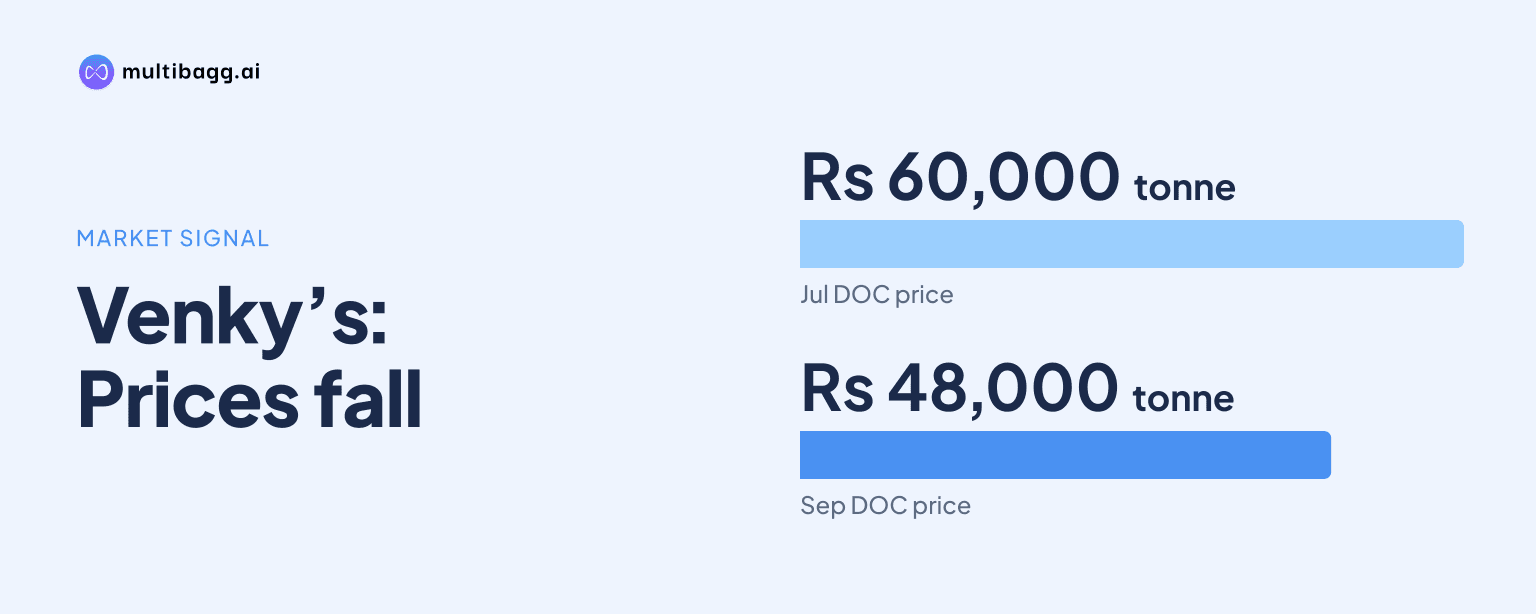
Venky's (India) Limited said oilseed profitability was affected in Q2 FY27 as soya de-oiled cake (DOC) fell Rs 12,000 a tonne, from Rs 60,000 in July to Rs 48,000 in September 2026, reversing the reasonably good contribution management reported for July and August.
Know Venkys (India) inside out
Results, valuation, peers and who's buying, in one view.
Why did Venky’s oilseed profitability decline in Q2 FY27?
Venky’s said an abrupt reversal in seed and end-product prices reduced oilseed profitability in September 2026. Management said conditions had been positive in the first quarter and through July and August, supported by seed availability and realizations, but prices changed from about August 15 and dropped unexpectedly during September. Material then in stock had to be sold at lower prices, according to management.
The main pressure was the fall in DOC, the major product of soya crushing. Management said DOC began the quarter at Rs 60,000 a tonne, fell to Rs 57,000 a tonne and reached Rs 48,000 a tonne in September. The Rs 12,000-a-tonne decline from July to September reduced realizations and offset the performance management described as reasonably good in July and August.
Management described the price movement as unexpected rather than as the result of a planned operating change. It said the oilseed segment is viewed internally as a steady performer, but global commodity-price movements can affect financial performance. The September reversal followed sharp increases in soya seed prices during July and August, creating pressure when DOC realizations subsequently declined.
How did Venky’s oilseed production and sales change in the September quarter?
Venky’s operated oilseed capacity at about 50% in Q2 FY27, while utilization for the first six months of FY27 was 53%. Management said utilization was lower partly because of seed availability and added that crushing was lower in the September quarter. This added volume pressure to the fall in DOC realizations.
DOC sales declined to 50,716 tonnes in the quarter ended September 2026 from 56,000 tonnes in the quarter ended September 2025. Refined oil sales fell by less, to 11,035 tonnes from 11,514 tonnes. The year-on-year comparison shows that the segment recorded lower volumes for both outputs during the quarter in which DOC prices dropped.
The larger reduction was in DOC, which management identified as the product with the major production contribution in the crushing operation. Venky’s sells refined edible soya oil in the market and uses DOC through a combination of captive consumption and external sales. Available seed stock for crushing, therefore, affects both sales volumes and the oilseed segment’s revenue and profitability.
Got a follow-up? Ask IRIS
What does Venky’s expect for soya prices and crushing?
Venky’s said it hopes to recover ground during the remaining months of FY27 as soya demand rises and price trends improve, but management gave no specific oilseed margin or profitability target. It said requirements for soya and DOC are higher in the third and fourth quarters and that it intends to catch up on crushing as seed availability permits.
The supply outlook remains unresolved because management said rains had affected crops in Maharashtra and other seed-belt areas. It said the crop impact could put pressure on soya prices, while uneven rainfall, yield and production availability remain relevant factors. Management also said it would seek to cover requirements through crops from Madhya Pradesh and other areas in the remaining months.
When asked whether price increases had been taken in the current month, management said they had. However, it said future performance would depend on how seed costs and soya DOC prices behave, rather than on a single price action. Its recovery expectation is consequently conditional on product realizations, stock availability for crushing and the timing of crop supply.
Can alternative protein sources change Venky’s DOC economics?
Venky’s said distillers dried grains with solubles (DDGS) could reduce pressure on soya protein costs but cannot replace all soya DOC in poultry feed. Management said a broiler ration may require 30% to 35% soya DOC, while DDGS could account for at most about 10% of the ration. In that example, around 20% of the soya requirement would remain.
Management said the effect of DDGS would depend on its landed price in India. It described DDGS as a high-quality alternative protein that could help check protein costs if its price matched its protein contribution relative to soya. It also said DDGS would support, rather than threaten, the soya industry because poultry demand cannot be met through full substitution.
The issue matters to Venky’s because it operates both soya crushing and poultry businesses that use protein feed. Management said domestic DDGS quality is not comparable with internationally available material, while poultry-industry soya demand is growing by an estimated 5% to 6% and soya crop growth has not kept pace. The company’s comments position DDGS as a possible cost-management input rather than a complete replacement for DOC.
Conclusion
Venky’s oilseed business faced lower realizations and lower output in the September 2026 quarter. DOC prices fell Rs 12,000 a tonne between July and September, while DOC sales declined by 5,284 tonnes year on year to 50,716 tonnes and capacity utilization was about 50%. Together, those factors offset the favorable conditions management reported through July and August.
The next points to watch are management’s plan to increase crushing in the third and fourth quarters, soya seed availability after rain-affected crops, and the direction of DOC realizations. Management said it had taken price increases in the current month and expects higher second-half requirements for soya and DOC, but said results will remain dependent on seed costs, crop supply and end-product prices.