










Venky’s (India) Limited converts soya into 82% feed DOC
Key highlights
- Venky’s says raw-soya crushing yields 82% De-Oiled Cake and 18% refined edible soya oil.
- Venky’s reported soya prices of Rs 56.8 per kg in H1 FY27, up 57% year on year.
- Venky’s current feed-conversion ratio is 1.50 to 1.60 versus a historical 1.70 to 1.80.
- Venky’s FY26 turnover and other income rose to Rs 3,774.93 crore from Rs 3,351.17 crore in FY25.
powered by IRIS
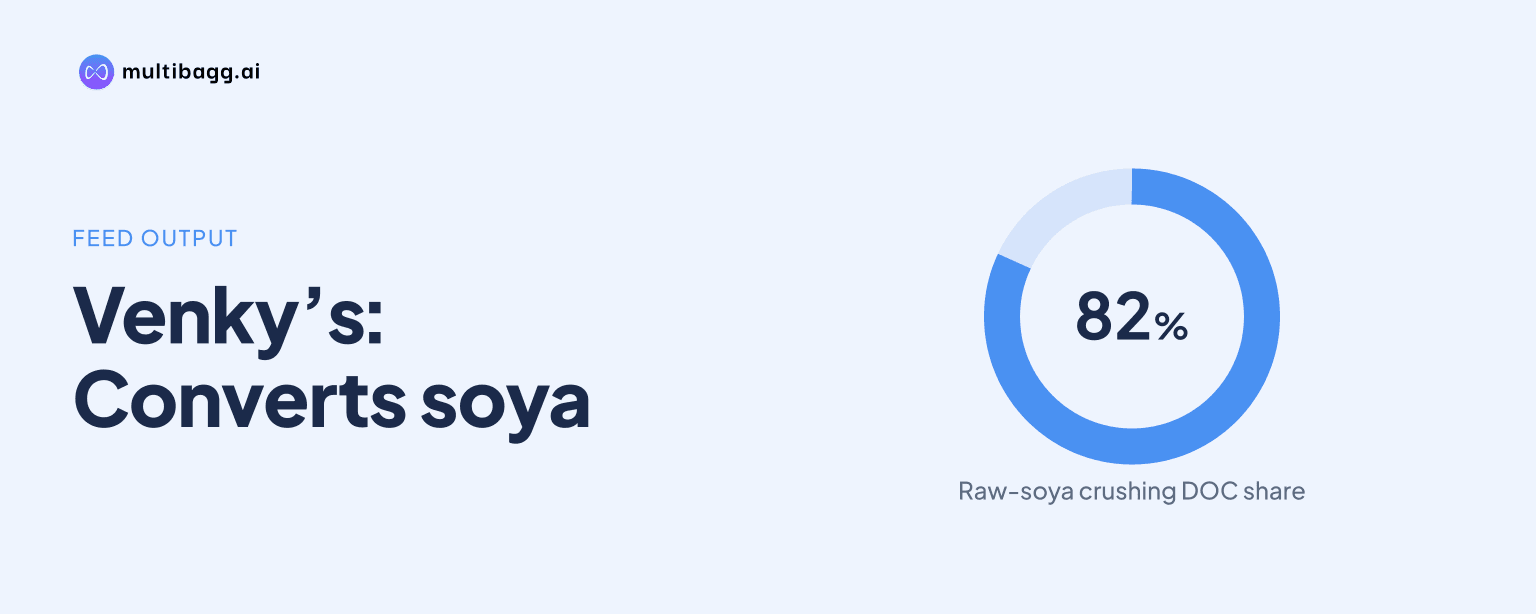
In its oilseeds presentation, Venky’s says raw-soya crushing produces 82% De-Oiled Cake (DOC) and 18% refined edible soya oil, making DOC available for poultry-feed operations. The company presents the two outputs as a vertical-integration mechanism that combines feed-input supply with revenue from market sales of edible oil.
Know Venkys (India) inside out
Results, valuation, peers and who's buying, in one view.
How does Venky’s turn soya into poultry-feed input?
Venky’s processes raw soya seeds through crushing, with the presentation showing an 82% yield of DOC and an 18% yield of refined edible soya oil. DOC, or De-Oiled Cake, is the protein-rich residue after oil extraction and is identified by Venky’s as a critical input for poultry feed. The company therefore describes one processing step producing two products: refined edible oil for sale and DOC for feed use.
The stated 82:18 output mix means that DOC is the larger product stream by weight, while edible oil accounts for the smaller stream. Venky’s does not disclose oilseed crushing capacity, raw-soya procurement volume, annual DOC production or the share of DOC consumed internally. The presentation instead sets out the operating rationale: internally processed DOC is intended to provide a reliable, high-quality protein input for the poultry-feed business.
Why does captive DOC matter to Venky’s poultry business?
Venky’s says DOC is the main protein source for poultry feed, so captive manufacturing is intended to protect feed production from open-market shortages and speculative pricing spikes. This is the supply-chain role of the oilseeds segment: it is not described simply as a stand-alone oil business, but as a source of a principal poultry-feed ingredient. The company labels the link between oilseed output and poultry feed as captive supply security.
Venky’s also identifies assured quality as the second benefit of internally manufactured DOC. In the company’s description, having DOC available from its own processing operations is meant to provide quality raw material for production capacity across the business. The presentation does not provide a measurable quality specification, rejection rate or cost difference between captive and purchased DOC, so this benefit is presented as a strategic objective rather than a quantified operating result.
The importance of that mechanism reflects the structure of Venky’s poultry operations. Its poultry and poultry products segment spans breeding and farming, commercial rearing, broiler and layer day-old chicks, live-bird operations and poultry feed. Within that wider chain, the oilseeds segment supplies a feed ingredient rather than a finished poultry product, linking upstream soya processing to feed required for commercial poultry rearing.
Got a follow-up? Ask IRIS
How do feed costs make the DOC strategy relevant?
Venky’s links poultry margins to maize and soya prices, making access to DOC relevant when protein-feed inputs become more costly. Soya prices rose 57% year on year in H1 FY27, which the company defines as April to September 2026, to Rs 56.8 per kg. The company says this increase makes feed-conversion improvements critical, although it does not quantify how much internally produced DOC offsets the effect of soya-market pricing.
Venky’s feed conversion ratio, or FCR, improved from a historical range of 1.70 to 1.80 to a current range of 1.50 to 1.60. FCR measures kilograms of feed needed for one kilogram of live body weight. Venky’s says the change represents about 200 grams less feed for each kilogram of live weight, reducing the volume of maize and soya-based inputs required by poultry operations.
The comparison shows that soya prices fell from Rs 47.6 per kg in FY24 to Rs 37.9 per kg in FY25, before increasing to Rs 38.3 per kg in FY26 and then reaching Rs 56.8 per kg in H1 FY27. Maize was Rs 25.4 per kg in FY25 versus Rs 22.3 per kg in FY26. Venky’s says years with maize above Rs 21 per kg, including FY20 and FY23 to FY26, had poultry margins of 5% or below.
What does Venky’s financial context show about integration?
Venky’s reported turnover and other income of Rs 3,774.93 crore in FY26, up from Rs 3,351.17 crore in FY25, while profit after tax increased to Rs 139.25 crore from Rs 116.62 crore. Material cost rose to Rs 2,601.40 crore in FY26 from Rs 2,261.52 crore a year earlier. These group-level figures show that input procurement remains a large cost category, but the presentation does not isolate oilseeds-segment revenue, profit or DOC-related cost savings.
Total assets rose to Rs 1,670.06 crore at the end of FY26 from Rs 1,539.79 crore at the end of FY25, while investments increased to Rs 213.34 crore from Rs 121.57 crore. Borrowings were Rs 162.77 crore on 31 March 2026 and Rs 172.06 crore on 30 September 2026. The financial tables do not assign these changes to the oilseeds segment, so they cannot establish the financial return from soya crushing alone.
The available disclosures distinguish the operational case from reported financial evidence. The operational case is specific: 82% DOC, 18% oil, supply protection and quality assurance. The financial evidence is consolidated across Venky’s businesses, including poultry, poultry products, animal health products and oilseeds, rather than providing a separate measure of captive DOC volumes or its contribution to poultry margins.
Conclusion
Venky’s presents soya crushing as an integrated input model: refined edible oil creates a saleable output, while the 82% DOC stream supports poultry-feed production. That positioning is particularly relevant after the company reported a 57% year-on-year increase in soya prices to Rs 56.8 per kg in H1 FY27 and highlighted an FCR improvement of about 200 grams of feed per kilogram of live weight.
The next disclosure to watch is the poultry segment margin for H1 FY27, which the presentation says is yet to be reported. Venky’s also does not disclose oilseed crushing capacity, DOC output, captive-consumption share or a quantified purchase-cost saving, leaving those measures unresolved when assessing how much the 82% DOC yield moderates feed-price volatility.