










Venky’s Kesurdi plant runs at 40% after Rs 67 crore outlay
Key highlights
- Venky’s began commercial production at Kesurdi in March 2024.
- Venky’s invested approximately Rs 67 crore in Kesurdi through internal accruals.
- Kesurdi operates at approximately 40% capacity and was built to double AHP production capacity.
- Management expects Kesurdi to support 15% to 20% volume growth and reach full utilisation in four to five years.
powered by IRIS
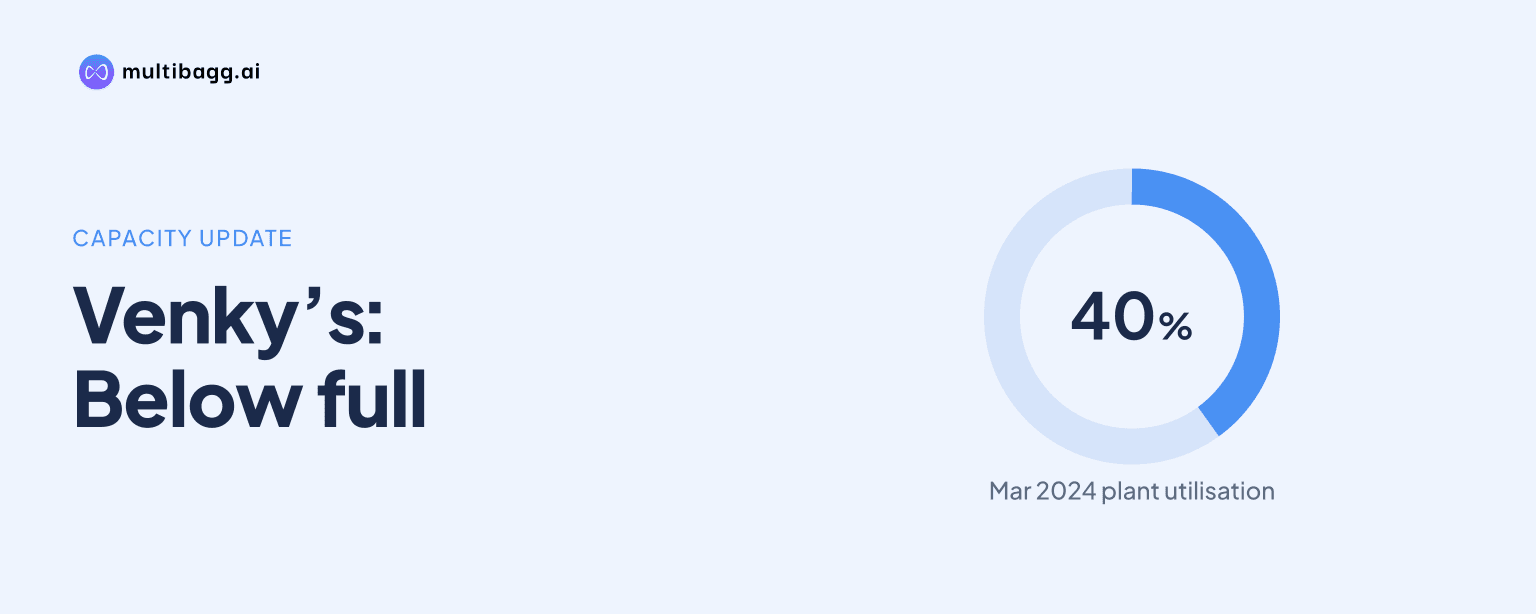
Venky’s (India) Limited says its Kesurdi animal health products, or AHP, plant was operating at approximately 40% capacity after commercial production began in March 2024, following an approximately Rs 67 crore investment funded entirely through internal accruals. Venky’s built the facility to double AHP production capacity and management expects 15% to 20% additional volume growth.
Know Venkys (India) inside out
Results, valuation, peers and who's buying, in one view.
What has Venky’s built at Kesurdi?
Venky’s has built a specialised manufacturing unit at Kesurdi for its AHP segment, with commercial production commencing in March 2024. The company describes it as a new specialised unit and says it was designed to meet stringent new drug authority guidelines while being prepared for domestic and international shifts.
The facility was built to double the segment’s current production capacity, according to the presentation. Venky’s does not disclose the plant’s capacity in tonnes, doses, packs or another physical measure, so the stated doubling is a relative capacity comparison rather than a quantified output figure.
The Kesurdi project is directed at the specialised poultry treatment segment. Venky’s identifies therapeutic solutions, nutritional supplements and innovative phytogenic solutions as the relevant product focus, but it does not disclose individual product capacity, sales contribution or production volumes for these categories.
How did Venky’s finance the Kesurdi expansion?
Venky’s funded the approximately Rs 67 crore Kesurdi project entirely through internal accruals. The company says this self-funded structure maintained the AHP segment’s zero-term-debt status, meaning the disclosed project did not require term borrowing at that segment level.
This segment-level statement differs from the company-wide financial position reported for 2025-26. Venky’s reported borrowings of Rs 9.50 crore at the end of 2025-26, compared with no borrowings reported for 2024-25, while total assets increased to Rs 1,670.06 crore from Rs 1,539.79 crore.
The presentation does not state the maturity, purpose or business-segment allocation of the Rs 9.50 crore in company borrowings. It therefore does not connect that balance to Kesurdi, and the company’s explicit statement on the project remains that AHP’s zero-term-debt status was maintained.
How much of Venky’s Kesurdi capacity is in use?
Venky’s says the Kesurdi facility is currently operating at approximately 40% capacity. On that basis, about 60% of the plant’s installed capacity remains available for future utilisation, although the company does not provide monthly or annual production data.
Management anticipates full utilisation over a four- to five-year horizon. This is a management expectation rather than a fixed completion date, and the presentation does not specify the date from which that four- to five-year period is measured or provide annual utilisation targets.
The 40% utilisation figure should not be treated as a measure of the AHP segment’s total output relative to its historic level. The company does not disclose pre-expansion capacity, output at older facilities or the utilisation of those facilities, even though Kesurdi was built to double the segment’s current production capacity.
Got a follow-up? Ask IRIS
What volume growth does Venky’s expect from Kesurdi?
Venky’s management expects the additional capacity at Kesurdi to support 15% to 20% volume growth. The presentation identifies the new unit as a volume driver, but does not define whether this range applies to the entire AHP segment, a product category, a particular financial year or the whole utilisation period.
The stated 15% to 20% expectation is volume guidance, not revenue or profit guidance. Venky’s does not disclose AHP revenue, segment profit, product pricing, sales mix or a margin target for the Kesurdi plant, so the presentation does not support a calculation of incremental sales or earnings.
Management also characterises the facility as focused on a high-margin specialised poultry treatment segment. However, Venky’s supplies no separate margin data for therapeutic solutions, nutritional supplements or phytogenic solutions, leaving the financial contribution of each product group undisclosed.
How does Kesurdi fit Venky’s manufacturing network?
Venky’s facility overview lists two AHP facilities in Maharashtra, the only state shown with AHP capacity in its 11-state manufacturing table. The same Maharashtra row lists five breeder farms, one commercial farm, two feedmills, three hatcheries, one foods facility, three oil-extraction facilities and two specific-pathogen-free egg facilities.
The presentation does not identify the locations of the two Maharashtra AHP facilities or explicitly confirm whether both include Kesurdi. It also does not state whether the Kesurdi plant is on company-owned land, despite noting that most farms, hatcheries and feedmills are located on company-owned land.
Venky’s wider poultry and poultry-products segment spans breeding and farming, commercial rearing, premium products and processed chicken. The company places specific-pathogen-free eggs and processed chicken in its premium and processed offering, whereas the Kesurdi project is presented as a specialised poultry treatment, nutritional and phytogenic solutions facility.
What is the financial context for the expansion?
Venky’s reported profit after tax of Rs 139.25 crore in 2025-26, up from Rs 116.62 crore in 2024-25. Profit before tax rose to Rs 185.55 crore from Rs 162.71 crore over the same period, while turnover and other income increased to Rs 3,774.93 crore from Rs 3,351.17 crore.
The Rs 67 crore Kesurdi investment equals less than the company’s 2025-26 profit after tax of Rs 139.25 crore, but the presentation does not assign any 2025-26 revenue or profit to the facility. Since commercial production commenced in March 2024, the disclosed financial highlights do not isolate the plant’s performance in either 2024-25 or 2025-26.
Venky’s 2025-26 material cost was Rs 2,601.40 crore, compared with Rs 2,261.52 crore in 2024-25, while other expenses increased to Rs 674.56 crore from Rs 583.83 crore. These company-wide changes cannot be attributed to Kesurdi because the presentation provides no AHP operating-cost or profitability breakdown.
Conclusion
Venky’s has added a self-funded Rs 67 crore Kesurdi manufacturing unit that began commercial production in March 2024 and is operating at approximately 40% capacity. The project was built to double AHP production capacity and management expects it to support 15% to 20% volume growth, but the presentation does not disclose plant output, AHP sales or project-level profitability.
The main disclosed point to watch is management’s anticipated four- to five-year route to full utilisation. Future AHP disclosures could show whether the expected 15% to 20% volume growth occurs and whether Venky’s provides capacity, product-mix, revenue or margin figures that measure Kesurdi’s financial contribution.