










Vijaya focuses on dense clusters, not a pan-India rollout
Key highlights
- Vijaya will not organically enter markets beyond its three to four identified geographies for now.
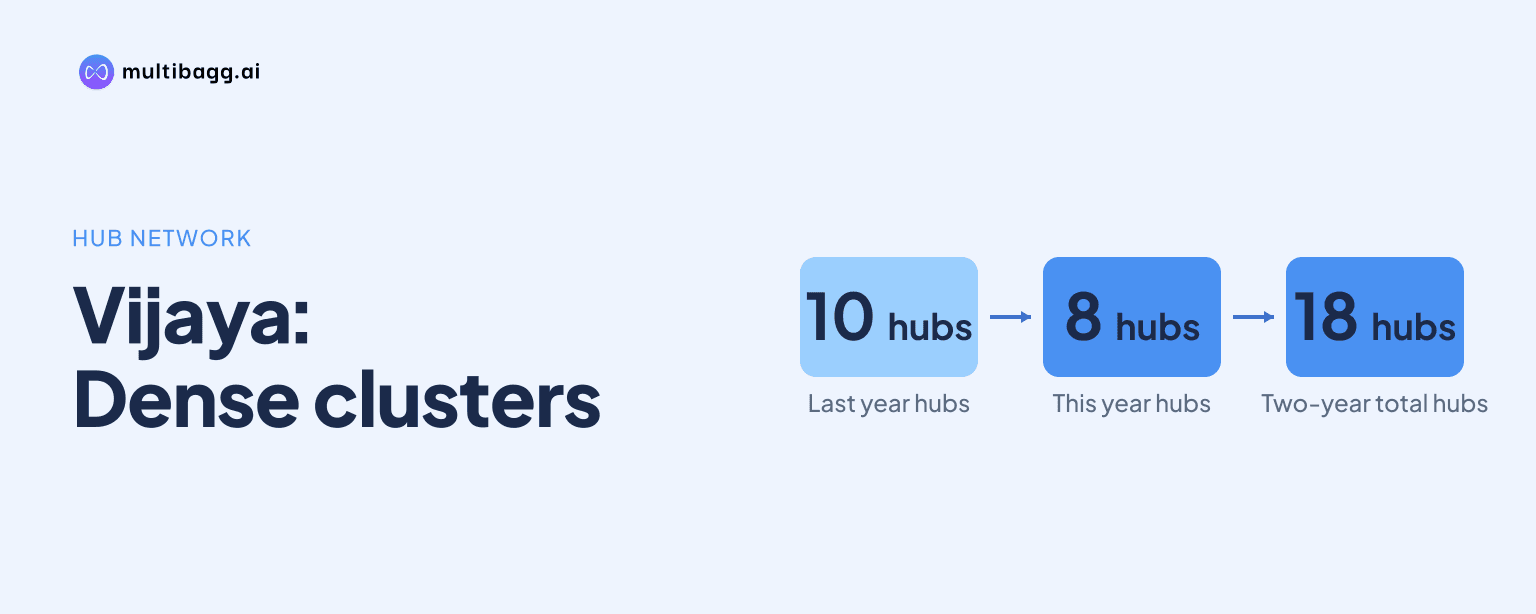
- Vijaya added 10 hubs last year and is adding 8 this year, totalling 18 across two financial years.
- Hyderabad had close to 100 Vijaya centres, up from 94 two years earlier.
- The PH Pune cluster was delivering a margin above 35%, according to management.
powered by IRIS
Vijaya Diagnostic Centre Limited is concentrating organic expansion in three to four identified geographies rather than pursuing a pan-India rollout, management said on November 4, 2026, after adding 10 hubs last year and planning 8 this year. Vijaya intends to use a hub-and-spoke model, drawing on Hyderabad’s network of close to 100 centres.
Know Vijaya Diagnostic Centre inside out
Results, valuation, peers and who's buying, in one view.
Why is Vijaya focusing on dense clusters instead of pan-India expansion?
Vijaya is focusing on dense clusters because management said adding hubs and spokes within one market improves operational efficiency and margins more effectively than rapidly entering many markets. Management said Vijaya would not organically add centres outside the three to four new geographies it has identified, because it wants to build density in those areas first.
The model begins with a hub and follows with spokes around it once the hub develops. Management said this structure had worked in Hyderabad, where the network had grown from 94 centres two years ago to close to 100 centres at the time of the call. The company’s consumer-facing model, integrated with radiology services, also requires attention to customer experience and safety as each geography expands.
Management did not endorse a fixed annual opening rate of 8, 9 or 10 hubs. It said Vijaya would provide guidance for the coming two to three quarters at each reporting point, rather than ask investors to assume that the 10 hubs opened last year would become a permanent annual run rate. Management nevertheless indicated that four to five hubs annually across geographies could be a continuing operating pace.
How will Vijaya expand within its identified geographies?
Vijaya will add hubs, stabilise them and then add spokes around them in the same geography. Management named Bengal and Karnataka among the chosen markets, while describing Bengal and the Northeast as adjacent areas, and said the aim was to replicate the network densification approach used in Hyderabad.
The 18 hubs added or planned across two financial years show the scale of the current programme, but management distinguished that total from a formal multi-year target. It said that opening 18 hubs over two financial years involved substantial execution work and that annual additions could vary rather than follow the previous year’s 10-hub level.
In Hyderabad, Vijaya had commissioned one hub and four spokes through the first half, with at least three to four additional spokes planned during the year. Management said the network’s recent growth was being driven mainly by higher throughput at existing centres rather than by a large increase in locations, since the city added only 6 centres over the two years from 94 to close to 100.
Got a follow-up? Ask IRIS
Is Hyderabad still growing despite Vijaya’s mature network?
Yes, Vijaya said Hyderabad continues to deliver double-digit growth despite being viewed as a mature market as early as 2021, when the network had about 60 to 65 centres. Management said the city had maintained double-digit growth for the last three to four years and expected that trend to continue over the next few years.
For the quarter discussed on the November 4 call, Hyderabad recorded mid-teen volume growth. Management attributed roughly 2% to 3% of growth to changes in test mix, while the remaining balance benefited from a revision in Central Government Health Scheme tariffs. It also agreed with an analyst’s observation that higher throughput at established centres was contributing to the city’s growth.
Vijaya expects to open its third flagship centre in Hyderabad within six to eight months after signing a lease in the western part of the city. Management said spokes in western Hyderabad had delivered exceptional growth and that it was evaluating high-end equipment for the new centre, including a possible Omega 3T magnetic resonance imaging, or MRI, system similar to the one installed at JP Nagar in Bengaluru.
Management also cited demand for advanced radiology, high-end pathology and genomics as support for Hyderabad’s throughput. It said patients and doctors were seeking procedures such as cardiac angiography and complex tests that smaller diagnostic centres may not offer. Management further said it had not seen a new player opening a centre in Hyderabad while Vijaya was adding capacity.
Are new hubs affecting Vijaya’s margins or ramp-up timetable?
No material margin drag from recent openings was reported by management, which said new hubs had been reaching break-even within internally set timelines. It did not disclose those timelines, but said the JP Nagar flagship in Bengaluru, opened during the quarter, and the Gachibowli hub and spokes in Hyderabad, opened in the first quarter, had not materially affected earnings before interest, taxes, depreciation and amortisation, or EBITDA, margins.
Management also said the 10 hubs opened last year had ramped as expected or faster than expected. Its view was that margins would not be a constraint on expansion if Vijaya first stabilised hubs and subsequently added spokes. That sequence is the practical basis for limiting organic expansion to the identified three to four geographies.
The PH Pune cluster provided a profitability reference, with management saying it was delivering a margin above 35% after posting double-digit revenue growth for the last couple of quarters. In Bengaluru, Vijaya said more than 50% of revenue at new centres would initially come from high-end radiology, including complex MRI and computed tomography, or CT, cases, before regular pathology volumes build over one to two years.
Wellness is a separate component of the revenue mix. Management said wellness represented about 14% to 15% of revenue, grew close to 27% in the second quarter and had historically grown at more than 20%. It expects the revenue share to remain broadly around 14% to 15% for the next couple of years, noting that package pricing is generally discounted and may not materially raise revenue per test.
Conclusion
Vijaya’s disclosed expansion strategy is centred on depth rather than geographic breadth. The company is using Hyderabad, where it has close to 100 centres and reported mid-teen volume growth in the quarter, as the template for building hubs first and spokes later in a limited set of markets. Management’s reported lack of material EBITDA-margin drag from recent openings supports its stated preference for planned cluster development.
The next milestones are the 8 hubs being added this year, the planned three to four additional Hyderabad spokes and the third Hyderabad flagship expected within six to eight months. Management’s equipment decision for that flagship, the break-even progress of newly opened hubs and the pace of spoke additions after hub stabilisation will show how the strategy is being executed.