










Vijaya says volumes led Q2 growth, with mix and tariffs
Key highlights
- Vijaya reported Q2 revenue of about Rs 255 crore, up 26.7% year on year.
- Test volumes rose 16.5%, while favourable test mix added an estimated 4%-5% to Q2 growth.
- The prior CGHS tariff revision contributed approximately 3% to revenue growth and about 2% to EBITDA margin.
- Q2 EBITDA rose 37.8% to about Rs 113 crore and EBITDA margin expanded 350 basis points to 44.1%.
powered by IRIS
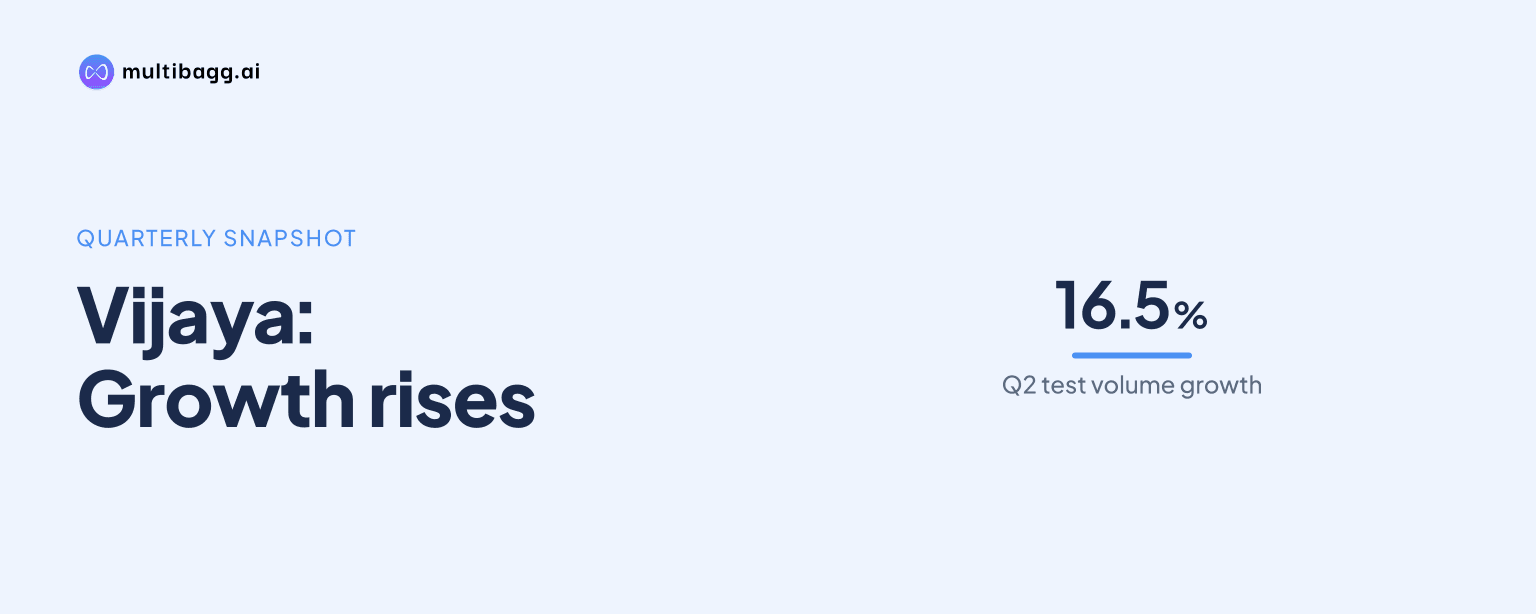
Vijaya Diagnostic Centre Limited reported 26.7% year-on-year revenue growth to about Rs 255 crore in the quarter ended September 2026, driven mainly by 16.5% test-volume growth, while higher-value test mix added an estimated 4%-5% and revised Central Government Health Scheme tariffs contributed about 3%.
Know Vijaya Diagnostic Centre inside out
Results, valuation, peers and who's buying, in one view.
What drove Vijaya's Q2 revenue growth?
Vijaya's Q2 revenue growth came principally from more tests being performed, supplemented by a shift toward higher-realisation services and the Central Government Health Scheme, or CGHS, tariff revision. Management said consolidated revenue rose 26.7% year on year to approximately Rs 255 crore in the quarter, with volume growth of 16.5% supplying the largest identified component.
The revenue result was broad-based across the two diagnostic segments, pathology and radiology, according to management. Hyderabad, Vijaya's largest geography at 67% of quarterly revenue, grew by more than 20% year on year, while Pune grew approximately 15.5%. Rest of Andhra Pradesh and Telangana represented about 20% of revenue, with Pune and West Bengal each contributing 5%.
The components are management estimates rather than a formal bridge and do not add precisely to the reported 26.7% growth rate. Still, they show that volume expansion accounted for more of the increase than either mix or the tariff effect, in a quarter when revenue per test was Rs 513 and revenue per footfall was Rs 1,865.
How did higher-value tests lift Vijaya's revenue mix?
Higher-value radiology tests lifted Vijaya's mix because customers increasingly moved from basic radiology modalities toward advanced scans, including computed tomography, or CT, and CT angiography. Management estimated this favourable test-mix shift contributed 4%-5% to Q2 growth, following a trend it said had been visible over the last couple of quarters.
Radiology accounted for approximately 37% of quarterly revenue, giving changes in imaging demand a material effect on average realisation. Vijaya also said it had upgraded two CT machines to high-end 160-slice cardiac CT equipment in response to rising demand for high-end complex CTs, linking capital spending to the procedures behind the mix improvement.
The mix effect differs from a general list-price increase because it reflects the composition of tests customers choose. Vijaya's 92% business-to-consumer, or B2C, revenue mix and integrated pathology-radiology model meant both segments contributed to growth, but management specifically identified advanced radiology as the reason for the 4%-5% mix benefit.
Did Vijaya raise prices to deliver Q2 growth?
No, Vijaya said it had not yet implemented a price hike in the current financial year, and it attributed about 3% of Q2 growth to the earlier CGHS tariff revision instead. Management said the CGHS tariff hike occurred around October or November of the prior year, making it separate from a new across-the-board retail pricing action by Vijaya.
Management said it had raised prices sometime in June of the previous year and that its historical compound annual growth rate, or CAGR, in price realisation was close to 2%. It said it would compare its prices with the market before deciding whether to make a price change in Q3 or Q4, so any such action remained under consideration as of the November 4, 2026 call.
The tariff benefit also influenced profitability in the quarter. Vijaya said roughly 2% of the Q2 earnings before interest, tax, depreciation and amortisation, or EBITDA, margin benefit came from the CGHS revision, alongside operating leverage from revenue growth. EBITDA margin reached 44.1%, up 350 basis points year on year, while EBITDA increased 37.8% to about Rs 113 crore from Rs 82 crore.
Got a follow-up? Ask IRIS
How did volume growth compare with Vijaya's longer-term plan?
Vijaya expects its long-term revenue growth to be primarily volume-led, even though Q2 included the support of a tariff revision and a favourable mix shift. Management said it was comfortable with revenue growth above 15% over a three-to-five-year period, compared with approximately 25% year-on-year growth in the first half ended September 2026.
For FY 2027, management said at least 20% revenue growth was achievable after first-half consolidated revenue rose 24.8% to Rs 486 crore from Rs 390 crore a year earlier. The first-half comparison also showed EBITDA rising 36% to Rs 211 crore from Rs 155 crore, with an EBITDA margin of 43.4%, above the long-term revenue-growth guidance but not presented as a permanent growth rate.
Management described existing-network volume growth of roughly 8%-10% and new-centre volumes of about 3%-3.5% as expected contributors to long-term growth. That framework places expansion capacity, rather than pricing, at the centre of its planning, while recognising that the Q2 mix benefit arose from more complex procedures with higher realisation.
Which expansion plans could support Vijaya's volumes?
Vijaya plans to launch eight hub centres and 14 spoke centres by Q1 FY 2028, with estimated expansion capital expenditure, or CAPEX, of Rs 155 crore to Rs 160 crore. Two hubs, including a Bengaluru flagship hub, had already been commissioned; management expects three more by March 2027 and the remaining three in Q1 FY 2028.
In Pune, Vijaya intends to launch a Market Yard hub and central laboratory during FY 2027 at an estimated Rs 18 crore to Rs 20 crore cost. The relocation is close to the existing Satara Road centre and is intended to ease capacity constraints; a separate property near Mayur Colony is expected to cost about Rs 19 crore and be commissioned in FY 2028.
The company also reported approximately Rs 355 crore of surplus cash, which management said gives it flexibility for the stated expansion programme. Its planned Panjagutta central laboratory, with an automated track system, is expected to be operational in the next few months at estimated CAPEX of about Rs 20 crore, while land in Kadapa cost approximately Rs 9 crore for a hub planned within two years.
Conclusion
Vijaya's Q2 growth was not presented as the result of a new price increase: management allocated 16.5% to higher test volumes, 4%-5% to a richer test mix and about 3% to the prior CGHS tariff revision. The higher mix toward advanced radiology coincided with 37% radiology revenue share, while revenue growth translated into a 44.1% EBITDA margin through operating leverage and the tariff effect.
Next, investors can watch whether Vijaya makes the potential Q3 or Q4 price decision it said would follow a market comparison, and whether it meets its at-least-20% FY 2027 growth expectation. Operational milestones include three further hubs by March 2027, the Market Yard Pune launch in FY 2027, and completion of the Arya Wellness Centre transaction in Guwahati, which management expected within two months of the November 4, 2026 call.