










Vijaya Diagnostic Centre Limited Q2 Profit Rises 37.4%
Key highlights
- Vijaya Diagnostic Centre reported Q2 FY27 revenue of ₹255.39 crore, up 26.7% year-on-year.
- Q2 FY27 net profit rose 37.4% year-on-year to ₹59.47 crore.
- EBITDA increased 37.8% to ₹112.75 crore and the EBITDA margin expanded 355 basis points to 44.1%.
- Test volumes grew 16.5% year-on-year, while Hyderabad accounted for 67% of quarterly revenue.
powered by IRIS
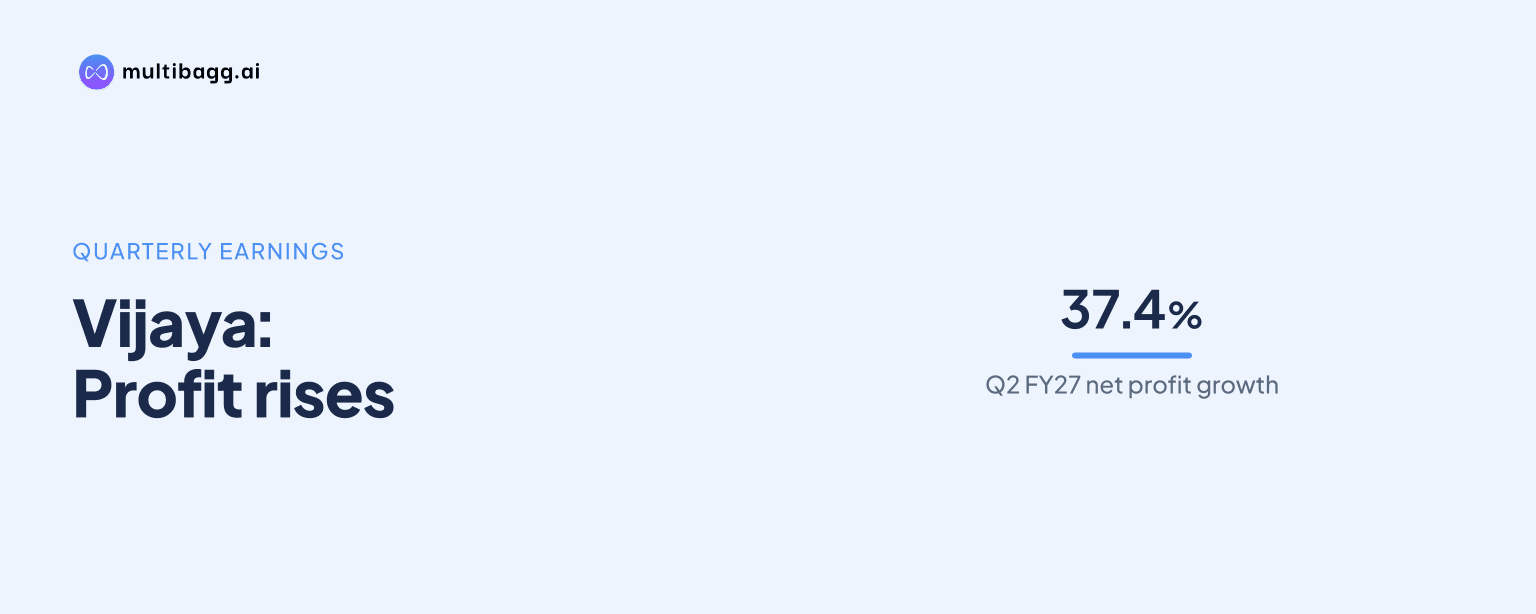
Vijaya Diagnostic Centre Limited reported Q2 FY27 net profit of ₹59.47 crore, up 37.4% year-on-year, as revenue rose 26.7% to ₹255.39 crore through 16.5% test-volume growth, a favourable test mix and revised CGHS tariffs. The results for the quarter ended September 30, 2026 also showed a substantial improvement in operating margins.
Know Vijaya Diagnostic Centre inside out
Results, valuation, peers and who's buying, in one view.
How did Vijaya Diagnostic Centre perform in Q2 FY27?
Vijaya Diagnostic Centre delivered broad-based growth in the September quarter, with consolidated revenue increasing from ₹201.56 crore in Q2 FY26 to ₹255.39 crore in Q2 FY27. Profit before tax stood at ₹79.42 crore, while profit after tax rose to ₹59.47 crore from the prior-year quarter. Basic earnings per share for the quarter were ₹5.80.
Operating profit grew faster than revenue. EBITDA rose 37.8% year-on-year to ₹112.75 crore, compared with about ₹81.84 crore a year earlier. This lifted the EBITDA margin by 355 basis points to 44.1%. PAT margin increased by 181 basis points to 23.3%, indicating that higher revenue translated into stronger profitability during the period.
What drove Vijaya Diagnostic Centre's revenue growth?
Vijaya Diagnostic Centre said its 26.7% quarterly revenue growth was supported principally by 16.5% year-on-year growth in test volumes. A favourable change in test mix and the revision in Central Government Health Scheme, or CGHS, tariffs also contributed to the increase in revenue.
Revenue per test was ₹513 in Q2 FY27, while revenue per footfall was ₹1,865. These metrics provide context for the effect of test mix and tariff changes alongside higher volumes. The company did not separately quantify the contribution of each driver to quarterly revenue growth.
Hyderabad remained the largest market, accounting for 67% of quarterly revenue. The rest of Andhra Pradesh and Telangana contributed approximately 20%, followed by Pune and West Bengal at 5% each. Other geographies accounted for the remaining 3%. Management said Hyderabad grew by more than 20% year-on-year, while Pune grew by approximately 15.5%.
Why did Vijaya Diagnostic Centre's margins improve?
Vijaya Diagnostic Centre's margin expansion was primarily driven by operating leverage, according to management. The EBITDA margin reached 44.1%, compared with roughly 40.6% in the corresponding quarter last year, while gross margin increased by 100 basis points to 88.9%.
Gross profit rose 28.1% year-on-year to ₹227.12 crore, exceeding the pace of revenue growth. The combination of volume growth, test mix and a higher gross margin supported the stronger EBITDA result. Net profit increased 37.4%, broadly in line with EBITDA growth, and PAT margin reached 23.3%.
For investors, the quarterly outcome highlights the relevance of utilisation and revenue quality in the diagnostic-services model. The disclosed figures show that Vijaya Diagnostic Centre generated faster growth in operating profit and net profit than in revenue during Q2 FY27. However, the company has not provided a quantified outlook for margins or earnings in the supplied disclosures.
Got a follow-up? Ask IRIS
What was Vijaya Diagnostic Centre's first-half FY27 performance?
Vijaya Diagnostic Centre reported H1 FY27 revenue of ₹486.37 crore, up 24.8% year-on-year. EBITDA increased 36.0% to ₹211.29 crore, while net profit rose 37.5% to ₹112.57 crore for the six months ended September 30, 2026.
The first-half figures are consistent with the September-quarter trend, where profit growth exceeded revenue growth. Q2 revenue of ₹255.39 crore represented more than half of the reported H1 revenue, while Q2 PAT of ₹59.47 crore was also higher than the first-quarter contribution implied by the half-year total.
The company provides diagnostic services including laboratory testing, radiology, nuclear medicine, health check-ups and medical services. Its geographic mix remains concentrated in Hyderabad and the wider Andhra Pradesh-Telangana region, although Pune, West Bengal and other locations also form part of the network.
How could network expansion affect Vijaya Diagnostic Centre?
Vijaya Diagnostic Centre has outlined plans to commission three additional hubs in H2 FY27 and three more in Q1 FY28. It has also indicated an intention to expand its network in East India and Tier-II markets, which would extend its operating footprint beyond its core geographies.
The company also reported entry into North-East India through the acquisition of Arya Wellness Centre. The supplied information does not quantify the acquisition's financial contribution or its expected effect on future revenue and profit. As a result, the immediate financial significance of this expansion cannot be assessed from the disclosed figures.
For customers and local communities, additional hubs could increase access to diagnostic services where the network is expanded. For shareholders, the important operational measures will be the rollout of the planned hubs, revenue contribution from newer markets and whether profitability remains supported as the network grows.
Conclusion
Vijaya Diagnostic Centre's Q2 FY27 results showed higher volumes, improved revenue per test and margin expansion. Revenue increased 26.7% to ₹255.39 crore, while EBITDA rose 37.8% to ₹112.75 crore and net profit climbed 37.4% to ₹59.47 crore. Hyderabad continued to be the principal market, while Pune also recorded double-digit growth.
The next disclosed operational milestones are the commissioning of three hubs in H2 FY27 and another three in Q1 FY28, alongside the company's stated East India and Tier-II market expansion. Investors will also monitor how the North-East India entry and the planned network additions contribute to revenue mix and operating performance.