










Vikram Solar Limited removes 1 GW US orders after Section 232
Key highlights
- Vikram Solar Limited removed 1 GW of US export orders, leaving a closing order book of 8.2 GW in Q2 FY27.
- Vikram Solar said the August 6 Section 232 circular introduced a minimum import price and a 15% ad valorem duty enforceable from December 4.
- Vikram Solar reported Q2 FY27 revenue of Rs 1,077 crore on 591 MW of volume, with EBITDA of Rs 101 crore.
- Vikram Solar's EBITDA per watt peak rose 37% sequentially to Rs 1.71 as distribution volume increased from 145 MW to 259 MW.
powered by IRIS
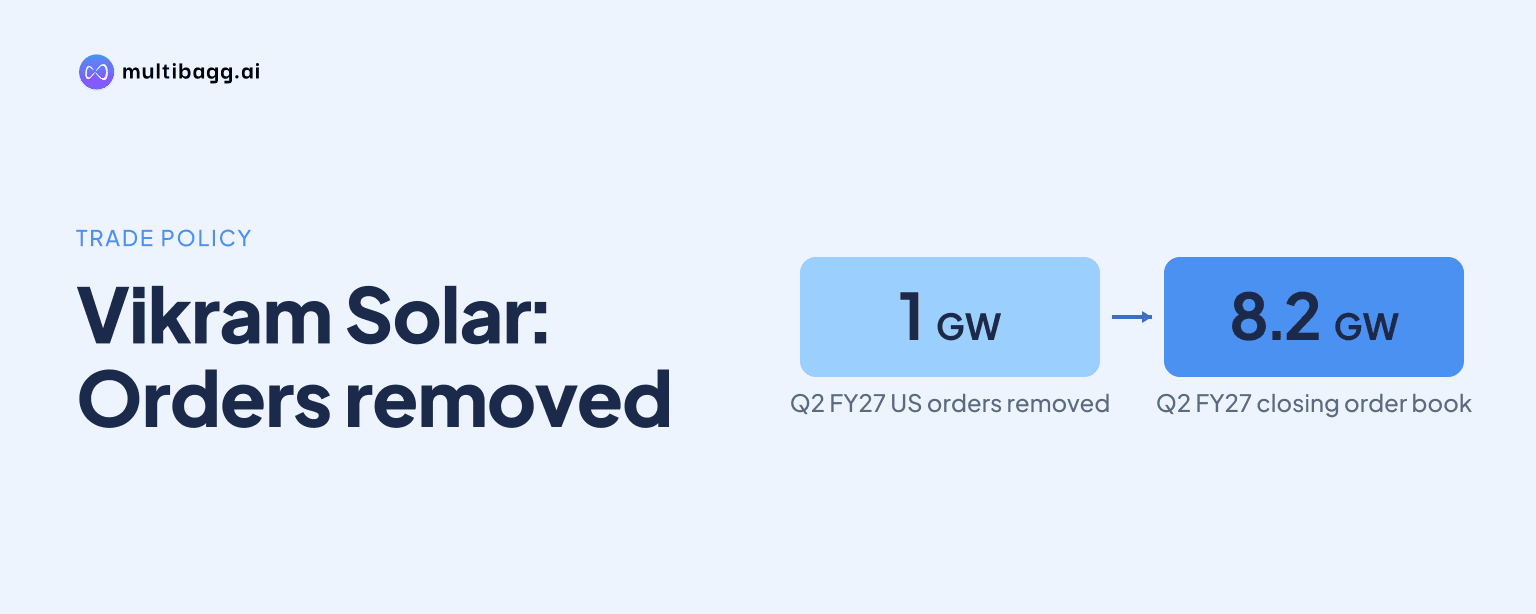
Vikram Solar Limited removed 1 GW of US export orders in Q2 FY27 after the August 6 US Section 232 circular introduced a minimum import price and an additional 15% ad valorem duty, leaving it with a closing order book of 8.2 GW. The measure has an enforcement deadline of December 4.
Know Vikram Solar inside out
Results, valuation, peers and who's buying, in one view.
Why did Vikram Solar remove 1 GW of US export orders?
Vikram Solar removed the 1 GW because management said the US Section 232 circular made the export orders no longer viable. The August 6 circular introduced a minimum import price and an additional 15% ad valorem duty, with enforcement due from December 4. Vikram Solar said it had been carrying these US export orders in its order book before their removal.
The disclosure identifies a regulatory change as the reason for the removal rather than a reported slowdown in the domestic pipeline. Vikram Solar did not disclose the affected customers, order value, module specifications, delivery schedule or whether any revenue had been recognised on the 1 GW of orders by Q2 FY27. It also did not quantify a cancellation charge, inventory impact or payment recovery related to the removed orders.
What is Vikram Solar's order book after the US order removal?
Vikram Solar's closing order book stood at 8.2 GW after it removed the 1 GW of US export orders. The company recorded 1.7 GW of order flow during Q2 FY27, more than double the preceding quarter, showing that fresh domestic orders were added during the period despite the export-order reduction.
Key accounts supplied 1.3 GW of the 1.7 GW quarterly order flow, while the mid-market segment added 400 MW. Vikram Solar said the new orders were spread across PM-KUSUM, commercial and industrial, or C&I, and independent power producer, or IPP, customers. Its 10 largest orders accounted for 1.1 GW, with smaller orders contributing the remaining 600 MW; management said smaller orders typically have better payment terms.
The order book is central to management's expectation of higher second-half volumes. Vikram Solar said the 8.2 GW order book, together with C&I orders following the July 18 clarity on the extension of the Approved List of Models and Manufacturers, or ALMM, List-II, should convert into deliveries in H2 FY27. Management did not provide an execution timetable or segment-by-segment split for the 8.2 GW balance during the call.
How did lower Q2 volume affect Vikram Solar's results?
Vikram Solar reported Q2 FY27 volume of 591 MW and revenue from operations of Rs 1,077 crore, both lower than Q1. Management attributed the volume decline to deferred IPP offtake because of evacuation, land availability and other customer constraints, while the monsoon also affected installations. Industry solar installations fell 25% sequentially, according to management.
The reduction in volume lowered absolute earnings, although unit economics improved. Earnings before interest, tax, depreciation and amortisation, or EBITDA, declined from Rs 126 crore in Q1 FY27 to Rs 101 crore in Q2 FY27, while profit was Rs 6 crore. EBITDA margin was 9.4%, and EBITDA per watt peak increased 37% sequentially from Rs 1.25 to Rs 1.71.
Management attributed the improvement in EBITDA per watt to channel mix, higher realisations for high-efficiency products and cost actions across procurement, bill of materials and plant operations. Distribution represented 44% of Q2 volume, while domestic-content-requirement, or DCR, volume within distribution rose 71% quarter on quarter. Finance cost declined 13% sequentially to Rs 43 crore, and other expenses fell 25%, but these changes did not fully offset a volume decline of about 40% from Q1.
Distribution volume increased about 80% from 145 MW in Q1 FY27 to 259 MW in Q2 FY27. The distributor network expanded from 119 to 133 during the quarter, alongside more than 750 dealers and system integrators. Vikram Solar said the channel's DCR growth supported its higher-margin mix, while it expects distribution momentum to continue over the next few quarters.
Got a follow-up? Ask IRIS
What is Vikram Solar doing to support domestic execution?
Vikram Solar is focusing on converting its order book, expanding distribution and commissioning captive cell manufacturing in FY27. Management expects H2 FY27 volumes to be substantially above the 1,596 MW reported in H1 FY27 as the 8.2 GW order book and delayed C&I orders move into deliveries. H1 FY27 revenue grew 18% year on year to Rs 2,641 crore, while volume increased 3%.
The company expects the first cell from its 9 GW TOPCon Plus cell facility in December 2026. Production lines are expected to be commissioned sequentially over the following three months, with a commercial operation date, or COD, targeted for March 2027. Management said captive DCR cell supply should support volumes and margins after commercial production begins, and said it had added technical supervision and relocated senior leadership to reduce ramp-up risk.
Vikram Solar's Gangaikondan project comprises 6 GW of module capacity and 9 GW of cell capacity, at a stated cost of Rs 5,800 crore. The project is funded roughly one-third through equity and two-thirds through debt; Rs 1,700 crore had been spent by Q2 FY27 and a further Rs 3,800 crore was planned for H2, primarily for the cell project. Gross debt was Rs 632 crore and net debt was Rs 547 crore at the end of Q2, with net debt to equity of 0.17.
Management said capital expenditure on the board-approved 9 GW wafer and ingot project and battery energy storage system, or BESS, projects would be paced to keep capital focused on the cell facility in FY27. The wafer and ingot project completed its Bhoomi Puja in August at the same site as the cell facility, while its commissioning is to be phased according to policy mandates and demand. This sequencing leaves the March 2027 cell-facility target as the nearer disclosed operating milestone.
Conclusion
The removal of 1 GW of US export orders reduced Vikram Solar's reported order book to 8.2 GW and demonstrates the effect that an external trade measure can have on an export pipeline. At the same time, Q2 FY27 operating performance reflected domestic execution delays: volume was 591 MW, revenue was Rs 1,077 crore and EBITDA fell to Rs 101 crore, while EBITDA per watt increased to Rs 1.71 through a larger distribution and DCR mix.
The next developments to watch are Vikram Solar's planned first cell output in December 2026, sequential commissioning over the following three months and the March 2027 COD target for the 9 GW TOPCon Plus cell facility. Management also expects substantially higher H2 FY27 volume as the 8.2 GW order book and post-July C&I orders convert, but it did not disclose a scheduled execution split for those orders.