










Vinyas Sees Semiconductor Supply Worsening Over Next Nine Months
Key highlights
- Memory-component lead times increased from 10-12 weeks to 18-24 weeks, according to management.
- Vinyas expects semiconductor supply conditions to worsen within six to nine months.
- Other non-current assets rose to Rs 54 crore from Rs 20 crore, mainly due to supplier advances.
- Vinyas reported H1 FY27 revenue of Rs 290.3 crore and an EBITDA margin of 12.2%.
powered by IRIS
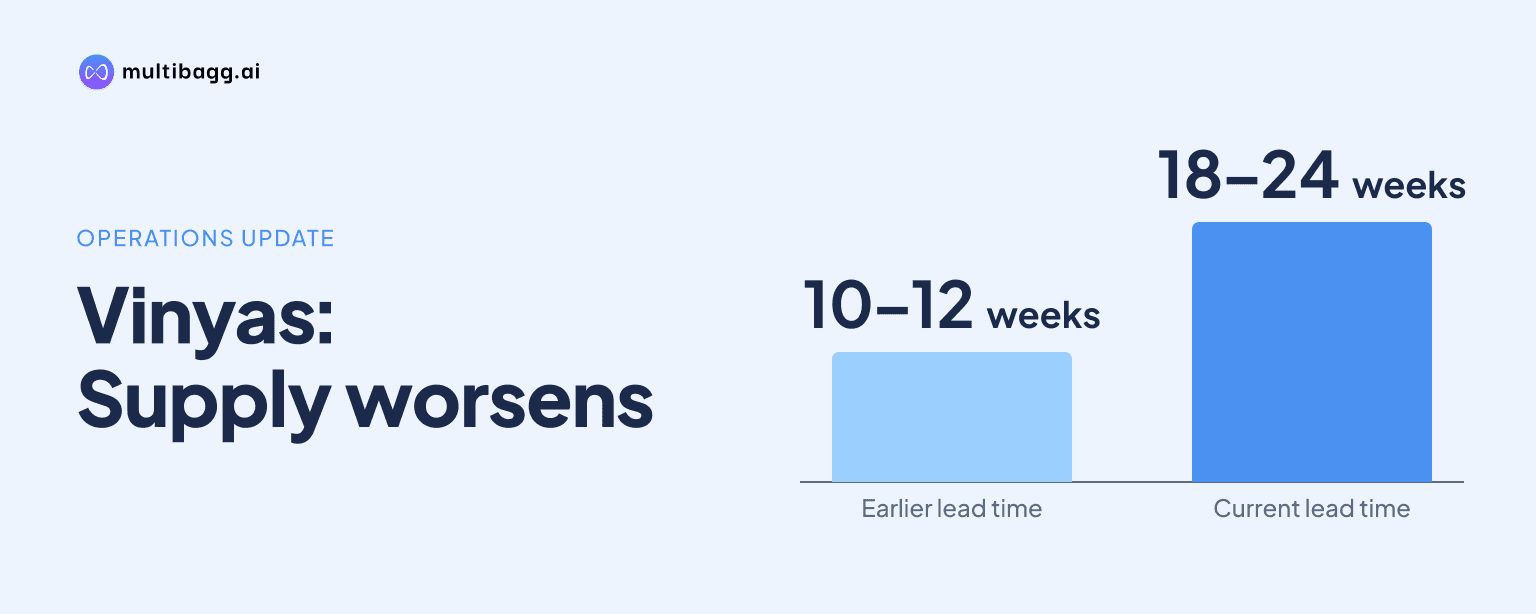
Vinyas Innovative Technologies Limited expects semiconductor supply conditions to worsen within six to nine months, after memory-component lead times increased from 10-12 weeks to 18-24 weeks, leading it to secure stock and supplier advances despite contracts that pass component-price changes directly to customers for its manufacturing schedules.
Know Vinyas Innovative Technologies inside out
Results, valuation, peers and who's buying, in one view.
Why does Vinyas expect semiconductor supply to worsen?
Vinyas expects semiconductor supply conditions not to ease over the next six to nine months and said they could worsen during that period. Management identified memory devices as the main pressure point, saying usual lead times of 10-12 weeks had extended to 18-24 weeks. The longer interval increases the time between placing component orders and receiving material for production.
Some semiconductors have also entered allocation, according to management. Allocation restricts available supply, so Vinyas has secured components when available and retained them in inventory. Management described the present environment as the start of a difficult period for semiconductor supply rather than a disruption it expects to resolve immediately.
Vinyas said its high-mix, low-volume manufacturing model provides relatively better component availability than high-volume manufacturing. Its production includes printed circuit board assemblies, cable harnesses, electromechanical assemblies, system integration and tested subsystems. Management's view is that its lower production volumes make component access more manageable than it would be for a volume manufacturer.
The risk matters because Vinyas had an order book of Rs 1,430 crore as of September 30, 2026. Management said orders are generally executable over 18-24 months, which makes component procurement important to delivery schedules through the remainder of FY27 and into subsequent periods.
How are longer lead times changing Vinyas working capital?
Vinyas has built inventory and work in progress to support planned H2 FY27 dispatches while also securing constrained semiconductor supply. Management said the inventory increase reflected both supply shortages and a larger monthly execution cycle. The company pulled in additional material to keep production lines operating continuously as monthly revenue rises.
Customer collections improved in H1 FY27, with receivables falling by almost Rs 62 crore. At the same time, inventory and work in progress increased, shifting more capital into stock needed for dispatches. Vinyas said its immediate H2 FY27 focus is converting that inventory into customer deliveries and collections.
Supplier advances are another consequence of the supply conditions. Other non-current assets rose to Rs 54 crore from Rs 20 crore, primarily because Vinyas paid suppliers in advance to secure material. Management said the payments were intended to protect availability, reduce lead-time uncertainty and limit the risk that component prices rise before supplies are received.
Borrowing and interest costs also rose during H1 FY27. Management attributed the increase to higher borrowing, as well as stamp duty and processing fees associated with renewing most working-capital limits in the first half. It expects interest cost by the end of March 2027 to be lower than in H1 because most annual processing fees have already been paid.
Got a follow-up? Ask IRIS
Can Vinyas pass higher component prices to customers?
Vinyas said changes in component prices are directly passed on to customers under its contracts. This means a rise in semiconductor or other electronic-component purchase prices is not intended, according to management, to become a permanent cost increase borne by Vinyas.
The contractual pass-through does not remove the cash-flow and execution effects of a shortage. Vinyas may still need to purchase earlier, hold more stock and pay supplier advances, as reflected in other non-current assets rising by Rs 34 crore, from Rs 20 crore to Rs 54 crore. The contract provision addresses price changes, while inventory and advances address physical supply availability.
Management did not say that every supply-chain effect is recoverable from customers. Its comment specifically covered component-price changes. Lead times of 18-24 weeks and allocation can still require procurement well before production, increasing the capital committed to inventory even where prices are passed through.
The company is therefore managing two separate exposures. The first is component-cost inflation, which management says is contractually passed through. The second is supply continuity, which Vinyas is addressing through inventory, supplier advances and borrowing needed to support procurement and its higher monthly manufacturing cycle.
What could supply constraints mean for Vinyas revenue and margins?
Vinyas affirmed an analyst's view that it could maintain 30%-35% growth despite the supply-chain challenges. In H1 FY27, consolidated revenue from operations was Rs 290.3 crore, earnings before interest, tax, depreciation and amortisation (EBITDA) were Rs 35.5 crore, and profit after tax was Rs 14 crore. EBITDA margin was 12.2%.
Management expects EBITDA margin to be between 11% and 12% over the immediate one-year period. For H2 FY27, it expects a range of 11.5%-12%, with a broadly similar business mix but a larger share of printed circuit board assembly (PCBA) work. That H2 range is below the 12.2% EBITDA margin reported in H1 FY27.
System integration provides a higher-margin element within the mix. Vinyas said this work represented 35%-40% of H1 FY27 business and can include PCBA, cable harnesses, mechanical integration and testing. Management said system-integration programmes carry gross margins of 24%-26%, or 300-400 basis points above company gross margin, and it aims for the activity to reach 45%-50% of revenue over the next financial years.
Management expects H2 FY27 orders to include repeat business and orders related to export-side initiatives, potentially split into smaller purchase orders. It said a second round of renewals for certain government programmes had been pushed out, with purchase orders for Vinyas expected mostly in Q1 FY28. The stated H2 FY27 order-inflow range is Rs 500 crore-Rs 550 crore.
Conclusion
Vinyas faces a semiconductor risk centred on execution and working capital rather than a stated inability to recover higher component prices. Memory lead times have expanded from 10-12 weeks to 18-24 weeks, while allocation has required the company to secure material, build inventory and pay supplier advances. Contractual price pass-throughs may limit direct component-cost exposure, but they do not eliminate the funding and scheduling effects of constrained physical supply.
The next measures to watch are whether H2 FY27 inventory converts into dispatches and collections, and whether interest cost declines by the end of March 2027 as management expects after annual processing fees were paid. Management's disclosed test points also include H2 FY27 order inflow of Rs 500 crore-Rs 550 crore, EBITDA margin of 11.5%-12%, and the expected worsening in semiconductor conditions within the next six to nine months.