










Waaree maps Rs 18,000-20,000 crore BESS revenue potential
Key highlights
- Waaree estimates Rs 18,000 crore to Rs 20,000 crore of BESS revenue potential at 20 GWh of capacity.
- Phase 1 could generate Rs 4,000 crore to Rs 5,000 crore from 5 GWh under management's container-sales illustration.
- Phase 1 includes 5.1 GW each of container and pack manufacturing, plus 3.5 GWh of cell manufacturing.
- Waaree said BESS orders are small while it pursues long-term offtake agreements in India and overseas.
powered by IRIS
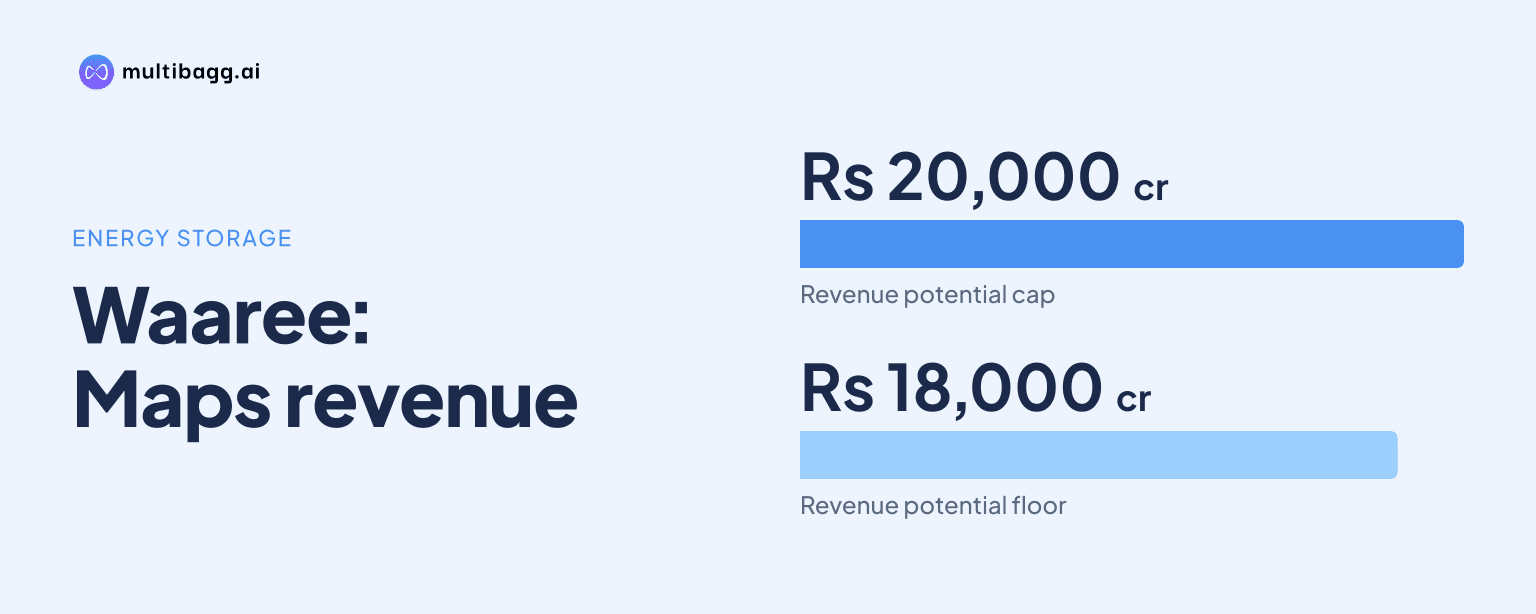
During the earnings call, Waaree Energies Limited said its planned 20 gigawatt-hour battery energy storage system business could generate Rs 18,000 crore to Rs 20,000 crore of revenue at capacity. Waaree based the framework on utility pricing of about US$100 per kilowatt-hour, while saying current battery-storage orders are small and larger offtake talks continue.
Know Waaree Energies inside out
Results, valuation, peers and who's buying, in one view.
What is Waaree's BESS revenue potential at 20 GWh?
Waaree estimates that 20 gigawatt-hours, or GWh, of battery energy storage system capacity could support Rs 18,000 crore to Rs 20,000 crore of revenue. Management split this framework between a Phase 1 estimate of Rs 4,000 crore to Rs 5,000 crore and a Phase 2 estimate of Rs 14,000 crore to Rs 15,000 crore.
The estimate is a capacity-based illustration rather than reported BESS revenue, a contracted order book or formal financial guidance. Management said a broad utility-market price of around US$100 per kilowatt-hour could be used for calculation purposes, and that 5 GWh of Phase 1 capacity could yield about Rs 4,000 crore to Rs 5,000 crore at peak if Waaree sells containers.
The Rs 18,000 crore to Rs 20,000 crore range therefore depends on sales from both phases at the indicated capacity. The call did not disclose a timetable for achieving that revenue level, assumed utilisation, BESS margins, contracted pricing, or the mix between container, pack and cell sales.
How is Waaree commissioning its Phase 1 BESS line?
Waaree is building Phase 1 with 5.1 gigawatts, or GW, of container manufacturing, 5.1 GW of pack manufacturing and 3.5 GWh of cell manufacturing. Management said the container line was commissioned in the previous quarter, the pack line was expected to go live in the current quarter, and the cell line was expected to begin pilot production in the next quarter.
Management expects the fully integrated Phase 1 line to start in the current financial year. The sequence combines containers, battery packs and cells, but Waaree did not disclose production volume, commercial sales, capital expenditure, manufacturing yield or utilisation for the container line already commissioned.
Waaree also described a route to revenue beyond sales of complete containers. Management said it could sell cells separately while using imported cells in locally made containers, potentially adding direct sales, supplies and exports to the Rs 4,000 crore to Rs 5,000 crore container-sales illustration.
The BESS plan forms part of a broader effort to diversify beyond modules. Management said modules currently account for more than 92% of retail revenue, with inverters and other products making up the balance, and said increasing battery-storage and inverter contributions should move the mix toward non-module components in coming quarters.
Got a follow-up? Ask IRIS
Does Waaree have enough BESS orders to support expansion?
Waaree said it has started receiving BESS orders, but described their sizes as small. Management did not disclose the number of orders, their capacity, value, delivery schedule, customer geography or whether any order is included in the 20 GWh revenue framework.
Waaree said it is building the BESS order book and discussing long-term offtake agreements with multiple large clients in India and overseas. These discussions matter because management made additional overseas orders one of the conditions for investing in the battery portion of Phase 2, while no signed long-term BESS offtake agreement was identified on the call.
Customer advances elsewhere in the business should not be treated as BESS order evidence. Management said higher other current liabilities reflected customer advances after orders received during the quarter, with utility customers in India and overseas providing the bigger portion and retail advances representing around 10% to 15%.
Management also referred to a single 2 GW order while explaining advances, but did not identify it as a battery-storage contract. The disclosed BESS demand position is therefore limited to small received orders and ongoing discussions, rather than a quantified BESS backlog supporting the full Rs 18,000 crore to Rs 20,000 crore capacity scenario.
What must happen before Waaree starts Phase 2 investment?
Waaree has finalised a Phase 2 location, but management said it will invest in the battery portion only after receiving more policy clarity and/or more overseas customer orders. This means the location and broad capacity plan are identified, while the capital commitment for Phase 2 battery operations remains conditional.
Management described Phase 2 as comprising 16.5 GW of cell capacity and 15 GWh of container capacity. Its Rs 14,000 crore to Rs 15,000 crore revenue illustration is larger than the Rs 4,000 crore to Rs 5,000 crore Phase 1 illustration, making a Phase 2 decision necessary to reach the combined 20 GWh framework.
Policy considerations extend across Waaree's manufacturing strategy. Management said the government was pushing localisation across the solar value chain, described batteries as the next priority after modules and cells, and said cell localisation would happen over the next 12 months; it did not specify a battery policy, incentive or approval required for Phase 2.
Waaree is also expanding adjacent equipment operations outside BESS. Management said it had committed roughly Rs 1,200 crore across transformers, electrolyzers and inverters, with 4 GW of inverter production already started and incremental transformer capacity expected to go live by March; it estimated Rs 7,000 crore to Rs 8,000 crore of revenue from those three businesses together.
Conclusion
Waaree has put a defined scale-and-price framework around battery storage: 5 GWh of Phase 1 capacity could generate Rs 4,000 crore to Rs 5,000 crore under its container-sales illustration, while 15 GWh in Phase 2 could contribute Rs 14,000 crore to Rs 15,000 crore. The combined Rs 18,000 crore to Rs 20,000 crore figure is potential revenue at 20 GWh, not disclosed current BESS sales.
The next disclosed milestones are pack-line commissioning in the current quarter, a cell pilot run in the next quarter and the integrated Phase 1 start in the current financial year. For Phase 2, investors should watch for the policy clarity, overseas orders or long-term offtake agreements that management said are needed before battery investment proceeds.