










Waaree plans project sales from its 10 GW grid pipeline
Key highlights
- Waaree reported more than 10 GW of renewable-project connectivity and about 2 GW of PPAs.
- The disclosed PPA portfolio includes 0.7 GW of FDRE agreements with SECI.
- Waaree is procuring 25,000 to 30,000 acres of land for renewable projects.
- Management cited an approximate Rs 3,200 crore to Rs 3,250 crore renewable-infrastructure capital commitment.
powered by IRIS
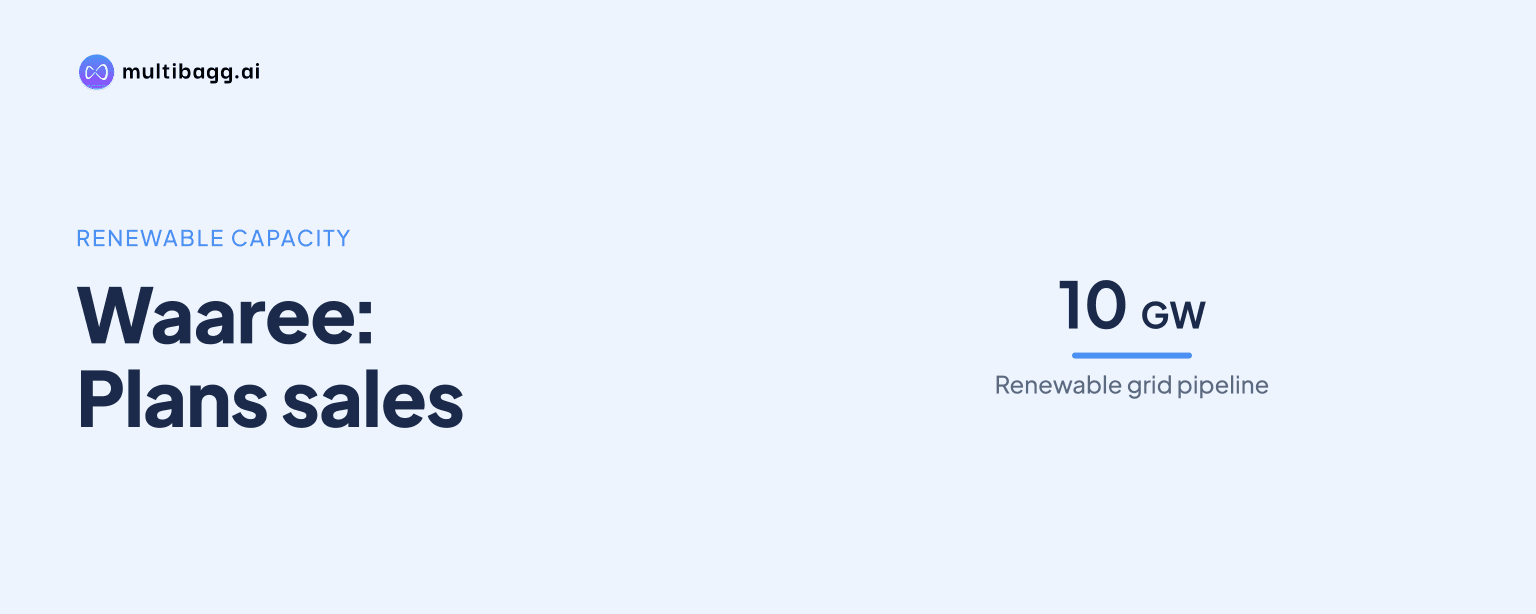
In its earnings call, Waaree said it had secured more than 10 gigawatts (GW) of renewable-project connectivity and about 2 GW of power purchase agreements (PPAs), while management plans to sell completed assets rather than hold them as long-term annuity investments. The model is intended to create equipment, engineering and construction revenue before project disposals.
Know Waaree Energies inside out
Results, valuation, peers and who's buying, in one view.
What is Waaree’s renewable power infrastructure strategy?
Waaree’s strategy is to develop renewable projects through land procurement, grid connectivity, equipment supply and engineering, procurement and construction (EPC), then transfer assets to institutional buyers at a mid-stage, after development or following commissioning. Management said the business addresses large commercial and industrial (C&I) customers, multinational companies, infrastructure funds and buyers that do not want to take initial land or connectivity risk.
The renewable power infrastructure unit is designed as a channel for Waaree’s wider manufacturing and services portfolio, rather than only as a power-generation owner. Management said its project offering can include equipment, EPC, transmission, transformers and operations and maintenance (O&M). That structure means a project can generate sales across multiple Waaree businesses during development and construction.
Management said Waaree is not building a portfolio of hold-to-maturity annuity assets. It expects to retain minority equity at most and may sell projects off its books after they are fully commissioned and have operated for a period. Management said an eventual sale could create capital gains in addition to the manufacturing and service opportunity created before transfer.
How large is Waaree’s renewable project pipeline?
Waaree reported more than 10 GW of connectivity and about 2 GW of PPAs, so its disclosed grid-access base is more than five times its contracted offtake base. The 2 GW PPA portfolio includes 0.7 GW of Firm and Dispatchable Renewable Energy (FDRE) PPAs with Solar Energy Corporation of India (SECI), alongside other highly rated PPAs received during the previous 18 to 24 months.
Waaree is also pursuing long-term procurement of 25,000 to 30,000 acres for these renewable projects. Management identified land and connectivity as development risks that prospective buyers may not be mandated to take. By arranging those inputs before a transaction, Waaree aims to offer mid-stage, post-development or shelf-ready projects to funds and institutions.
The difference between more than 10 GW of connectivity and about 2 GW of PPAs indicates that the disclosed development platform extends beyond the projects with contracted offtake. The call did not specify how much of the connectivity is allocated to individual projects, nor did it provide commissioning dates for the 2 GW of PPAs. Management’s disclosures nevertheless show that grid access is being secured ahead of full PPA conversion.
Why does Waaree intend to sell renewable projects?
Waaree intends to sell renewable projects because management sees demand from infrastructure funds, Infrastructure Investment Trusts (InvITs) and institutions seeking operating or advanced-stage assets without greenfield development exposure. Management said it was already discussing transfers of energy-storage and FDRE assets with clients, with Waaree continuing as a turnkey solution provider.
An analyst described the expected sequence as building projects linked to the roughly 2 GW of PPAs, seeking acquirers during construction, operating a plant if no buyer is available at commissioning, and transferring it later. Management confirmed that description. It added that it had identified clients with whom it was discussing asset handovers at a premium, but did not disclose buyer identities, sales prices or transaction dates.
The model can leave Waaree involved in a project without requiring permanent full ownership. Management said buyers are looking for a partner to manage land, connectivity, EPC, equipment supply, O&M and project timelines. For Waaree, the stated benefit is equipment and service revenue before a project sale, while the buyer receives a developed or commissioned asset.
Got a follow-up? Ask IRIS
What capital has Waaree committed to renewable infrastructure?
Waaree said it had committed about Rs 3,250 crore to the renewable power infrastructure business. In a later discussion, management referred to a Rs 3,200 crore renewable-infrastructure commitment that includes annuity-type assets. The call did not reconcile the Rs 50 crore difference, so the disclosed allocation is an approximate range rather than a single confirmed figure.
Management said the Rs 3,200 crore renewable-infrastructure commitment includes potential data-centre-related power assets and is not incremental to them. It described three capital-allocation categories in its presentation: deployed capital, capital under deployment and capital in planning. Management also said cash and liquid investments as of September 26 were almost sufficient for all facilities then under construction.
The wider four-to-five-year plan includes renewable development alongside module manufacturing, EPC, battery energy storage, transformers, inverters and electrolyzers. Management said solar could account for about 45% of the business over that period, while non-solar activities could contribute about 50%. It said revenue of Rs 90,000 crore to Rs 1 lakh crore could be reached using approximately 20 GW of module production and assumed utilisation of about 75%, including potential contributions from new businesses and acquisitions.
How does Waaree’s project model support other businesses?
Waaree’s renewable projects can support its equipment and EPC businesses because each development requires modules, transmission equipment, transformers and construction services. Management described the renewable infrastructure business as a source of channel sales for Waaree, rather than a standalone effort to accumulate operating generation assets. The approach is particularly relevant to clients that want a single supplier across development and delivery.
Management said FDRE and energy-storage projects are among the assets being discussed with potential acquirers. These projects combine renewable generation with storage or dispatchability requirements, which can require a broader supply package than a conventional solar project. Waaree’s stated plan is to supply that package as a turnkey provider and then retain minority equity at most after a transfer.
The sales model also fits management’s view that large financial platforms want control over land, connectivity, quality and commissioning timelines without conducting initial development themselves. Waaree said prospective buyers include sovereign funds, private-equity funds, InvITs and annuity-income platforms. The call did not disclose the number of projects being marketed or any binding project-sale agreement.
Conclusion
Waaree’s renewable infrastructure strategy prioritises development, equipment supply and EPC delivery over permanent asset ownership. More than 10 GW of connectivity, about 2 GW of PPAs and planned procurement of 25,000 to 30,000 acres provide the development base, while management expects asset transfers to add potential capital gains to manufacturing and services revenue.
The next disclosures to watch are conversion of the 2 GW PPA portfolio into construction and commissioning, the outcome of discussions with funds and institutions over asset sales, and clarification of the approximately Rs 3,200 crore to Rs 3,250 crore capital commitment. Management has not disclosed transaction values, buyer names or timelines for completed-project sales.