










Waaree Removes 3 GW US Export Orders as Section 232 Resets
Key highlights
- Waaree removed more than 3 GW of at-risk US export orders from its reported order book.
- Waaree's reported order book was around Rs 59,200 crore as of October 26, 2026.
- Exports from India declined to 7.8% of Waaree's order book from around 24% in the prior quarter.
- Waaree management expects US realization to rise from 26-27 cents per Wp to around 30-35 cents or more.
powered by IRIS
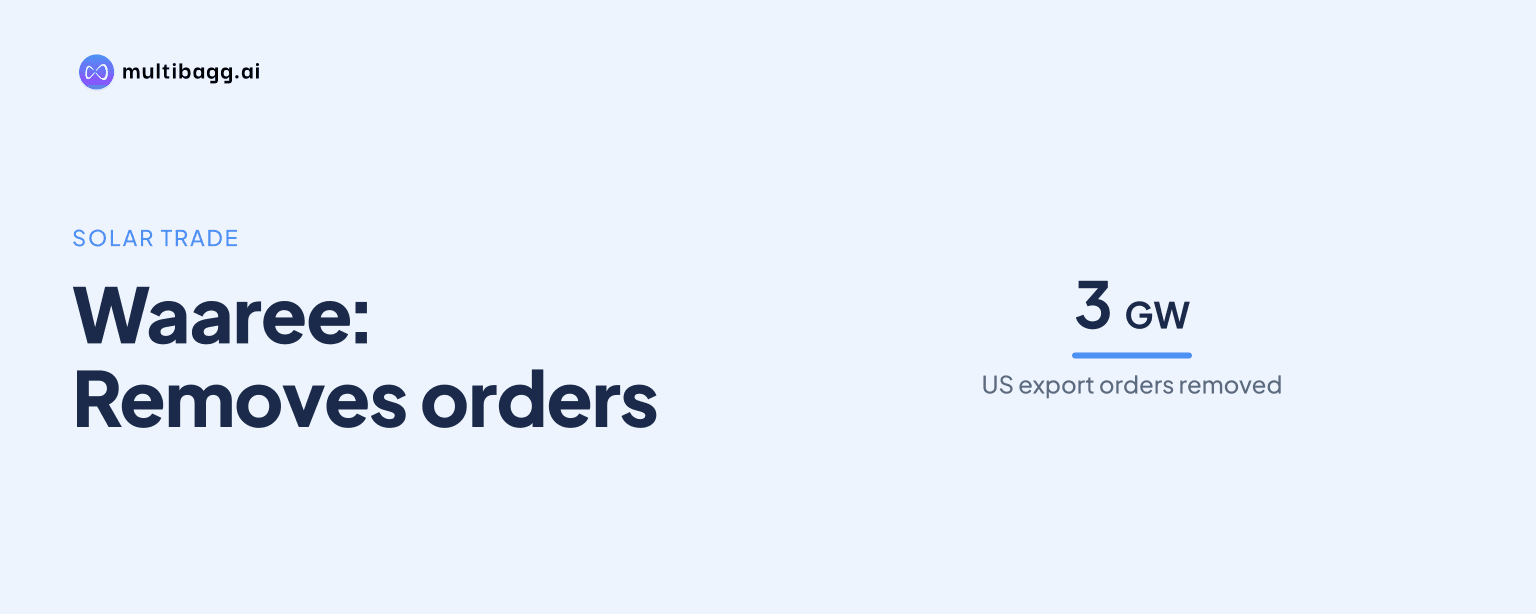
Waaree Energies Limited removed more than 3 GW of US export orders from its reported book in Q2 FY27 because Section 232 changed US import pricing, while its total order book remained around Rs 59,200 crore as of October 26, 2026. Management said new US negotiations could lift realization from 26-27 cents per watt peak to 30-35 cents or more.
Know Waaree Energies inside out
Results, valuation, peers and who's buying, in one view.
Why did Waaree remove more than 3 GW of US export orders?
Waaree removed more than 3 GW of export orders from its reported book because management saw a high risk of renegotiation or cancellation after the US Section 232 change. The company said the underlying contracts had not necessarily been terminated or formally closed, but it stopped reporting orders exposed to that risk as a fair disclosure and without assuming liability under those agreements.
The trigger was the minimum import price, or MIP, applicable to panels imported into the US from December 4. Waaree said it dispatched shipments that could reach US shores before that date, while shipments arriving later would need MIP compliance and price adjustments. The reporting reset therefore concerned exports from India, rather than modules manufactured and sold within the US.
Waaree said the lower export share did not reduce the reported order book below its prior broad range, with the total at around Rs 59,200 crore and the module order book at 25.6 gigawatt as of October 26, 2026. The company presented the change as a prudent reassessment of contracts affected by the import regime, rather than a statement that all removed orders had been cancelled.
How does Section 232 change Waaree's US pricing?
Section 232 gives Waaree a defined framework for renegotiating US contracts because management said imported panels would be priced at 38 cents plus 15% duty after December 4. It also cited a 22-cent cell price plus 15% duty, wafer pricing of around 14-15 cents plus 3% duty, and polysilicon at around $21 plus 15% duty.
Management said the framework could raise Waaree's US realization from 26-27 cents per watt peak, or Wp, to around 30 cents and potentially 35 cents or more. This is management's expectation from customer discussions, rather than a reported realization or formal financial target, and it includes talks with customers whose export orders were removed from the reported book.
Waaree also said the clarified import structure could improve the longevity of US orders and reduce supply and geographic risks. That view reflects a potential shift toward modules manufactured at its US facilities, which are not exposed to the import-price mechanism that prompted the removal of India-export contracts.
Got a follow-up? Ask IRIS
What US business remains after Waaree's order-book reset?
Waaree said the export-related orders it retained mainly cover dispatched modules for which revenue remains unrecognised until delivery occurs in the US. Management said these shipments are being renegotiated into MIP-workable contracts, meaning revenue recognition and final terms remain dependent on delivery and customer agreement.
Domestic US orders made up 43.8% of Waaree's reported order book on October 26, compared with 7.8% for exports from India and 48.4% for domestic India. In Q2 FY27, overseas revenue declined to Rs 1,389 crore from Rs 2,875 crore a year earlier, but US domestic revenue increased to Rs 1,300 crore from Rs 732 crore as exports from India fell to Rs 89 crore from Rs 2,143 crore.
Waaree had 1.6 GW of installed US module capacity, and US production reached 0.3 GW in H1 FY27, representing annualised utilisation of 71%. It is adding 3.2 GW at the Brookshire factory, with two lines under trial production by March FY27, including 1.6 GW expected to become operational in Q3 FY27, taking planned US photovoltaic, or PV, manufacturing capacity to 4.8 GW.
Management contrasted export economics with local US manufacturing during the call. It said India-made module exports generate earnings before interest, tax, depreciation and amortisation, or EBITDA, of about 3-4 cents per Wp, while US-made modules at utilisation above 70% generate 2-3 cents of operating margin plus a 7-cent incentive, or about 8-9 cents per Wp overall.
How does the US reset fit Waaree's FY27 earnings plan?
Waaree reaffirmed FY27 operating EBITDA guidance of Rs 7,000 crore to Rs 7,700 crore after removing more than 3 GW of export orders from the reported book. H1 FY27 operating EBITDA rose 15.5% year on year to Rs 2,775.1 crore, while revenue increased 47.3% to Rs 15,449.5 crore and profit after tax was Rs 1,645.5 crore, compared with Rs 1,651.1 crore a year earlier.
Management expects H2 FY27 to contribute about 55% to 60% of its full-year EBITDA guidance, making planned capacity additions important to delivery. It said 5 GW of new Indian cell capacity is expected in Q3 FY27 and another 5 GW in Q4 FY27, while 1.6 GW of additional US module capacity is expected in Q3 FY27 and a further 1.6 GW in the following quarter.
The company cited retail as another contributor to the FY27 plan, reporting H1 retail revenue of Rs 5,753 crore, nearly twice the prior-year level and 37% of total revenue. Management said it is targeting Rs 10,000 crore to Rs 11,000 crore of FY27 retail revenue through more than 775 retail channels and more than 3,000 associated distribution points.
Management also linked the US expansion to its broader capital-expenditure programme of around Rs 30,000 crore, of which 35% had been deployed, 28% was under execution and 37% was in planning. By FY28, Waaree said it expects to have 29 GW of solar PV capacity, 15.4 GW of cell capacity, 5 gigawatt-hour of battery energy-storage pack and container capacity, and 3.5 gigawatt-hour of battery-cell capacity.
Conclusion
Waaree's removal of more than 3 GW of US export orders was a reporting response to contracts exposed to Section 232 pricing changes, not confirmation that every affected agreement had been cancelled. The revised reported mix favours domestic India and domestic US orders, while management expects MIP-based negotiations and US manufacturing to support higher US realization.
The next disclosures to watch are the December 4 MIP transition, the conversion of dispatched but unrecognised exports into workable contracts, and the Q3 FY27 commissioning of 1.6 GW of additional US module capacity. Management also plans to bring 5 GW of Indian cell capacity online in Q3 FY27 and another 5 GW in Q4 FY27, while expecting H2 FY27 to provide 55% to 60% of full-year EBITDA guidance.