










Waaree US-made modules more than double India export margins
Key highlights
- Waaree said US-made modules can generate 8-9 cents of EBITDA per watt, versus 3-4 cents for exports from India.
- Waaree's US module-factory utilisation rose from 60% in the first quarter to more than 70% in the second quarter.
- Waaree expects 1.6 gigawatts of additional US capacity in the current quarter and another 1.6 gigawatts in the next quarter.
- Waaree expects the second half to contribute 55-60% of its Rs 7,000 crore to Rs 7,700 crore EBITDA guidance.
powered by IRIS
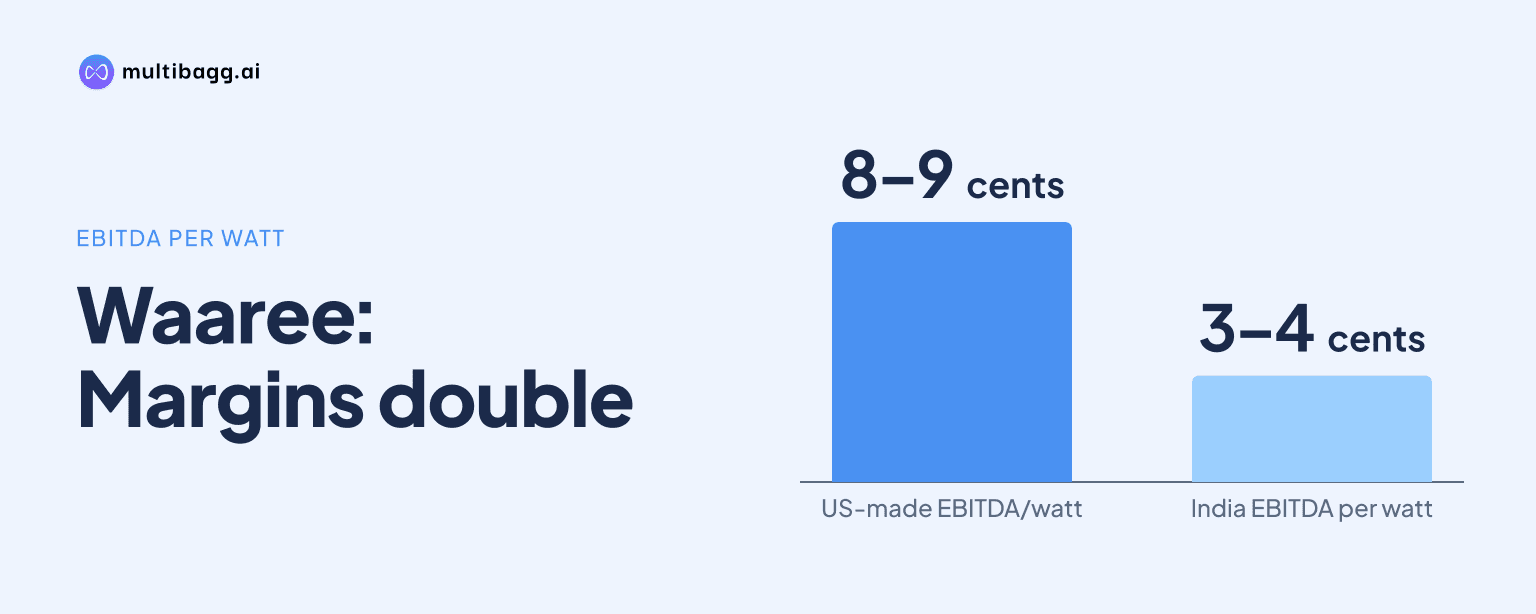
At its earnings call, Waaree said United States (US)-manufactured and US-sold solar modules can generate 8-9 cents of earnings before interest, tax, depreciation and amortisation (EBITDA) per watt at more than 70% utilisation, compared with 3-4 cents per watt for exports from India, because the US model includes a 7-cent-per-watt incentive.
Know Waaree Energies inside out
Results, valuation, peers and who's buying, in one view.
Why are Waaree's US module margins higher than India export margins?
Waaree said its US-made modules produce more than double the EBITDA margin of India-to-US module exports once incentives are included. Management put the broad EBITDA range for modules exported from India at 3-4 cents per watt, while local US manufacturing generated 2-3 cents per watt of operating margin at utilisation above 70%, plus an underlying 7 cents per watt of incentive-related margin.
That combination gives an overall US-business EBITDA range of 8-9 cents per watt, according to management. The comparison is important because the 7-cent component is tied to every watt peak supplied in the US, rather than being described as a separate, one-time gain. Management said the existing US facility had already crossed the 70% utilisation mark and that operating leverage from the facility and new capacity at the same location was giving positive signals.
Waaree also confirmed that the reported numbers included Inflation Reduction Act (IRA) cash incentives. Management said it books IRA incentives against dispatches and sells the related IRA credits at various stages to other customers. This means the cited US margin range reflects both factory operating performance and the incentive structure that management described as central to its US business model.
How is Waaree expanding US module output?
Waaree said it had almost 4.8 gigawatts of ready US capacity at scale, supported by significant orders and offtake agreements. In the second quarter, its US facility supplied about 400 megawatts, of which roughly 300 megawatts were self-manufactured and more than 100 megawatts were purchased from other original equipment manufacturers.
Management said US module-factory utilisation rose from 60% in the first quarter to more than 70% in the second quarter. It expects an additional 1.6 gigawatts of US capacity to go live in the current quarter and another 1.6 gigawatts in the next quarter, which it said should support both supply volumes and margins over the next two quarters.
The company separately said it expects significant scale in its US business in financial year 2028, or FY28. Management described return on invested capital in the US business as “very, very good,” but did not provide a return-on-invested-capital percentage, a US revenue target or a specific US EBITDA target for FY28.
What changed in Waaree's second-quarter EBITDA margin?
Waaree said the reported EBITDA margin declined sequentially to 17.8% in the second quarter from 18.2% in the first quarter, mainly because the first quarter included a larger US-duty refund effect. The cumulative refund cited by an analyst rose from Rs 349 crore in the first quarter to Rs 360.4 crore in the second quarter, implying Rs 11.4 crore was recognised during the second quarter, which management confirmed.
Management said that, excluding the refund income, underlying EBITDA margin improved sequentially. It attributed that change to cell output rising from about 800 megawatts in the prior quarter to more than 1.1 gigawatts in the second quarter, along with US module-factory utilisation moving above 70% from 60%.
Waaree said existing cell capacity operated at about 81% in the second quarter and had already moved above 90% after the quarter. Management expects the remaining 9-10 percentage points of improvement at existing facilities to add more than 100 megawatts of cell output in the current quarter. It also said 5 gigawatts of new India cell capacity would go live in the current quarter and another 5 gigawatts in the following quarter.
Got a follow-up? Ask IRIS
What could support Waaree's margin profile over the next two quarters?
Waaree identified higher cell utilisation, 10 gigawatts of new India cell capacity and added US module capacity as the three stated drivers of margins over the next two quarters. Management said the India cell expansion should allow greater use of its own domestically manufactured Domestic Content Requirement (DCR) cells rather than purchasing DCR cells in the market for DCR module production.
Management said the new 10-gigawatt India cell facility would need time to ramp up, but expected the first 5 gigawatts going live in the current quarter to provide reasonable volume in the fourth quarter. It said module utilisation would be higher than cell utilisation in the fourth quarter, while the new cell facilities could run at roughly 30-40% utilisation.
The company reiterated EBITDA guidance of Rs 7,000 crore to Rs 7,700 crore and said it expects the second half to contribute 55-60% of that total. Management characterised both the third and fourth quarters as loaded, with the fourth quarter expected to be particularly heavy as India cells and US modules add supply.
What pricing and policy factors could affect Waaree's outlook?
Waaree said a six-month policy extension and resulting supply-chain replanning reduced domestic module utilisation to 45% during the quarter. Management said the shift delayed the planned mix of non-DCR supplies, but expects volumes to rise over the following four to five months and further increase in the third quarter before the extension closes.
Management also expects domestic module price correction in FY28 as solar-cell capacity rises from close to 40 gigawatts to about 60 gigawatts over the next two quarters. It cited current DCR utility spot pricing of 20-21 cents and retail pricing of 23-24 cents, while forward pricing for the next year was 17.5-18.5 cents for utility and 20-21 cents for retail.
On supply-chain risk, Waaree said it had secured equipment for cells and batteries and had also secured ingot-wafer orders, so management saw no impact from the China technology-transfer concern raised by an analyst. The company said its 10-gigawatt ingot and wafer facility was under construction and envisaged commercial production from around September 2027.
Conclusion
Waaree's disclosed economics place US local manufacturing at the centre of its near-term margin plan: 8-9 cents per watt of EBITDA including incentives compares with 3-4 cents for India exports. The higher US margin, rising factory utilisation and the rollout of US and India capacity explain why management expects the second half to account for 55-60% of its Rs 7,000 crore to Rs 7,700 crore EBITDA guidance.
The next items to watch are the ramp-up of 1.6 gigawatts of US capacity in the current quarter and another 1.6 gigawatts in the next, alongside the first 5 gigawatts of new India cell capacity. Management also expects price corrections in FY28 and plans commercial production at its 10-gigawatt ingot and wafer facility around September 2027, leaving execution and utilisation as the key disclosed variables.