










WAAREE expects non-module revenue share to reach 40%-45%
Key highlights
- WAAREE expects newer businesses to contribute 40%-45% of revenue within two to three years, versus 15%-20% recently.
- Solar modules accounted for around 95%-96% of WAAREE revenue a few years ago and around 80%-85% recently.
- WAAREE plans around Rs 30,000 crore of investment across newer verticals over 2.5 years.
- WAAREE expects its BESS cell line to produce its first cell in Q4 and operate commercially in FY '28.
powered by IRIS
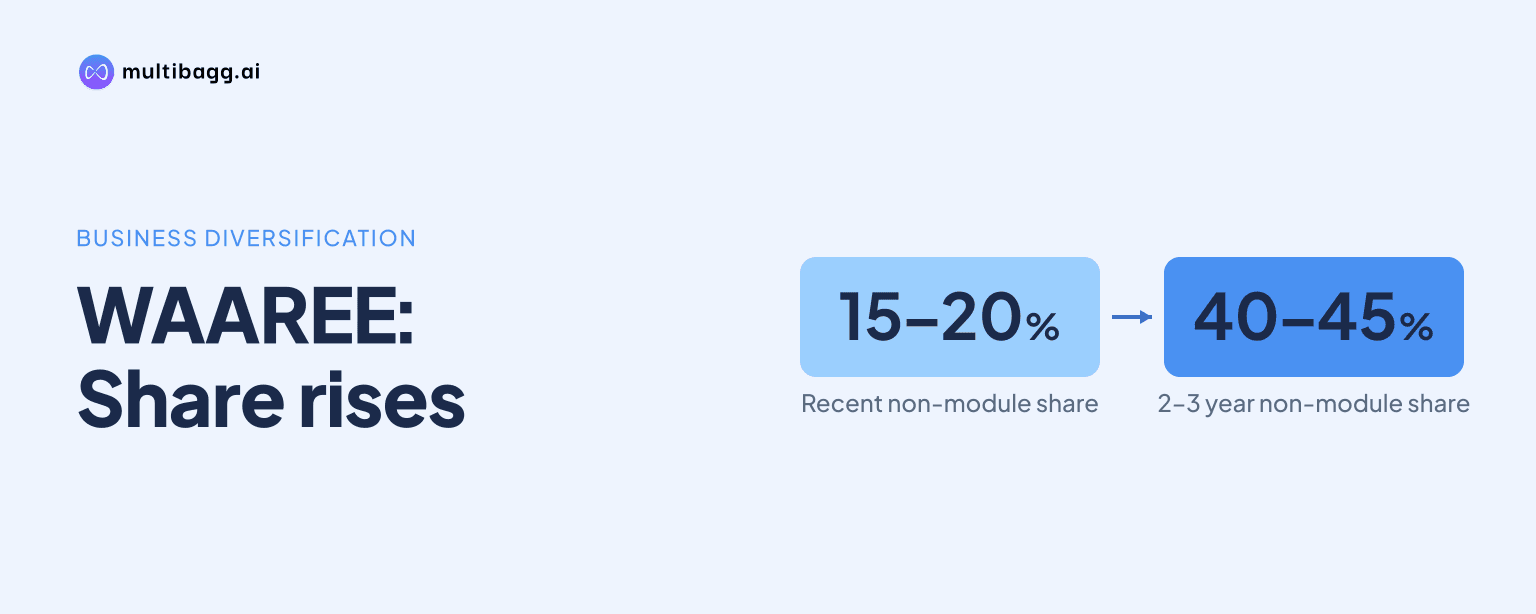
WAAREE expects businesses outside its core solar-module operation to contribute 40%-45% of revenue within two to three years, compared with 15%-20% recently. Management linked the planned mix change to around Rs 30,000 crore of investment over 2.5 years in battery storage, engineering, procurement and construction, transmission and distribution, transformers, inverters and electrolyzers.
Know Waaree Energies inside out
Results, valuation, peers and who's buying, in one view.
How much revenue could WAAREE's newer businesses contribute?
WAAREE expects its newer businesses to account for around 40%-45% of revenue over the next two to three years, according to management. The current contribution is around 15%-20%, while battery energy storage systems, or BESS, are expected to be the predominant component, supported by engineering, procurement and construction, or EPC, and transmission and distribution, or T&D, businesses.
Solar panel modules accounted for around 95%-96% of WAAREE revenue a few years ago and about 80%-85% recently. Management indicated that pure-play solar could represent 50%-60% of revenue in the longer range, even as its absolute solar revenue rises through greater production volumes at Indian and US facilities.
Management did not provide a separate FY '28 revenue target for BESS, EPC, T&D, transformers, inverters or electrolyzers. The 40%-45% range is therefore a directional portfolio indication rather than formal guidance for an individual segment or product line.
Which businesses are expected to drive WAAREE's revenue mix change?
WAAREE expects BESS to be the largest contributor to the newer-business mix, alongside EPC, T&D, transformers, inverters and electrolyzers. Management said it is investing around Rs 30,000 crore across these newer verticals over 2.5 years, with most investments expected to start contributing revenue and profit from Q1 FY '28.
The BESS cell facility is expected to produce its first cell in Q4 of the current year and operate commercially during FY '28. WAAREE said its order book already includes some energy-storage product supply, while discussions with customers in India and overseas cover energy-storage container packs and exports of cells from the planned facility.
EPC and T&D provide another route to a broader revenue base, although their margin profiles differ from module manufacturing. Management said the listed subsidiary's standalone EPC operation has EBITDA, or earnings before interest, tax, depreciation and amortisation, of around 17%-18%, while the acquired T&D business generally records 10%-11%; the blended range was described as 14%-15%.
Management said T&D projects can create larger and more concentrated order books for the subsidiary than EPC alone. That mechanism matters to the mix target because the planned portfolio includes equipment supply, EPC execution and grid-related work rather than only sales of solar panels.
When will WAAREE's new capacity begin contributing?
WAAREE expects most investments relevant to the new-business portfolio to begin adding revenue and profit from Q1 FY '28. The BESS line has an earlier operational milestone, with first-cell output expected in Q4 of the current year, but management expects commercial production to continue through FY '28.
The expansion of Indian cell capacity is scheduled in two 5-gigawatt stages, with the first 5 gigawatts due in Q3 of the current year and a further 5 gigawatts in the following quarter. Management said the first phase should generate reasonable volumes in Q4, although the new cell capacity will require time to ramp up and could operate at around 30%-40% utilisation in Q4.
WAAREE is also adding US module capacity while it develops the newer lines. Management said 1.6 gigawatts of US module capacity would go live in the current quarter and another 1.6 gigawatts in the next quarter, adding to almost 4.8 gigawatts of ready US capacity at scale.
The US operation supplied around 400 megawatts in Q2, according to management. Of that total, roughly 300 megawatts were self-manufactured and more than 100 megawatts were sourced from other original equipment manufacturers, showing that internal manufacturing still represented most reported US supply in the quarter.
Got a follow-up? Ask IRIS
Why does WAAREE expect solar's revenue share to decline?
WAAREE expects solar's percentage of revenue to decline because newer businesses are intended to grow faster, not because solar sales are expected to fall. Management said solar modules represented around 80%-85% of revenue recently, down from 95%-96% a few years ago, and indicated a 50%-60% pure-play solar share over the next two to three years.
The company plans to retain solar expansion through higher utilisation of both Indian and US facilities. Management said existing Indian cell capacity operated at around 81% in Q2 and had already reached more than 90% utilisation after the quarter, creating scope for a further 9%-10% output improvement and more than 100 megawatts of additional cells in the current quarter.
US manufacturing is also central to the continuing solar business. Management said modules made and sold in the US at utilisation above 70% generate operating margin of around 2-3 cents per watt peak, plus around 7 cents per watt peak of incentive-related EBITDA, compared with around 3-4 cents per watt peak of EBITDA for exports from India.
Management attributed the US economics to the incentive available on domestic supply and said the existing facility had already crossed 70% utilisation. Those remarks concern the established solar operation, while the 40%-45% mix objective depends on BESS, EPC, T&D and associated equipment achieving faster revenue growth.
What could determine whether WAAREE reaches the 40%-45% mix target?
WAAREE's target depends on timely commissioning, BESS order conversion and execution of EPC and T&D projects. Management said it had secured equipment for its cell and battery facilities, and had also secured ingot-wafer equipment orders, stating that the China technology-transfer matter raised by an analyst would not affect those plans.
Some projects remain on longer schedules. Management expects commercial production from its 10-gigawatt ingot and wafer facility around September 2027, while its solar-glass facility near Navsari, Gujarat, is expected to go live in FY '29; around Rs 360 crore had been spent on the glass project, mainly on land acquisition, filling and related works.
The renewable power infrastructure business could provide an internal channel for modules, equipment, EPC, transmission and transformers. WAAREE said it had committed around Rs 3,250 crore to that business, secured connectivity of more than 10 gigawatts and obtained around 2 gigawatts of power-purchase agreements, including 700 megawatts of firm and dispatchable renewable-energy agreements with Solar Energy Corporation of India.
Management said it was procuring between 25,000 and 30,000 acres of land for these projects over the long term. The platform is intended to develop projects for customers and institutions that do not want to take early-stage land or connectivity risk, while creating opportunities to supply the wider WAAREE portfolio.
Conclusion
WAAREE is outlining a structural shift from a business led almost entirely by solar modules toward one in which BESS, EPC, T&D and related equipment could produce 40%-45% of revenue within two to three years. The shift rests on around Rs 30,000 crore of planned investment, commercialisation of battery capacity and the growth of project-led and grid-related activities, while solar capacity continues to expand in India and the US.
The next disclosed markers are first-cell output from the BESS facility in Q4, commercial BESS operations during FY '28 and management's expectation that most new investments will start contributing revenue and profit from Q1 FY '28. WAAREE also plans commercial production from its 10-gigawatt ingot and wafer plant around September 2027 and expects the solar-glass facility to go live in FY '29.