










Welspun Corp builds Saudi plant and holds Jordan contract
Key highlights
- Welspun Corp is building a Saudi DI-pipe plant capable of diameters up to 2,600 mm.
- Welspun Corp’s Jordan partnership has a firm 450-km Aqaba-Amman Water Desalination Project contract.
- Welspun Corp’s Saudi manufacturing platform occupies a 500,000-square-metre area near Dammam Port.
- Welspun Corp’s Perma-Pipe partnership covers manufacturing and coating for pipes from 24 inches to 120 inches.
powered by IRIS
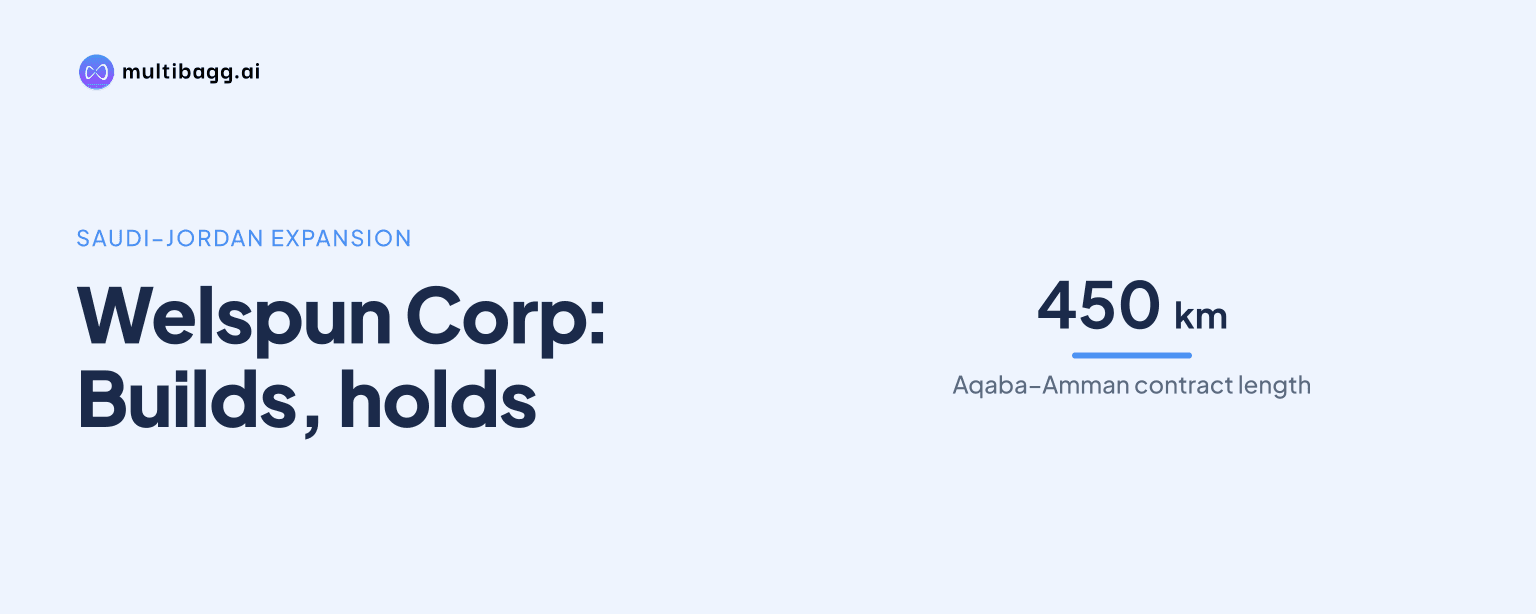
Welspun Corp is expanding its Middle East water-infrastructure presence through a Saudi ductile-iron pipe plant capable of making pipes up to 2,600 mm and a firm 450-km Aqaba-Amman desalination-pipeline contract in Jordan. The presentation positions the two initiatives alongside existing energy-pipe manufacturing and anti-corrosion coating capabilities.
Know Welspun Enterprises inside out
Results, valuation, peers and who's buying, in one view.
What is Welspun Corp building in Saudi Arabia?
Welspun Corp is building a greenfield ductile-iron, or DI, pipes facility in the Kingdom of Saudi Arabia, or KSA, after two decades of presence in the country. The presentation describes the planned facility as highly automated and modern, with pipe diameters of up to 2,600 mm, a size it says is available at very few plants worldwide.
Welspun Corp’s Saudi position already includes helical submerged arc welded, or HSAW, pipes through East Pipes Integrated Company for Industry, identified as EPIC, and longitudinal submerged arc welded, or LSAW, pipes. The DI-pipe facility adds a water-infrastructure product to a Saudi portfolio that the presentation otherwise links to energy pipelines, including deep-offshore LSAW capability.
Welspun Corp locates this manufacturing platform on a 500,000-square-metre area with proximity to Dammam Port. The presentation cites port and logistics advantages for exports, but does not disclose the DI plant’s annual capacity, construction cost, commissioning date or projected revenue contribution.
Why is Saudi Arabia part of Welspun Corp’s water strategy?
Saudi Arabia is part of Welspun Corp’s strategy because the presentation identifies water-infrastructure plans for urbanisation, DI-pipe import substitution and regional export opportunities. These demand themes sit alongside Vision 2030 and investment in oil and gas, indicating that the Saudi manufacturing base is intended to address both water networks and energy corridors.
The Saudi plan combines existing pipe production with a new product category. EPIC is described as a leading supplier to Saudi Aramco and as having the country’s largest HSAW capacity, while the new DI facility is being added after 20 years of Saudi presence. This changes the disclosed Saudi offering from welded energy-pipe products alone to include locally made DI pipes.
Dammam Port proximity supports the regional-export rationale, while the presentation’s map places KSA near markets including Jordan, Iraq, Kuwait, Qatar, the United Arab Emirates and Oman. Welspun Corp does not identify export volumes, destination-specific sales or production utilisation, so the export opportunity remains a stated plan rather than a quantified order pipeline.
The presentation distinguishes Saudi water potential from the disclosed Jordan project. In KSA, it refers to water plans, urbanisation and import substitution, whereas in Jordan it specifies a firm 450-km water contract. The difference is material because one disclosure describes prospective market demand and the other identifies a contract in hand.
What does Welspun Corp’s Jordan partnership with Perma-Pipe cover?
Welspun Corp’s partnership with Perma-Pipe covers integrated pipe manufacturing and anti-corrosion coating for pipe sizes from 24 inches to 120 inches. The presentation describes the arrangement as a strategic partnership offering high-grade steel pipes and tubular solutions engineered for regional water networks and energy corridors.
The partnership is positioned in Jordan as a neutral regional base with proximity to Europe and the Levant region. That role differs from the 500,000-square-metre Saudi manufacturing location near Dammam Port: Jordan is presented as a hub for integrated production and coating access, while KSA combines HSAW, LSAW and the planned DI-pipe plant.
Anti-corrosion coating is a defined part of the 24-inch-to-120-inch scope, alongside pipe manufacturing. Welspun Corp identifies oil-and-gas pipeline projects and water infrastructure as addressable applications, but the presentation does not disclose partnership ownership, manufacturing capacity, financial terms or a split of responsibilities between Welspun Corp and Perma-Pipe.
The Saudi and Jordan operations therefore have complementary disclosed roles. The Saudi project is a greenfield DI-pipe addition with 2,600-mm diameter capability, while the Jordan arrangement focuses on integrated steel-pipe manufacturing and coating from 24 inches to 120 inches. The presentation does not describe them as duplicate facilities.
Got a follow-up? Ask IRIS
What is Welspun Corp’s 450-km Aqaba-Amman contract?
Welspun Corp says its Jordan partnership has a firm contract for the 450-km Aqaba-Amman Water Desalination Project, which the presentation also calls the National Water Carrier Project. This is the most specific Middle East water-infrastructure contract disclosed in the supplied material because it gives a defined project length and names the project.
The 450-km contract aligns with the partnership’s stated scope of steel pipes and anti-corrosion coating for water networks. However, the presentation does not give the contract value, award date, execution period, pipe specifications, coating system, revenue-recognition schedule or the exact allocation of work between Welspun Corp and Perma-Pipe.
The project also provides a clearer order-linked data point than the Saudi demand discussion. Saudi Arabia is presented through water-infrastructure plans, DI-pipe import substitution and export potential, while Jordan has a named desalination-pipeline project with a firm 450-km contract. No comparable Saudi water-project length or order value is disclosed.
How does the Middle East position compare with Welspun Corp’s other markets?
Welspun Corp presents the Middle East expansion alongside distinct pipe-market opportunities in India and the United States. India’s listed demand drivers include river interlinking, interstate water sharing, sewage networks, the Jal Jeevan Mission, natural-gas pipelines and city gas distribution, while the Saudi and Jordan initiatives focus on water networks, energy corridors and regional exports.
In the United States, Welspun Corp states that it has about 1 million metric tonnes of capacity across HSAW, high-frequency induction welded, or HFIW, and LSAW pipes, covering outside diameters from 6 inches to 60 inches. The presentation says US capacity is booked until financial year 2029, or FY29, with visibility until 2032, unlike the Middle East pages, which provide no equivalent capacity-booking horizon.
The US operation occupies about 800 acres and is positioned near railroads and the Arkansas-Mississippi River, while the Saudi site spans 500,000 square metres near Dammam Port. Both disclosures emphasise logistics, but the Middle East material supplies a 450-km Jordan contract and a 2,600-mm Saudi DI-pipe capability rather than a stated order-book horizon or annual capacity figure.
Conclusion
Welspun Corp’s Middle East disclosures outline a two-part expansion: a Saudi DI-pipe plant with capacity for diameters up to 2,600 mm and a Jordan partnership with a firm 450-km desalination-pipeline contract. Together, they add water-infrastructure and coating exposure to the existing regional HSAW and LSAW pipe platform serving energy and offshore applications.
The next disclosures to watch are the Saudi greenfield plant’s commissioning, capacity and commercial output, since none is specified in the presentation. Execution details for the 450-km Aqaba-Amman project, including contract value, delivery timetable and scope allocation within the Perma-Pipe partnership, also remain unresolved in the supplied material.