










Welspun Living retains customers as H1 margin reaches 12.9%
Key highlights
- Welspun said zero customers were lost during a stated 50% US tariff challenge.
- Welspun reported EBITDA margin of 12.9% in H1 FY27, compared with 9.1% in FY26.
- Welspun reported free cash flow of Rs 1,059 crore in H1 FY27 and net cash of Rs 2 crore in September 2026.
- Welspun plans about Rs 3,200 crore of investment over the next 18 to 24 months.
powered by IRIS
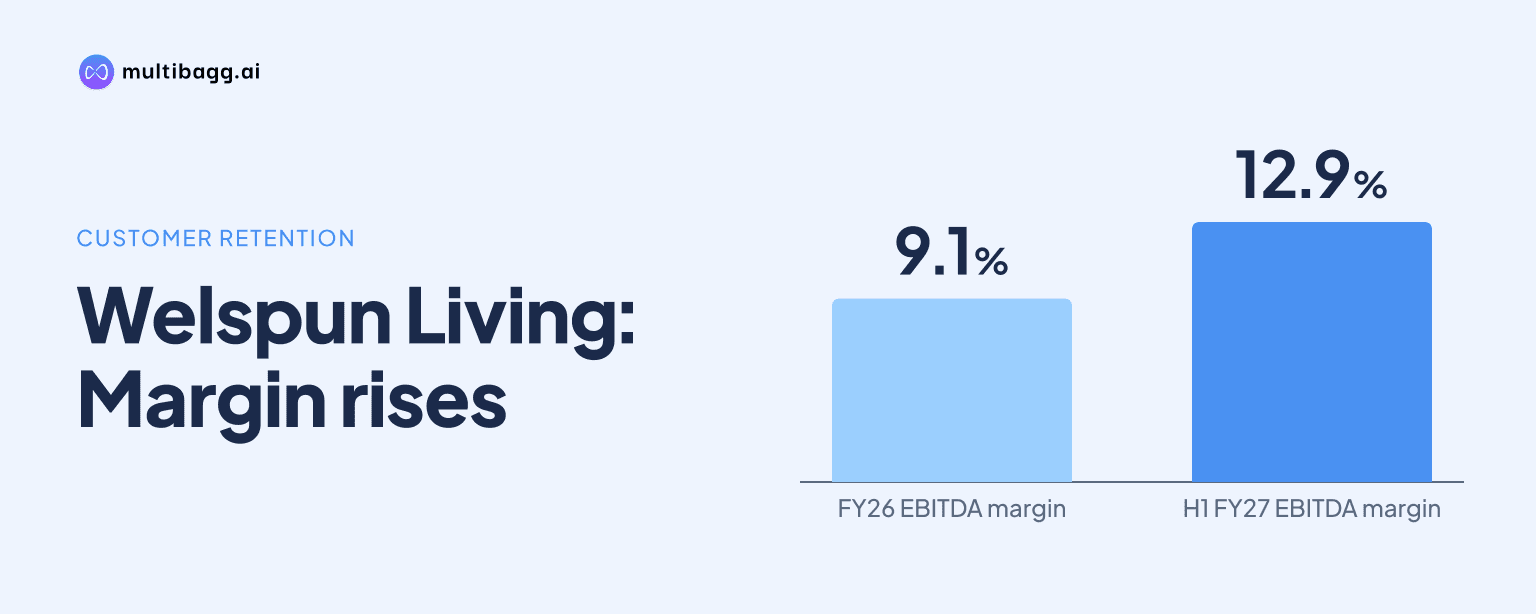
Welspun Living said it lost no customers during a stated 50% US tariff challenge and raised its earnings before interest, tax, depreciation and amortisation (EBITDA) margin to 12.9% in H1 FY27, from 9.1% in FY26. Welspun attributed the result to retailer cost-sharing, freight actions and long-term procurement positions.
Know Welspun Enterprises inside out
Results, valuation, peers and who's buying, in one view.
How did Welspun retain customers during US tariffs?
Welspun said zero customers were lost while its largest market faced a stated 50% US tariff challenge. The company said long-standing retailer relationships allowed it to share the tariff burden with customers, though the presentation does not disclose the size of the customer base, the terms of cost-sharing, or the revenue affected.
The US accounted for 59% of Welspun’s revenue in the regional mix shown, compared with 18% from the UK and European Union, 13% from India and 10% from the rest of the world. Welspun also describes itself as the number-one supplier of towels and bath rugs in the US and says one in five towels imported into the country is a Welspun towel.
A separate presentation table lists a 10% tariff for India and Pakistan, against 12.5% for Vietnam, China and Turkey, with Bangladesh also shown at 10%. Welspun does not explain how that country comparison relates to its separate statement about 50% US tariffs, including the products, dates or tariff mechanisms involved.
What did Welspun do to manage freight and input costs?
Welspun said it maintained on-time, in-full (OTIF) delivery above 98% amid volatile freight rates and disrupted shipping routes. Its disclosed actions were rerouting shipments, building inventory and locking in long-term freight contracts, rather than relying on a single logistics response.
For rising cotton and crude-linked input costs, Welspun cited long-term procurement positions and transparent customer pricing. The company linked these measures to the EBITDA-margin move from 9.1% in FY26 to 12.9% in H1 FY27, but did not assign a separate margin benefit to procurement, freight contracts or customer pricing.
Welspun operates five manufacturing locations, including three in India and two in the US. It identifies India’s position as the world’s number-two cotton producer as a sourcing advantage, while its bath, sleep and fashion bedding, flooring, and advanced-textiles businesses create exposure to multiple home-textile and industrial product categories.
How did Welspun’s financial position change?
Welspun reported EBITDA margin of 12.9% in H1 FY27, 3.8 percentage points above the 9.1% reported for FY26. This is not a like-for-like half-year comparison because the presentation compares a six-month period with a full financial year, but it is the profitability comparison disclosed by the company.
The presentation also reports a shorter cash conversion cycle, higher free cash flow and a move to net cash by September 2026. Free cash flow was Rs 1,059 crore in H1 FY27, compared with Rs 784 crore in FY23, while return on capital employed (RoCE) rose to 12.7% from 5.7% over those stated periods.
Net debt moved from Rs 1,534 crore in March 2026 to net cash of Rs 2 crore in September 2026, a Rs 1,536 crore change in position. Welspun does not provide a bridge for that movement, although the presentation places the September net-cash figure alongside H1 FY27 free cash flow of Rs 1,059 crore and a 44-day cash conversion cycle.
Got a follow-up? Ask IRIS
What tariff and trade opportunities has Welspun identified?
Welspun identifies more than 50 free-trade agreements (FTAs) as under discussion, mostly involving zero duty on home textiles. Its presentation lists the UK agreement as in force from July 2026, the Australia Economic Cooperation and Trade Agreement as in force since December 2022, and the New Zealand agreement as in force after its December 2025 conclusion.
The European Union FTA is shown as concluded and expected to become live around early 2027, while a US bilateral trade agreement remains under discussion. Welspun says India seeks tariff parity in the US discussions, but the deck supplies no target tariff rate, timetable for an agreement or financial estimate of any benefit.
The company’s UK exposure was 18% of revenue and its rest-of-world exposure was 10%, compared with the 59% US share. In towels, Welspun says it is the number-one exporter from India to the UK; in bedding, it says it is the number-two exporter of bed sheets to the US, illustrating the product categories connected to its trade discussion.
What investment and financial targets has Welspun disclosed?
Welspun plans about Rs 3,200 crore of investment over the next 18 to 24 months, split into about Rs 1,600 crore for terry-towel capacity and about Rs 1,600 crore for spinning and weaving integration. The towel programme is intended to increase capacity by about 30% to about 130,000 metric tonnes.
Management says backward integration could produce a 200 to 300 basis-point EBITDA uplift by reducing input-yarn costs. It also says demand from existing retailers is already in place and that an research and development centre will support product innovation and value-added capabilities; these are management expectations rather than reported outcomes.
For FY27E, Welspun projects revenue of about Rs 11,000 crore and EBITDA margin of about 13%, against Rs 8,215 crore of revenue and a 10.6% margin in FY23. Its medium-term aspiration is 15% compound annual revenue growth, EBITDA margin and RoCE of 15% to 16%, net debt to EBITDA of up to 1x, and a 55- to 60-day cash conversion cycle.
Conclusion
Welspun’s disclosures combine a zero-customer-loss claim during a stated 50% US tariff challenge with a reported EBITDA-margin increase to 12.9% in H1 FY27. Freight measures supported OTIF above 98%, while procurement positions and customer pricing were cited as responses to cotton and crude-linked costs; free cash flow reached Rs 1,059 crore in H1 FY27.
The next items to watch are the planned Rs 3,200 crore investment over 18 to 24 months, the targeted 30% expansion of terry-towel capacity to about 130,000 metric tonnes, and management’s FY27E revenue target of about Rs 11,000 crore. Further clarification would also be needed on the different 50% and 10% US tariff references in the presentation, which it does not reconcile.