










Welspun Living Plans Rs 3,200 Crore Capex for 30% Towel Growth
Key highlights
- Welspun Living plans Rs 3,200 crore of capital expenditure over the next 18–24 months.
- About Rs 1,600 crore is allocated to a 30% terry-towel capacity expansion to about 130,000 metric tonnes.
- Management expects spinning and weaving integration to add 200–300 basis points to EBITDA margin.
- Welspun Living reported net cash of Rs 2 crore in September 2026, compared with net debt of Rs 1,534 crore in March 2026.
powered by IRIS
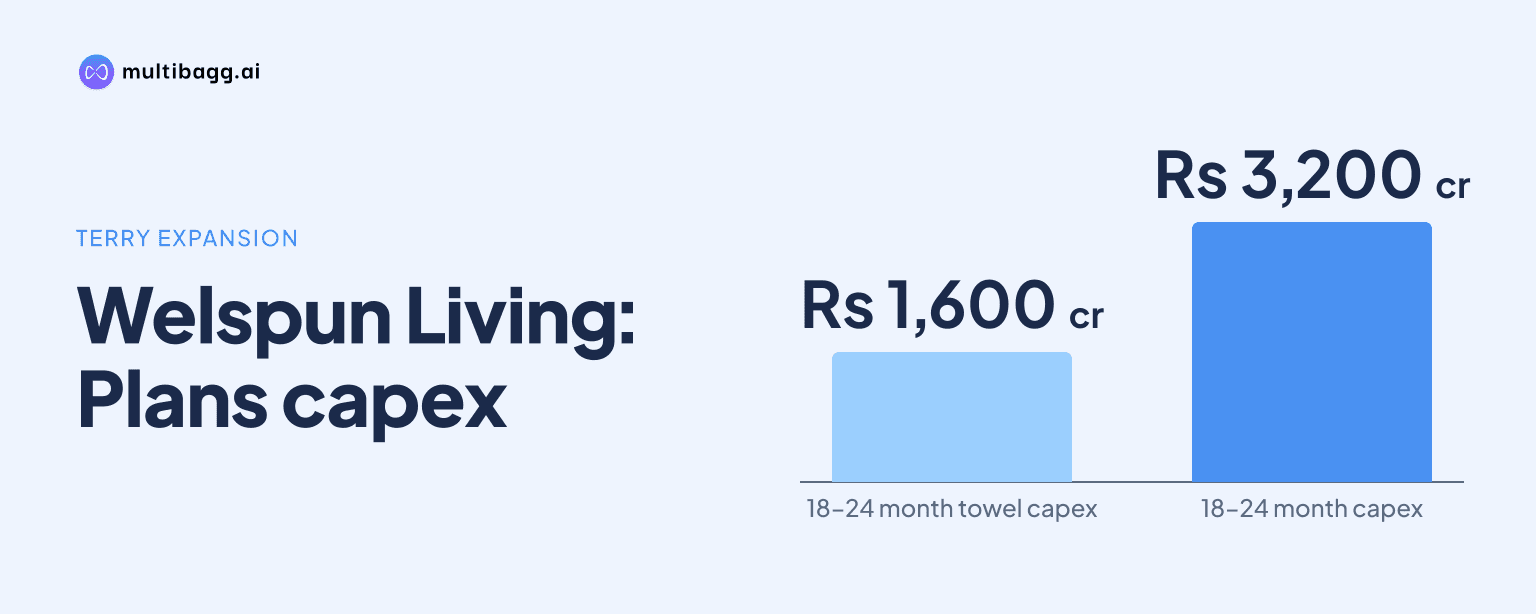
Welspun Living plans Rs 3,200 crore of capital expenditure over the next 18–24 months, comprising a 30% expansion in terry-towel capacity to about 130,000 metric tonnes and Rs 1,600 crore for spinning and weaving integration. Management expects lower yarn costs from integration to lift earnings before interest, tax, depreciation and amortisation, or EBITDA, margin by 200–300 basis points.
Know Welspun Enterprises inside out
Results, valuation, peers and who's buying, in one view.
What is Welspun Living investing Rs 3,200 crore in?
Welspun Living is dividing the planned Rs 3,200 crore investment equally between terry-towel expansion and backward integration into spinning and weaving. About Rs 1,600 crore is allocated to each component, with execution planned over the next 18–24 months. The presentation frames this as a future investment programme rather than capital expenditure already incurred.
The towel project is intended to create room for incremental growth, with Welspun Living stating that demand from existing retailers is already in place. The company also plans to invest in a research and development centre for product innovation and value-added capabilities. It does not disclose a separate budget, commissioning date or location for the research and development centre.
How much will Welspun Living’s towel capacity increase?
Welspun Living plans to raise terry-towel capacity by about 30% to about 130,000 metric tonnes. Management describes the resulting capacity as the largest in the world. The presentation provides the planned end-capacity figure but does not separately state current capacity in metric tonnes.
The capacity addition is linked to Welspun Living’s priority of expanding its total addressable market in core categories. Its plan includes growing United States share in bath and bedding and using free-trade-agreement access to scale in other geographies. The material does not provide retailer-wise capacity commitments, utilisation targets or a market-by-market allocation for the additional output.
The expansion follows a period in which Welspun Living cited a 50% United States tariff on its largest market as a challenge. It said its retailer relationships enabled tariff costs to be shared with customers and reported zero customers lost. The presentation does not quantify the tariff cost, explain the effect on the Rs 3,200 crore budget or disclose the expected return on the towel project.
Why is Welspun Living adding spinning and weaving capacity?
Welspun Living is adding spinning and weaving capacity to lower yarn-input costs and reduce reliance on outsourcing partners. Management estimates that backward integration can add 200–300 basis points to EBITDA margin, equivalent to 2–3 percentage points. This is a projected benefit from the planned facilities, not a margin result reported from completed integration.
The company also expects internal spinning and weaving to support faster lead times, a more efficient and reliable supply chain, and improved compliance. Welspun Living cites India’s position as the world’s number-two cotton producer and its integrated manufacturing model as sourcing advantages. It does not disclose the proportion of yarn currently sourced externally or the expected internal yarn production after the investment.
Input costs are relevant because Welspun Living identifies higher cotton and crude-linked costs as a recent operating challenge. It said long-term procurement positions and transparent customer pricing helped its response. EBITDA margin rose from 9.1% in FY26 to 12.9% in H1 FY27, a 3.8-percentage-point increase, while the 200–300-basis-point integration estimate is a separate future expectation.
Got a follow-up? Ask IRIS
How does the capex programme fit Welspun Living’s targets?
Welspun Living’s investment programme sits alongside its FY27E revenue estimate of about Rs 11,000 crore and EBITDA-margin estimate of about 13%. FY27E means the company’s estimate for financial year 2027. These compare with FY23 revenue of Rs 8,215 crore and an EBITDA margin of 10.6%, indicating higher projected revenue and margin over the period.
The FY27E revenue estimate is about Rs 2,785 crore above FY23 revenue, while the indicated EBITDA margin is about 2.4 percentage points higher. Welspun Living does not break the FY27E estimate into towels, spinning, weaving, global brands, hospitality, India business or flooring. The presentation therefore does not support attributing a defined share of FY27E revenue to the proposed projects.
For the medium term, Welspun Living aims to maintain net debt to EBITDA at up to 1x and a cash conversion cycle of 55–60 days. Net debt to EBITDA compares debt with EBITDA, while cash conversion cycle measures the time working capital remains tied up. These are management’s stated financial parameters while it undertakes the planned capital expenditure.
What financial position and growth plans accompany the investment?
Welspun Living reported net cash of Rs 2 crore in September 2026, compared with net debt of Rs 1,534 crore in March 2026. It also reported free cash flow of Rs 1,059 crore in H1 FY27, compared with Rs 784 crore in FY23. The presentation does not disclose how the Rs 3,200 crore programme will be split between internal cash, borrowings or any other funding source.
Its cash conversion cycle fell from 93 days in FY23 to 44 days in H1 FY27, while return on capital employed, or RoCE, rose from 5.7% to 12.7%. The company’s medium-term cash-conversion-cycle range of 55–60 days is above the H1 FY27 outcome but below the FY23 level. Its medium-term RoCE objective is 15–16%, compared with a low-teen FY27E indication.
Beyond core towels and bedding, Welspun Living targets more than 20% compound annual growth rate, or CAGR, in global brands and hospitality in the medium term. It also targets Rs 1,500 crore of India-business revenue through wider e-commerce and quick-commerce distribution and expansion of its global capability centre and hospitality segment. For flooring, management aims for EBITDA margin in the low teens through recalibrated production.
Conclusion
Welspun Living’s plan combines higher towel output with greater control of yarn and fabric inputs. The disclosed rationale is both commercial and operational: retailer demand is cited for the capacity addition, while internal spinning and weaving are expected to reduce yarn costs, shorten lead times and reduce outsourcing dependence.
The next points to watch are execution over the stated 18–24-month period and management’s progress toward medium-term EBITDA margin and RoCE targets of 15–16%. Welspun Living also plans to keep net debt to EBITDA at up to 1x and the cash conversion cycle at 55–60 days while pursuing FY27E revenue of about Rs 11,000 crore and EBITDA margin of about 13%.