










Welspun Enterprises says projects could handle over half of MMR water
Key highlights
- WEL says its 2,000 MLD Bhandup, 910 MLD Panjrapur and 418 MLD Dharavi projects total 3,328 MLD of stated capacity.
- WEL says project completion could result in handling over 50% of MMR potable water and about 15% of wastewater.
- WEL reports a water-treatment order book of about Rs 11,000 crore.
- WEL says Dharavi STP completion is due in the next 6–7 months and would provide PQ eligibility for larger water projects.
powered by IRIS
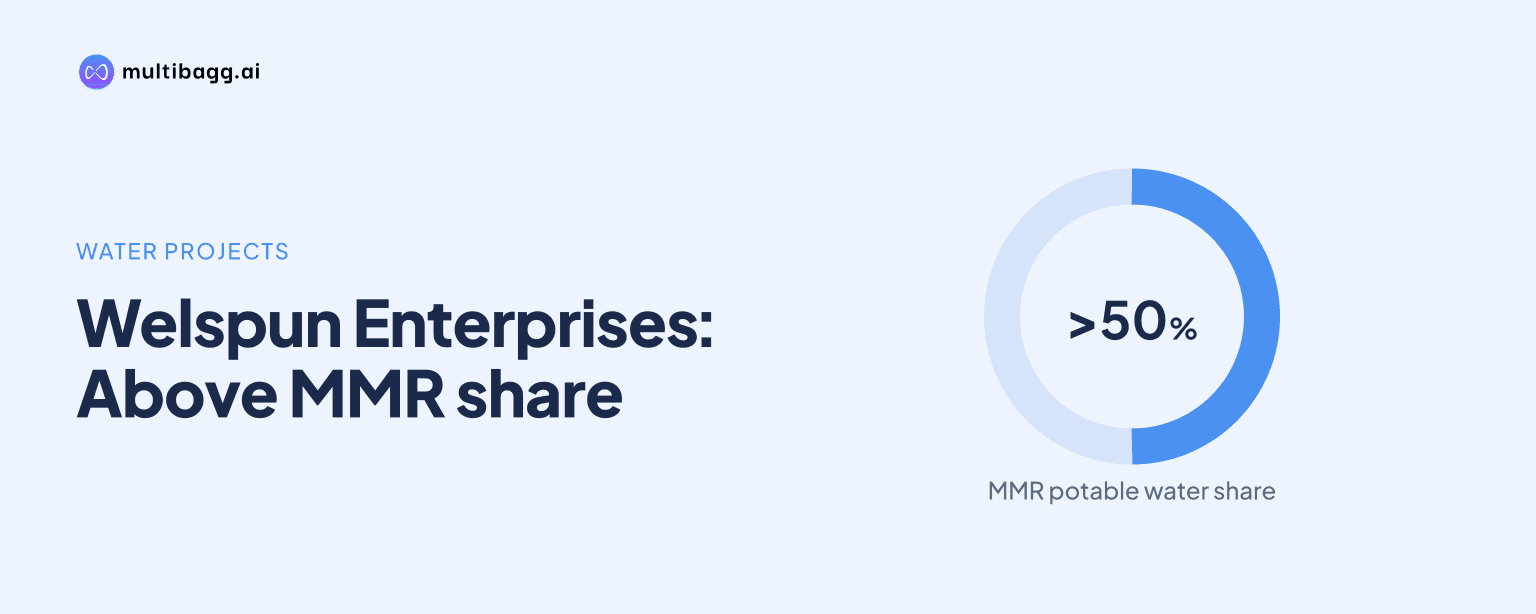
Welspun Enterprises says completion of the 2,000 million litres per day (MLD) Bhandup, 910 MLD Panjrapur and 418 MLD Dharavi projects would let WEL handle over 50% of Mumbai Metropolitan Region (MMR) potable water and about 15% of wastewater. The claim is conditional on completion of the three projects.
Know Welspun Enterprises inside out
Results, valuation, peers and who's buying, in one view.
Which WEL projects support the MMR water claim?
WEL bases its MMR water claim on the Dharavi sewage treatment plant (STP), the Bhandup water treatment plant (WTP) and the Panjrapur WTP. The presentation lists capacities of 418 MLD for Dharavi, 2,000 MLD for Bhandup and 910 MLD for Panjrapur, while describing the resulting MMR shares as an outcome upon project completion.
Bhandup is the largest disclosed project at 2,000 MLD and is under execution. WEL describes it as Asia’s largest WTP. Dharavi is a multi-storeyed 418 MLD STP, whereas Panjrapur is a 910 MLD WTP, separating the wastewater asset from the two potable-water treatment projects.
WEL reports a water-treatment order book of about Rs 11,000 crore alongside the three projects. The presentation does not split this order book between Dharavi, Bhandup and Panjrapur, nor does it disclose project-level revenue, profitability or completion dates for the two WTPs.
How much capacity do WEL’s named water projects represent?
WEL’s three named projects represent 3,328 MLD of stated treatment capacity in total. Bhandup contributes 2,000 MLD, exceeding the combined 1,328 MLD capacity of Dharavi and Panjrapur, and is therefore the largest component of the portfolio cited in the MMR disclosure.
The two WTPs account for 2,910 MLD of the disclosed 3,328 MLD total, while Dharavi adds 418 MLD of sewage-treatment capacity. This capacity split aligns with WEL’s separate statements that it could handle over 50% of MMR potable water and about 15% of wastewater after the projects are completed.
What does Dharavi completion change for WEL?
WEL says completion of the 418 MLD Dharavi STP in the next 6–7 months would provide prequalification, or PQ, eligibility for larger water projects. This is the stated mechanism linking the project’s completion with the company’s ability to pursue a wider range of water contracts.
The presentation does not quantify the value of projects for which WEL may become eligible after Dharavi is completed. It also does not identify specific tenders, authorities or award dates connected to the PQ benefit, meaning the disclosed eligibility should not be read as a project award.
WEL presents its water platform as integrated across the value chain, with specialised ties to global water-technology companies and long-term operation and maintenance (O&M) streams. The platform combines engineering, procurement and construction (EPC) work with O&M capabilities, although no O&M duration, tariff or annual income is disclosed.
Got a follow-up? Ask IRIS
Where does WEL see its next water opportunities?
WEL identifies river linking, bulk-water transmission, potable water, desalination and public-private partnerships (PPPs) as new avenues for future growth. It places the group capability relevant to these opportunities in the next 12–15 months, without naming a tender, counterparty, contract value or award schedule.
The group capabilities cited include spiral pipes and ductile-iron pipes at Welspun Corp, tunnelling at Welspun Michigan Engineers, EPC and O&M at WEL, and UPVC, OPVC and CPVC products at Sintex under Welspun Corp. The presentation shows how the group can provide pipes, underground construction, project execution and water-related products across a transmission or treatment project.
WEL distinguishes its Rs 11,000 crore water-treatment order book from the prospective PPP, desalination and bulk-transmission categories. The slides therefore support treating the latter as opportunity areas rather than as confirmed orders within the reported water-treatment backlog.
How does tunnelling support WEL’s water platform?
WEL describes tunnelling, pipeline rehabilitation and storm-water management as specialised capabilities that sit beside water treatment. It cites the Dharavi-Ghatkopar Tunnel as among the longest and deepest water tunnels, while identifying Welspun Michigan Engineers as its in-house platform for tunnelling, rehabilitation and storm-water work.
Management says utility tunnelling has entry barriers because there are few qualified players and has a better margin profile than other infrastructure segments. Its stated growth areas include water and sewage tunnelling as well as large-diameter urban-transit tunnels for regional rapid transit systems and passenger traffic, but the presentation provides no project-level margins.
The combination of 3,328 MLD of named treatment capacity and underground-construction capabilities positions WEL across treatment and network infrastructure. WEL says this platform creates a leading position to win large orders, though it does not disclose a quantified tunnelling pipeline or expected award timetable.
How has WEL’s broader financial profile changed?
WEL reported an earnings before interest, tax, depreciation and amortisation (EBITDA) margin of 22.8% in FY26, up from 13.5% in FY23. The movement was not uniform: the margin was 20.1% in FY24, fell to 19.3% in FY25 and rose to 22.8% in FY26; the presentation does not attribute these changes specifically to water operations.
Cash and cash equivalents stood at Rs 1,728 crore in March 2026, compared with Rs 1,155 crore in March 2025 and Rs 1,919 crore in March 2023. Over FY23 to FY26, the cash-conversion cycle moved from negative 6 days to 80 days, after 57 days in FY24 and 79 days in FY25, with no water-segment cash-flow breakdown disclosed.
Conclusion
WEL’s disclosed MMR position depends on completing the 2,000 MLD Bhandup WTP, 910 MLD Panjrapur WTP and 418 MLD Dharavi STP. Together, these projects underpin management’s statement that WEL could handle over 50% of MMR potable water and about 15% of wastewater, alongside a reported water-treatment order book of about Rs 11,000 crore.
The nearest disclosed milestone is Dharavi STP completion in the next 6–7 months, which WEL says would create PQ eligibility for larger water projects. The next development to watch is whether WEL converts its stated 12–15-month opportunities in bulk-water transmission, river linking, desalination and PPPs into named orders, since the presentation gives no values or award dates for those opportunities.