










Welspun Corp Says US Pipe Capacity Is Booked Through FY29
Key highlights
- Welspun says its approximately 1 million MTPA US pipe capacity is booked through FY29.
- Welspun reports more than US$4 billion of orders booked in the last 15 months.
- Welspun says US demand visibility extends until 2032.
- The US site has approximately 800 acres of land and dedicated railroads.
powered by IRIS
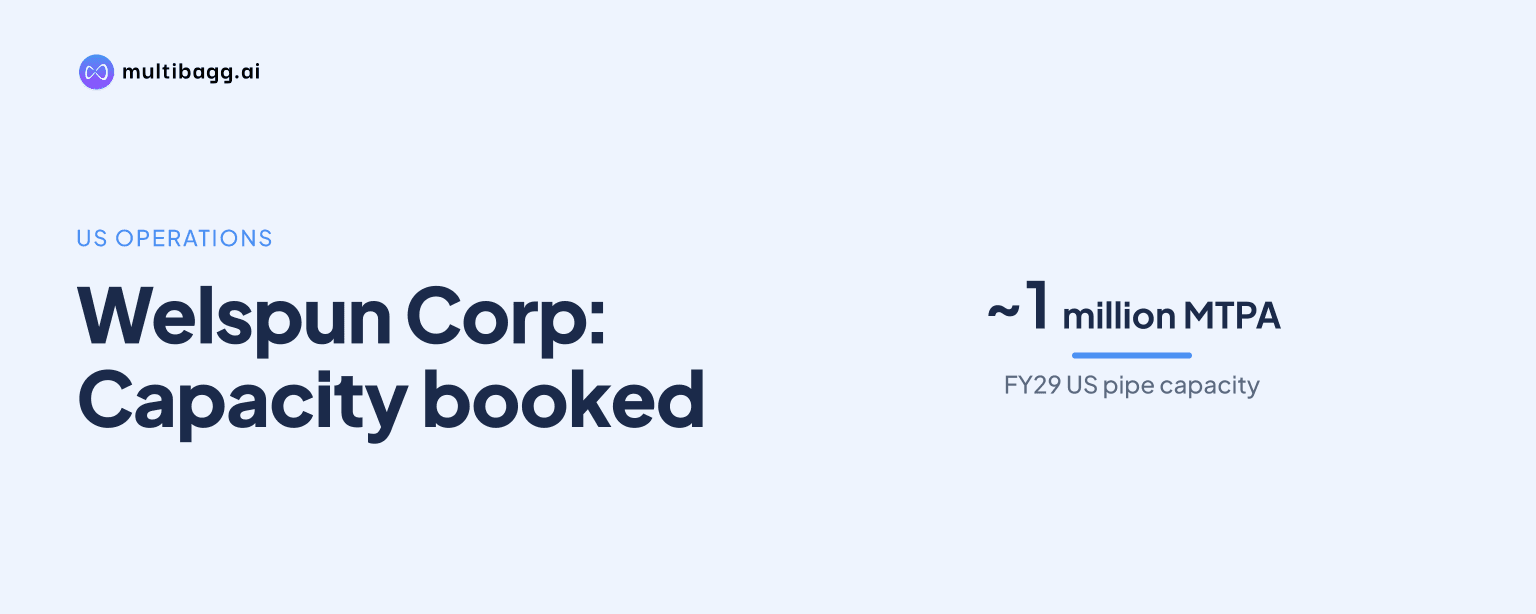
Welspun Corp says its approximately 1 million metric tonnes per annum (MTPA) of US pipe capacity is booked through FY29, with demand visibility until 2032, after more than US$4 billion of orders were booked in the last 15 months. Welspun links that outlook to oil and gas pipelines, liquefied natural gas exports, power generation and artificial-intelligence data-centre infrastructure.
Know Welspun Enterprises inside out
Results, valuation, peers and who's buying, in one view.
What has Welspun disclosed about US capacity bookings?
Welspun has stated that its US capacity is booked until FY29 and that it has visibility until 2032. The statement appears in its US market presentation, which also describes more than US$4 billion of orders booked in the last 15 months and calls this the sector’s largest-ever single order win. The presentation does not give a year-by-year production or delivery schedule through FY29.
The FY29 booking statement is a capacity-status disclosure, not a revenue forecast. Welspun does not identify the customers, project locations, pipe volumes, contract values or product allocation within the more than US$4 billion order figure. It also does not disclose how much of the stated capacity is committed to high-strength arc-welded, high-frequency induction-welded or longitudinal submerged arc-welded pipes.
Welspun’s US pipe range covers outside diameters from 6 inches to 60 inches. The company presents this range alongside its position as a supplier to midstream oil-and-gas customers, indicating that the booked capacity can serve multiple pipeline applications rather than one disclosed project category. No order split between oil, gas, liquefied natural gas or power-related infrastructure is provided.
How large is Welspun’s US manufacturing base?
Welspun lists approximately 1 million MTPA of US capacity across high-strength arc-welded (HSAW), high-frequency induction-welded (HFIW) and longitudinal submerged arc-welded (LSAW) pipes. The capacity is part of a four-geography footprint that the presentation describes as approximately 3 million metric tonnes of line-pipe capacity and 850,000 metric tonnes of ductile-iron pipe capacity.
India is the larger listed line-pipe base at approximately 1.3 million MTPA, compared with approximately 1 million MTPA in the US. Jordan is listed at approximately 350,000 MTPA of HSAW capacity, while Saudi Arabia is shown with 500,000 MTPA of HSAW capacity through East Pipes Integrated Company for Industry and 350,000 MTPA of LSAW capacity. Some capacity figures are marked as post commissioning of announced capital expenditure.
The US site has approximately 800 acres of land, dedicated railroads and proximity to the Arkansas-Mississippi River, according to Welspun. The company says the location is close to customers and suppliers and is at the epicentre of the supply chain. It also says it partners with every midstream oil-and-gas major in the US and is the largest buyer of American Petroleum Institute-grade steel, without providing customer-level volumes or steel purchase values.
Got a follow-up? Ask IRIS
Which demand drivers support Welspun’s visibility until 2032?
Welspun attributes its visibility until 2032 to four US demand channels: oil and natural-gas pipelines, new liquefied natural gas terminals, domestic power generation and captive gas power plants for artificial-intelligence data centres. These are demand mechanisms identified by management rather than forecasts of pipe shipments, revenue or order intake through 2032.
For oil and gas, Welspun cites new refineries and a resurgence in pipeline requirements. Its presentation identifies the Permian Basin as the largest oil-and-gas reserve and says the region will require more evacuation pipelines for natural gas. The company does not state the number of Permian projects in its FY29-booked capacity or the pipe tonnage associated with the basin.
For liquefied natural gas, Welspun points to new export terminals and says they create strong pipeline potential. Its US map places liquefied natural gas terminals, the Permian Basin and the Gulf Coast port area within the same infrastructure discussion. However, the presentation does not name any terminal, provide a construction timetable or state whether a specific terminal accounts for part of the more than US$4 billion booked over 15 months.
For power demand, Welspun says natural gas is a preferred option to meet a large generation requirement and that captive gas power plants at data centres need dedicated pipeline laterals. Texas data centres are identified on the US map. The company does not disclose the number of data-centre laterals, their diameter range within its 6-inch-to-60-inch portfolio, or the share of US capacity expected to supply them.
How does the US opportunity differ from Welspun’s other markets?
Welspun presents the US market around approximately 1 million MTPA of line-pipe capacity, FY29 bookings and visibility until 2032. India, by comparison, is described as an export-focused manufacturing base with approximately 1.3 million MTPA of HSAW, LSAW and electric-resistance-welded pipe capacity. India’s listed demand mechanisms include river interlinking, interstate water-sharing agreements, expanding natural-gas grids, city gas distribution, sewage networks and the Jal Jeevan Mission.
Saudi Arabia is positioned around oil and gas, water infrastructure and regional exports, rather than a disclosed FY29 booking horizon. Welspun lists 500,000 MTPA of HSAW capacity there and says a greenfield ductile-iron pipe facility is being built with diameter capability of up to 2,600 millimetres. Jordan has approximately 350,000 MTPA of HSAW capacity and a firm contract for the 450-kilometre Aqaba-Amman Water Desalination Project, also called the National Water Carrier Project.
The Jordan business also has a partnership with Perma-Pipe for integrated pipe manufacturing and anti-corrosion coating in the 24-inch-to-120-inch range. That contract and product range show that Welspun’s wider portfolio includes water infrastructure as well as energy pipelines. The presentation’s explicit claim that capacity is booked through FY29 and visible until 2032, however, applies to the US business.
Conclusion
Welspun’s main disclosure is that its approximately 1 million MTPA US pipe capacity is booked through FY29, supported by more than US$4 billion of orders recorded over 15 months and a claimed visibility horizon until 2032. Management links this position to natural-gas evacuation from the Permian Basin, liquefied natural gas exports, domestic power demand and gas laterals for data-centre generation.
The next item to watch is whether Welspun discloses the annual execution profile, customer mix or product allocation of capacity booked through FY29. Investors can also monitor commissioning of announced capital expenditure, because the presentation marks several geographic capacity figures as post commissioning, while leaving the timing and contribution of those additions unresolved.