










Yuvraaj Hygiene Products targets 30-40% warehousing growth
Key highlights
- YHPL targets 30-40% annual growth in its warehousing vertical.
- Warehousing revenue rose 227% year on year to Rs 12.6 crore in Q2 FY27.
- Warehousing contributed 70% of Rs 18 crore Q2 FY27 revenue and 81.3% of Rs 2 crore EBITDA.
- YHPL reported 18 active warehousing SKUs, 8 clients, 640 dark stores and 21 states in Q2 FY27.
powered by IRIS
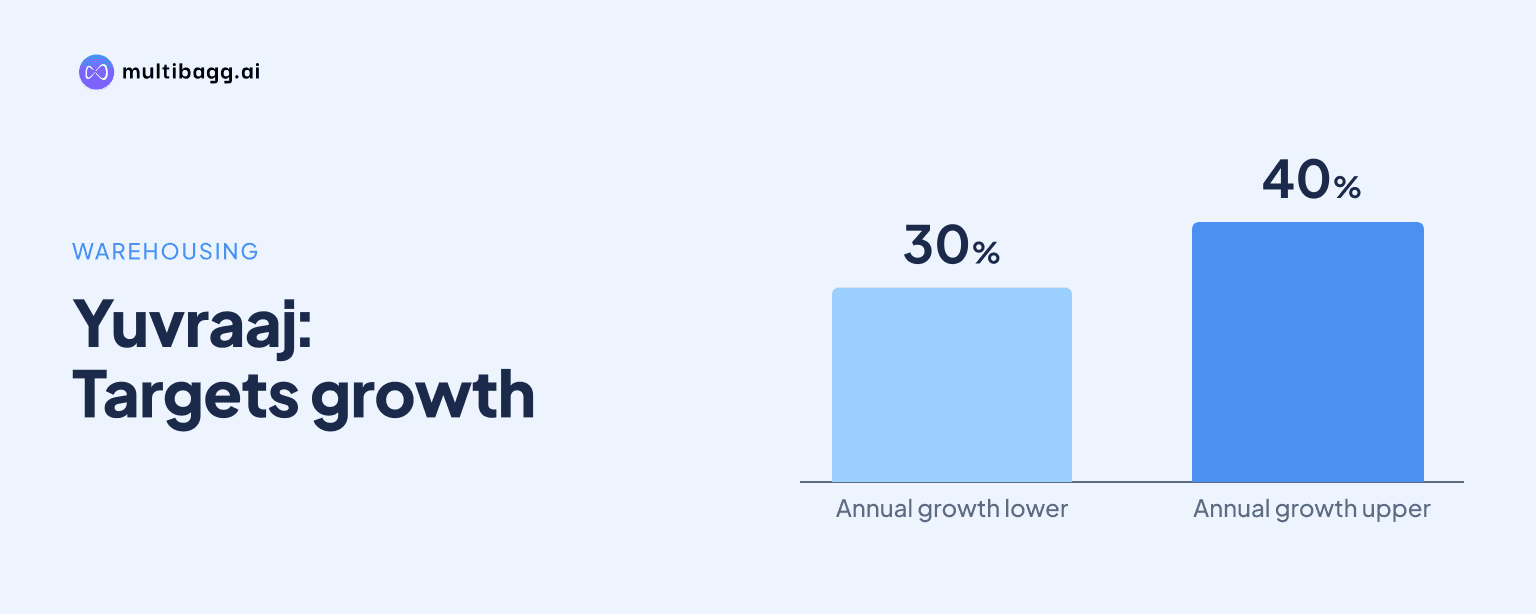
In Q2 FY27, Yuvraaj Hygiene Products set a 30-40% annual growth target for warehousing, after the segment generated Rs 12.6 crore, or 70%, of Rs 18 crore revenue from operations. The plan combines company-owned product dies, external job-work production, more stock-keeping units and deeper quick-commerce and e-commerce customer sales.
Know Yuvraaj Hygiene Products inside out
Results, valuation, peers and who's buying, in one view.
How does YHPL plan to grow warehousing sales?
YHPL plans to grow warehousing sales by expanding within e-commerce and quick-commerce dark-store networks, strengthening existing accounts and developing newer customer relationships. Management specifically identifies Zepto, Amazon and Flipkart among customers to deepen, while the 30-40% target applies to the warehousing vertical rather than total company revenue.
Warehousing and storage revenue rose 227% year on year to Rs 12.6 crore in Q2 FY27 from Rs 3.9 crore in Q2 FY26, while total revenue increased 81% to Rs 18 crore. Cleaning-products revenue declined 7% to Rs 4.3 crore and insecticide-products revenue fell 25% to Rs 1 crore, shifting warehousing's revenue contribution to 70% from 38.8% a year earlier.
The mix change also concentrated operating profit in warehousing. Segment earnings before interest, taxes, depreciation and amortisation, or EBITDA, increased 41% to Rs 1.6 crore and represented 81.3% of total Q2 FY27 EBITDA of Rs 2 crore; cleaning EBITDA declined 39% to Rs 0.3 crore.
What is YHPL's asset-light manufacturing model?
YHPL combines company-owned product dies, in-house moulding capabilities, external contract-based job-work facilities and inventory management. The model is designed to use external production for fulfilment flexibility while the company invests in dies for product development and portfolio diversification.
The warehousing portfolio includes bin dividers, plastic crates and allied rack components, as well as polypropylene, or PP, bin separators, Panda Bins, Rhino Bins, corrugated boxes, PP corrugated boxes, tote bins and polypropylene crates. The presentation says products can be supplied in customised sizes, colours and designs, with the product-specific dies supporting those additions.
YHPL reports 18 active warehousing stock-keeping units, or SKUs, in Q2 FY27, compared with 13 in Q2 FY26. Its portfolio page says the business expanded from one SKU to about 18 after entering the segment in 2024, although the company's journey page identifies 2023 as the year of entry into warehousing and storage solutions.
How far has YHPL expanded its warehousing customer reach?
YHPL reported 8 warehousing clients, 18 active SKUs, 640 dark stores and 21 states served in Q2 FY27. The comparable Q2 FY26 figures were 7 clients, 13 SKUs and 18 states, while the presentation gives no prior-year dark-store count and separately states that more than 2,915 dark stores have been served.
The company lists Amazon, Reliance Industries Limited, Flipkart, Zepto, DP World, Blinkit, DHL, Holisol Supply Chain Management, SCINNTC Supply Chain Synchronised and Merck in its clientele. It also reports an average order-fulfilment time of two days, but does not disclose the revenue contributed by any named customer.
Customer concentration increased in Q2 FY27. The largest client accounted for 53% of revenue, compared with 43% in Q2 FY26, while client retention was reported at 50% against 0% in the preceding-year quarter. The stated plan to build newer accounts sits alongside its aim to sell a wider product range to existing customers.
Got a follow-up? Ask IRIS
What working-capital demands accompany YHPL's strategy?
YHPL says it will align inventory levels and funding requirements with customer demand and store-expansion plans while maintaining product availability for short delivery timelines. This requirement remains relevant despite job-work manufacturing because the model includes inventory management and the company reports 30-40% capacity utilisation without defining its measurement basis or date.
Q2 FY27 debtor days rose to 89 from 47 in FY26, inventory days increased to 148 from 126, and the cash conversion cycle reached 127 days from 79. Net debt to equity moved in the other direction, declining to 1.0 times in Q2 FY27 from 2.6 times in FY26.
The H1 FY27 balance sheet shows trade receivables of Rs 10 crore, up from Rs 7.5 crore at FY26, while inventories declined to Rs 9.8 crore from Rs 10.5 crore. Cash and cash equivalents rose to Rs 2.7 crore from Rs 0.8 crore, and cash from operating activities was Rs 4 crore in H1 FY27 after negative Rs 3.1 crore in FY26.
What do Q2 FY27 margins show about the expansion?
YHPL reported higher Q2 FY27 revenue and profit amounts but lower company-level margins than in Q2 FY26. Gross profit rose 22% to Rs 5.5 crore, EBITDA increased 16% to Rs 2 crore and profit after tax rose 7% to Rs 1.3 crore, while gross margin declined to 30.8% from 45.7%.
EBITDA margin declined to 11.0% in Q2 FY27 from 17.2% in Q2 FY26, and profit-after-tax margin fell to 7.0% from 11.8%. Cost of goods sold increased 131% to Rs 12.5 crore, ahead of the 81% rise in revenue, and other expenses increased 54% to Rs 2.8 crore; the presentation does not allocate gross-margin changes by segment.
The quarterly sales increase follows a lower full-year comparison base. Revenue from operations declined 16% to Rs 38.7 crore in FY26 from Rs 46.3 crore in FY25, EBITDA fell 18% to Rs 5.7 crore and profit after tax declined 43% to Rs 3.3 crore.
Conclusion
YHPL's stated strategy relies on warehousing becoming its principal revenue and EBITDA contributor, with owned dies intended to enable product additions and job-work facilities intended to provide production flexibility. Q2 FY27 demonstrates the shift in mix, as warehousing contributed Rs 12.6 crore of Rs 18 crore total revenue while the cleaning and insecticide segments both declined.
The next disclosed measures to watch are progress toward the 30-40% annual warehousing-growth target, the expansion beyond 18 SKUs and 8 clients, and the working-capital indicators supporting store coverage. Management has not specified a target year, and the presentation's differing 2023 and 2024 warehousing-entry dates, 53% largest-client revenue share and 127-day cash conversion cycle remain matters requiring clarification or monitoring.