










Zydus Pauses MASH Phase III Despite Positive Phase IIb Data
Key highlights
- Zydus said Saroglitazar’s Phase IIb MASH trial met its primary endpoint and showed no increase in fibrosis.
- Zydus is not pursuing MASH Phase III now because the expected biopsy-led study is almost impossible to conduct, management said.
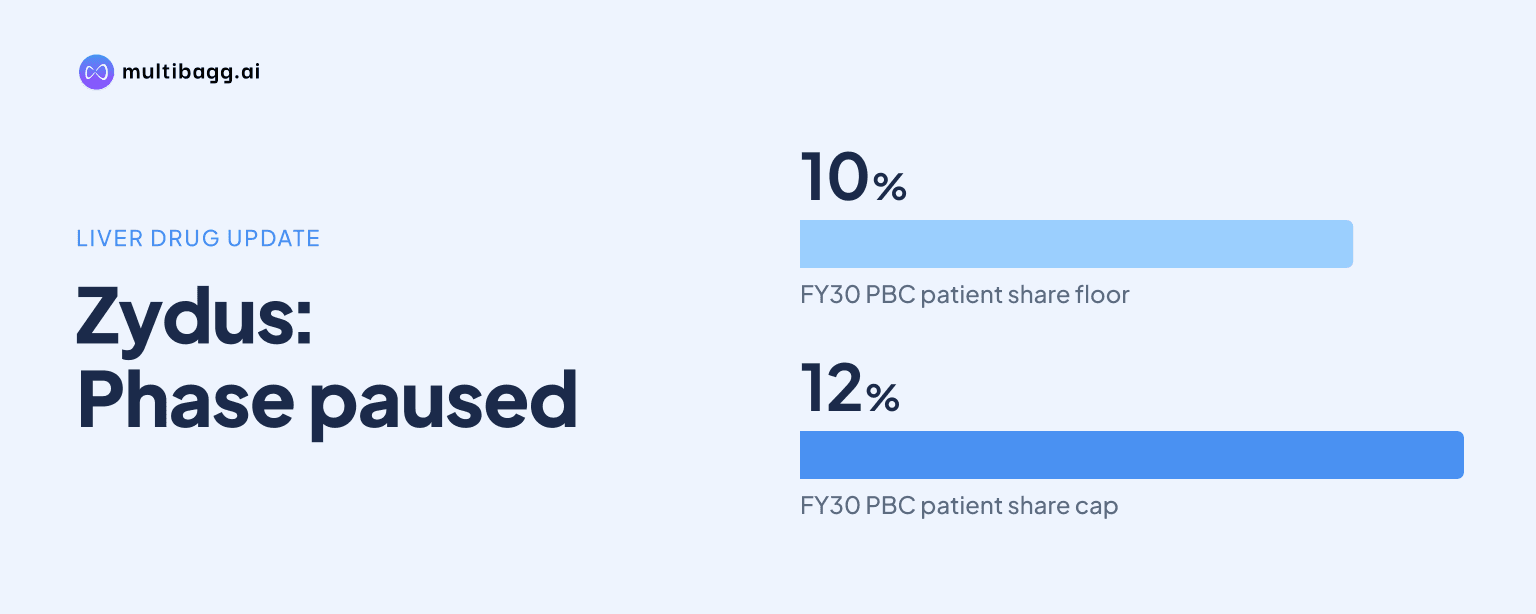
- Zydus targets 10% to 12% PBC patient share by FY30 after expecting no meaningful PBC revenue in FY28.
- Management guided Zydus R&D spending at about 8% to 8.5% of revenue.
powered by IRIS
Zydus will not take Saroglitazar into Phase III development for MASH after its positive Phase IIb readout, because management said the currently expected biopsy-led pivotal trial is “almost impossible” to conduct. The Phase IIb study met its primary endpoint and showed improvement in steatohepatitis ballooning without an increase in fibrosis.
Know Zydus Lifesciences inside out
Results, valuation, peers and who's buying, in one view.
Why is Zydus not starting a Phase III MASH trial?
Zydus is not starting Phase III MASH work because management considers the expected biopsy-led trial design impractical to execute. Dr. Sharvil Patel said the company was not pursuing the Phase III study “right now” because biopsy-led trials are “almost impossible to do anymore.” The stated hurdle is therefore the pivotal-study pathway, rather than a disclosed failure of Phase IIb efficacy or safety.
Zydus also did not identify licensing as an immediate alternative for the MASH programme. Asked whether Saroglitazar could be licensed, Patel said the issue was that the development work itself was highly difficult. Management did not disclose a partner-led protocol, an alternative endpoint, a non-biopsy study design or a timetable for regulatory discussions.
The distinction is material because Zydus described the MASH programme as having a positive Phase IIb readout while ruling out its next US development step. Phase IIb evidence can support a product’s clinical profile, but it does not create an approvable US pathway where management sees the expected Phase III design as infeasible. Zydus gave no forecast for a US MASH launch.
What did Zydus report from the MASH Phase IIb trial?
Zydus reported that the Phase IIb MASH trial improved steatohepatitis ballooning and showed no increase in fibrosis. Patel said the findings provided good data on Saroglitazar’s efficacy and safety, alongside the study meeting its primary endpoint. The call did not disclose patient numbers, treatment duration, numerical endpoint results, statistical measures or adverse-event rates.
The Phase IIb outcome contrasts with the Phase III decision: Zydus has clinical evidence but no currently disclosed route to advance MASH in the US. Management did not say fibrosis improved, only that it did not increase. It also did not claim the study established superiority to another MASH treatment or created a near-term approval opportunity.
The completed US trial may have relevance in other markets, including India, where Zydus said it has the relevant indications. Patel said the data would have a meaningful role in those markets. That was not a disclosure of a new approval, a launch date, a pricing decision or a revenue estimate tied to the MASH evidence.
How could Zydus use MASH data in its PBC launch?
Zydus said the MASH evidence can support Saroglitazar’s broader profile as it prepares a PBC launch in March, but management did not say it changes the PBC label. PBC, or primary biliary cholangitis, has seen a rise in diagnosed patients and in patients receiving treatment, according to Patel. He described these trends as favourable conditions for drugs in the PPAR class.
Zydus said Saroglitazar is among the few products with data showing a significant decrease in alkaline phosphatase, or ALP. Management discussed the MASH Phase IIb results as part of the product’s efficacy and safety evidence, while saying product-specific discussion of side effects must wait for the PBC label. No numerical ALP reduction was provided on the call.
Zydus described itself as third to market in PBC and set a current long-term goal of 20% patient share rather than claiming it would equal or exceed earlier entrants. Management expects no meaningful PBC revenue in FY28, with revenue starting mostly in FY29 and a more realistic ramp in FY30. By FY30, Zydus is targeting 10% to 12% patient share, while it said intellectual property extends through 2033-34.
Got a follow-up? Ask IRIS
What does the MASH decision mean for Zydus R&D spending?
The MASH Phase III pause does not mean Zydus plans to reduce research spending, because management said its differentiated development pipeline remains a priority. An analyst said quarterly research and development, or R&D, spending was almost Rs 650 crore, while management guided R&D at about 8% to 8.5% of revenue. Patel said R&D would continue to grow as Zydus invests in specialty portfolios in India and the US.
Zydus said only about 10 to 12 of roughly 30 product filings are common generic programmes. The remaining development emphasis includes first-to-file products, complex generics, biologics, vaccines, specialties and new chemical entities. That allocation allows Zydus to halt the MASH Phase III route while continuing clinical work, including Saroglitazar’s next trial for marginal ALP.
Other disclosed clinical priorities include an amyotrophic lateral sclerosis, or ALS, Phase IIb trial in the US that has started recruiting, Desidustat studies in sickle cell anaemia, biologics and biosimilar trials, and vaccine prequalification work. Management said innovation and late-stage clinical spending would increase, but did not give a specific allocation for Saroglitazar, MASH or any single programme.
Will Zydus revisit MASH development later?
Zydus could revisit MASH only if a practicable development route emerges, but management gave no commitment, date or trial design for doing so. Its disclosed position is limited to not pursuing Phase III “right now” because of the expected biopsy-led requirement. The company did not identify a non-biopsy endpoint, a planned regulator meeting or an external developer for Saroglitazar in MASH.
For now, Saroglitazar’s nearer commercial focus is PBC and markets including India, rather than a US MASH approval programme. The Phase IIb trial remains completed US clinical evidence, but Zydus has not said that it substitutes for a pivotal study. The practical outcome is that the positive MASH readout does not currently translate into a disclosed US development or launch pathway.
The MASH decision also sits within a broader R&D programme that management said is weighted toward differentiated products. Zydus is continuing the marginal-ALP Saroglitazar trial, US ALS recruitment, Desidustat work in sickle cell anaemia and biosimilar and vaccine programmes. Those programmes, rather than a MASH Phase III study, are the disclosed uses of the company’s growing clinical-development effort.
Conclusion
Zydus has separated encouraging Phase IIb MASH evidence from the decision to advance Saroglitazar in the US. The study met its primary endpoint, improved steatohepatitis ballooning and showed no increase in fibrosis, but management considers the expected biopsy-led Phase III trial impractical. The result is a pause driven by the stated feasibility of pivotal development, not by a disclosed negative Phase IIb finding.
The next developments to watch are the March PBC launch, receipt of the PBC label and the next Saroglitazar trial for marginal ALP. Management has also set operating benchmarks for PBC: no meaningful revenue in FY28, revenue beginning mostly in FY29, a more realistic ramp in FY30 and a 10% to 12% patient-share target by FY30.