










Aadhar Housing retains 25-bps target despite El Niño exposure
Key highlights
- Aadhar Housing said 5%-6% of AUM is in 30 of roughly 88 El Niño-priority districts.
- Aadhar Housing retained FY 2027 credit-cost guidance of 25 bps after reporting 31 bps in Q2 FY 2027.
- Gross NPA was 1.34% at September 30, 2026, versus 1.42% in Q2 FY 2026.
- Aadhar Housing said Stage 2 was about 3.55% in September 2026, compared with 3.3% in the preceding quarter.
powered by IRIS
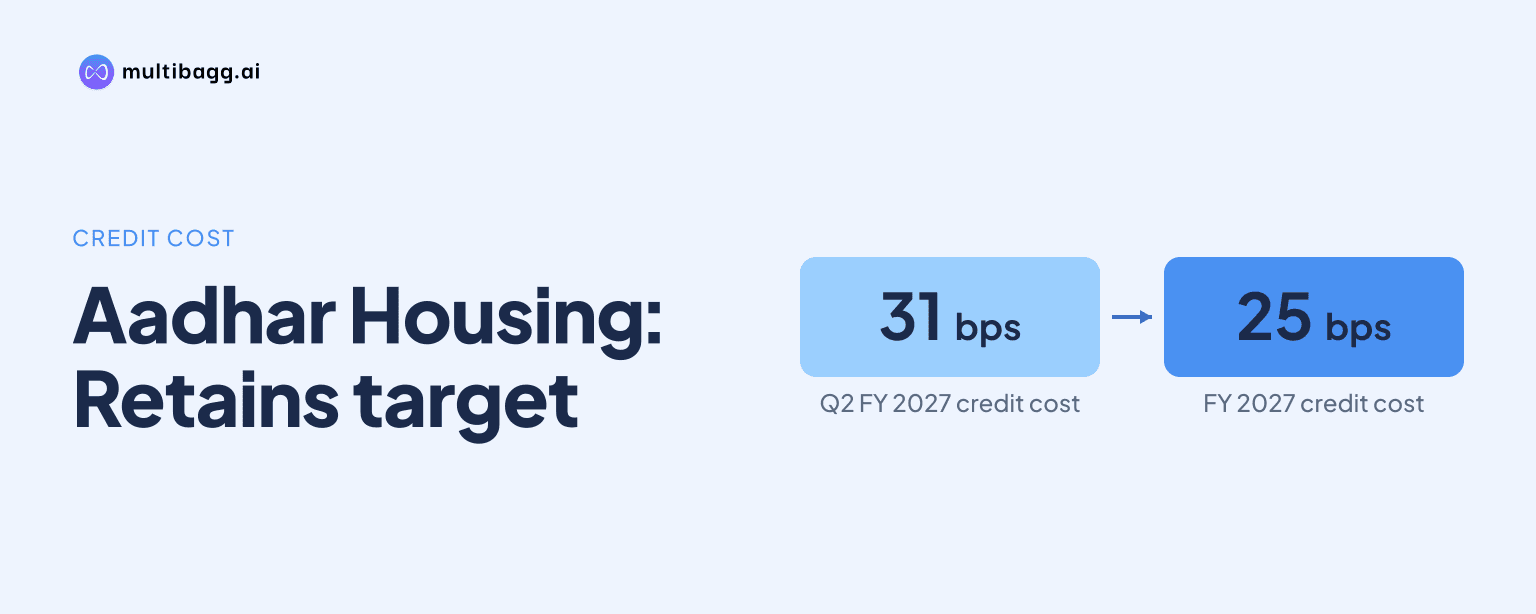
Aadhar Housing Finance Limited said 5%-6% of assets under management (AUM) is in 30 El Niño-priority districts and retained its FY 2027 credit-cost target of 25 basis points (bps), despite reporting 31 bps of credit cost in Q2 FY 2027 and a seasonal increase in Stage 2 loans.
Know Aadhar Housing Finance inside out
Results, valuation, peers and who's buying, in one view.
How exposed is Aadhar Housing to El Niño-priority districts?
Aadhar Housing said about 5%-6% of AUM is in 30 of roughly 88 high-priority districts identified in the context of El Niño. Management said El Niño conditions could affect borrowers’ cash flows, particularly in semi-urban markets, but it did not disclose an absolute loan amount for the exposure in these districts.
Aadhar Housing said its risk team is monitoring repayment bounces in the affected districts during the current equated monthly instalment, or EMI, banking cycle. Management described bounces as its first line of defence and said they were completely stable on the November 5, 2026 earnings call. It also said no individual geography was showing an undue increase in Stage 2 loans or bounces.
The exposure is within a portfolio spanning more than 555 districts across 23 states through 632 branches as of September 2026. Aadhar Housing said no single state represents a disproportionately large portfolio share. It added one Jammu branch during Q2 FY 2027 and said expansion decisions are based on sustainable demand and planned branch productivity.
Why did Aadhar Housing retain its 25-bps credit-cost target?
Aadhar Housing retained annual credit-cost guidance of 25 bps because management expects collections and portfolio behaviour to bring the full-year measure back to that level. Credit cost was 31 bps in Q2 FY 2027, after an analyst cited 41 bps in Q1 FY 2027 on average AUM. Management said the 25-bps target is an annual measure, equivalent to about 22-23 bps on AUM.
Management attributed the quarter-on-quarter Stage 2 movement to seasonality rather than a particular state or market. Stage 2 was about 3.55% in September 2026, compared with 3.3% in the preceding quarter. Aadhar Housing said the September 2026 level was broadly comparable with September 2025 and that it was monitoring performance market by market.
Aadhar Housing also said headline non-performing assets, or NPA, should be about 1.10%-1.15% by the end of FY 2027. Gross NPA stood at 1.34% on September 30, 2026, versus 1.42% a year earlier, an 8-bps improvement. Management’s stated range implies a decline from the September exit ratio during the rest of FY 2027.
Got a follow-up? Ask IRIS
What changed in Aadhar Housing asset quality by September 2026?
Aadhar Housing reported a lower blended gross NPA ratio in Q2 FY 2027, with home loans showing a larger year-on-year improvement than non-home loans. Home loans accounted for 73% of September 2026 AUM, while non-home loans accounted for 27%. Management said it had tightened non-home-loan underwriting in Q4 of the prior year before reopening certain lending levers.
The larger home-loan portfolio improved by 20 bps, while non-home-loan gross NPA was broadly unchanged at about 2%. Aadhar Housing reported net NPA on AUM of 1% in both Q2 FY 2027 and Q2 FY 2026. Stage 3 provision coverage was 34.5% at September 30, 2026, and collection efficiency was 99% during Q2 FY 2027.
Management expects non-home loans to reach about 28% of the portfolio by the end of Q4 FY 2027 and about 30% next year, implying a 70% home-loan and 30% non-home-loan mix. Aadhar Housing said its loan-against-property policy caps agriculture and other seasonal-business income at 25% of a borrower’s income and applies a 55% fixed-obligation-to-income ratio.
How will Aadhar Housing manage weather and interest-rate risk?
Aadhar Housing said it will address local weather-related risks through customer- and branch-level assessment rather than broad-based tightening of underwriting. Management cited differing historical experiences in markets including eastern India and Kerala as the basis for calibrated underwriting. The company said this approach allows it to monitor local repayment behaviour without imposing portfolio-wide restrictions.
About 75% of Aadhar Housing’s assets and liabilities are floating rate, management said. This allows the company to pass funding-cost changes to customers after review by its asset-liability committee, or ALCO, under its retail prime lending rate model. Management said no rate increase had been decided and that ALCO would probably meet in December or January after considering the Reserve Bank of India’s January policy announcement.
Aadhar Housing reported an exit cost of funds of 7.7%, a portfolio yield of 13.4%, and an exit spread of 5.73% at the end of Q2 FY 2027. Its incremental Q2 FY 2027 borrowings carried a 7.5% cost. Management said its AA+ ratings from India Ratings, ICRA and CARE could make a new non-convertible debenture issuance about 20 bps cheaper on average than an AA-rated issuance, subject to market conditions.
Conclusion
Aadhar Housing’s disclosed El Niño exposure is 5%-6% of AUM in 30 priority districts, while gross NPA fell year on year to 1.34% in September 2026. The main gap against management’s annual objective remains credit cost, which was 31 bps in Q2 FY 2027 after 41 bps in Q1 FY 2027, alongside Stage 2 of about 3.55%.
The next indicators are whether repayment bounces remain stable in the priority districts, whether gross NPA approaches management’s 1.10%-1.15% FY 2027 range, and whether annual credit cost returns to 25 bps. Management expects at least 20% Q3 disbursement growth and plans an ALCO review in December or January before deciding whether customer lending rates need to change.