










Aadhar Housing Finance Limited AA+ Ratings May Cut NCD Costs
Key highlights
- Aadhar said AA+ NCD issuance could be about 20 basis points cheaper on average than AA issuance.
- Aadhar had Rs 20,400 crore of borrowings at September 30, 2026, with banks accounting for 53% of the total.
- Aadhar said 75% of both its assets and liabilities were floating rate at September 30, 2026.
- Aadhar received a fresh Rs 1,000 crore National Housing Bank sanction in the week of the November 5, 2026 call.
powered by IRIS
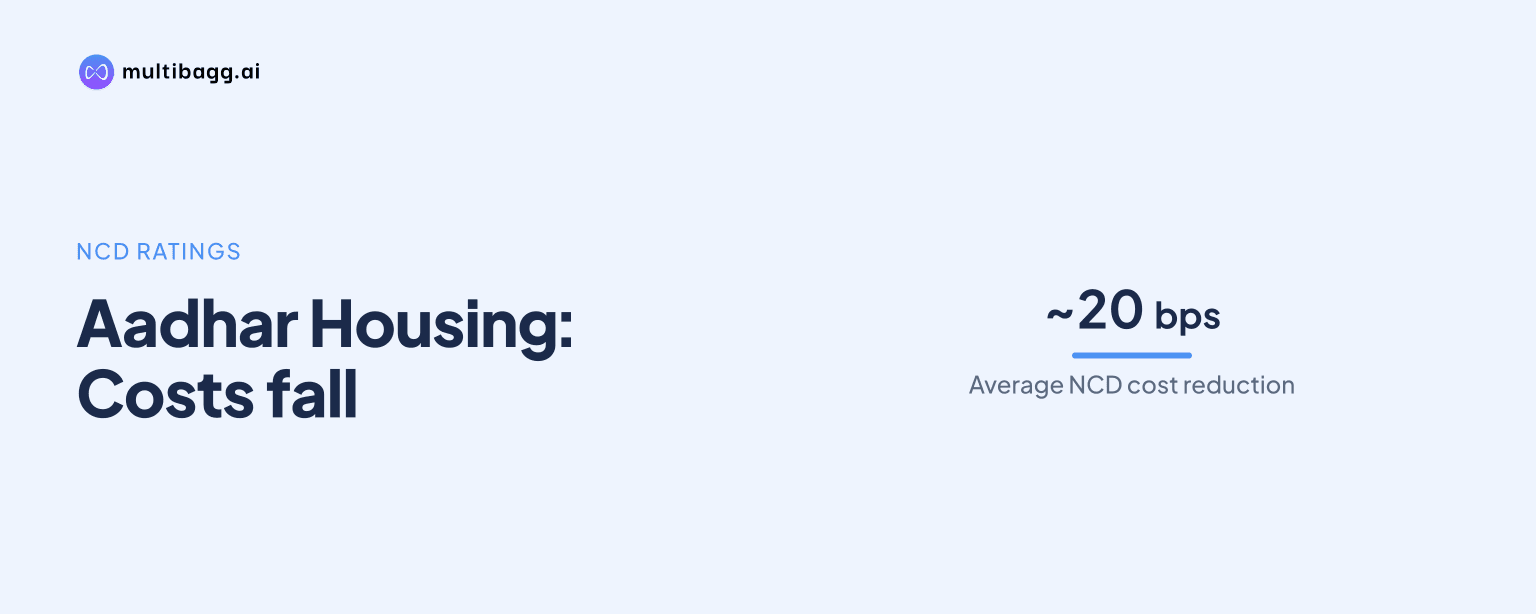
Aadhar Housing Finance Limited said in Q2 FY 2027 that its AA+ ratings could reduce fresh non-convertible debenture issuance costs by about 20 basis points and provide access to pension-fund and life-insurer funding pools. The benefit applies to new funding while 75% of Aadhar’s liabilities remain floating rate as of September 30, 2026.
Know Aadhar Housing Finance inside out
Results, valuation, peers and who's buying, in one view.
How much could Aadhar save on NCD funding?
Aadhar said an AA+ rating, compared with an AA rating, could make a non-convertible debenture, or NCD, issuance 20 to 30 basis points cheaper, with management using about 20 basis points as its average estimate. One basis point equals one-hundredth of a percentage point, and management said the advantage could be 10 to 15 basis points in some market conditions.
The estimate concerns fresh NCD placements rather than Aadhar’s existing borrowing book. At September 30, 2026, NCDs represented 15% of Rs 20,400 crore of total borrowings, while the reported exit cost of funds was 7.7%. Incremental borrowings of Rs 1,550 crore in Q2 FY 2027 were raised at 7.5%.
India Ratings and ICRA upgraded Aadhar’s long-term rating to AA+ stable during Q2 FY 2027. Aadhar said India Ratings, CARE and ICRA now each assign it an AA+ standalone rating. Management attributed the upgrades to its scale, capitalisation and diversified funding access, while noting that borrowing-cost benefits depend on market conditions.
What funding access do Aadhar’s AA+ ratings create?
Aadhar said its AA+ ratings enable it to approach lender pools that generally do not lend to AA-rated companies, specifically pension funds and life insurance companies. Management said these institutions are more comfortable with AA+ borrowers and typically require AA+ ratings from at least two agencies; Aadhar has the rating from three agencies.
The disclosed benefit is access to longer-tenor capital, not a completed transaction. Management said pension funds and life insurers can provide higher-tenor funding, giving Aadhar more comfort in asset-liability management, or ALM, which matches the maturity of funding with that of loans. The call did not disclose a committed amount, lender name or drawdown date from either category.
Aadhar had 43 borrowing relationships and Rs 1,466 crore of undrawn sanctions at September 30, 2026. During the week of the November 5, 2026 call, it also received a fresh Rs 1,000 crore sanction from National Housing Bank, or NHB. Management did not say whether that capacity would replace bank, NCD or other funding sources.
What does Aadhar’s borrowing mix show?
Aadhar’s borrowing base was led by banks at September 30, 2026, followed by NHB and NCDs. Total borrowings increased by Rs 2,800 crore from Rs 17,600 crore a year earlier to Rs 20,400 crore, while assets under management, or AUM, reached Rs 32,643 crore, up 18% year on year.
The mix means that a lower coupon on new NCDs would initially affect only incremental issuance and a smaller share of the existing liability base. Bank funding accounted for 53% of borrowings, compared with 15% for NCDs. Management said it would incorporate all changes in incremental funding costs into its retail prime lending rate, or RPLR, model.
Aadhar reported Rs 2,040 crore of liquidity at the end of Q2 FY 2027 and made no fresh NHB drawdown during the quarter. Its portfolio yield was 13.4% and exit spread was 5.73% at quarter-end. These figures set the reported position before any repricing arising from policy rates or lower-cost NCD issuance.
Got a follow-up? Ask IRIS
How exposed is Aadhar to higher floating borrowing rates?
Aadhar said about 75% of both assets and liabilities were floating rate at September 30, 2026, creating an offset when policy-linked funding rates move. The Reserve Bank of India had raised the repo rate by 25 basis points to 5.5%, and management said banks could pass the effect through to its repo-linked and marginal-cost-of-funds-based lending-rate-linked liabilities over time.
The matching 75% floating share of assets allows Aadhar to reprice customer loans when funding costs change. Management said higher costs reaching the balance sheet can be taken to the Asset Liability Committee, or ALCO, for a decision under the RPLR model. It said the mismatch could be a timing effect of up to one quarter.
Management made no customer rate-increase decision during the November 5, 2026 call. It said the RPLR model was not then indicating a substantial increase to pass on, and that ALCO would probably meet in December or January during Q3, considering the Reserve Bank of India’s January policy announcement.
When could Aadhar pass funding changes to borrowers?
Aadhar said its RPLR model determines whether movements in incremental funding costs are passed to customers. Management said consistently lower incremental funding costs could benefit incremental lending rates, but it did not commit to reducing loan pricing after the AA+ upgrades.
Conversely, higher rates on the roughly 75% floating-rate liability base could lead to a customer rate increase after ALCO review. Management said it would wait until December and assess the Reserve Bank of India’s January announcement. Its stated approach was to protect spreads rather than pursue higher yields.
The funding plan sits alongside management’s FY 2027 guidance of 18% to 20% disbursement growth and 20% growth in AUM and profit after tax, adjusted for employee stock-option costs. Q2 FY 2027 disbursements were Rs 2,577 crore, up 22% year on year, and AUM was Rs 32,643 crore at September 30, 2026.
Conclusion
Aadhar’s AA+ ratings create two stated funding benefits: management estimates fresh NCD issuance could be about 20 basis points cheaper on average, and the company can seek longer-tenor capital from pension funds and life insurers. The benefits apply to incremental funding, while bank borrowings still made up 53% of the Rs 20,400 crore borrowing base at September 30, 2026.
The next disclosed event to watch is Aadhar’s expected ALCO review in December or January, after the Reserve Bank of India’s January policy announcement. Management has not decided on a customer rate increase, leaving the key unresolved issue whether policy-rate transmission and lower NCD costs produce an RPLR change.