








Aaron Industries targets ₹150-160 crore revenue by FY28
MAX Plan at ₹4,999/yr

Find your next multibaggerBe a Pro Investor
Research stocks and track your picks on the go. Download the app.
Key highlights
- Aaron targets ₹150-160 crore of revenue by FY28 from capacity designed for ₹180-200 crore.
- Aaron said production-capacity utilisation was around 55%, versus the 45-50% range cited for the first quarter.
- Aaron reported 24% first-half growth, below management's earlier 25-30% growth indication.
- Aaron generated around ₹2 crore of first-half EVOQ360 revenue, including ₹1.20 crore from 19 second-quarter projects.
powered by IRIS
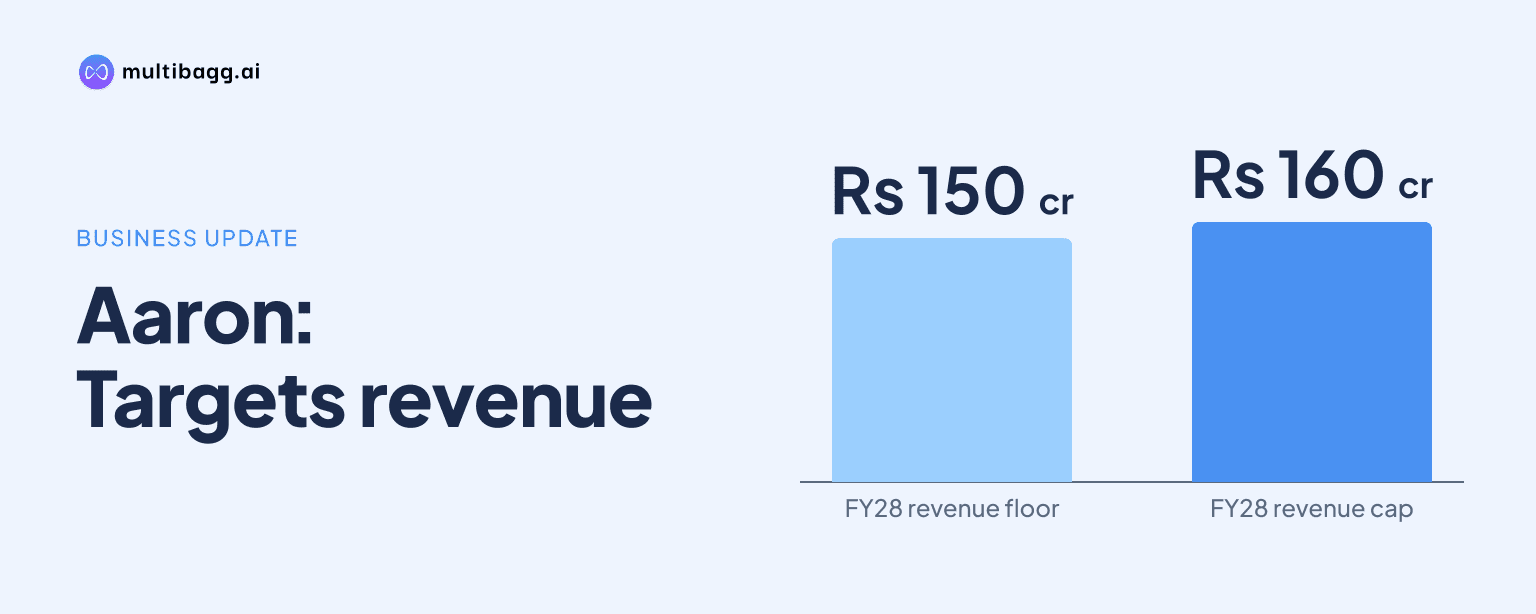
Aaron Industries is targeting ₹150-160 crore of revenue by FY28 from manufacturing capacity designed to support ₹180-200 crore, management said on its first-half earnings call. The target follows 24% first-half growth, below the 25-30% pace previously indicated by management, which expects delayed order billings to improve in the second half.
Know Aaron Industries inside out
Results, valuation, peers and who's buying, in one view.
What is Aaron's FY28 revenue target?
Aaron is targeting revenue of more than ₹150 crore, with a stated FY28 range of ₹150-160 crore. Management said this was part of a previously communicated three-year plan, while the production-capacity enhancement was built to support ₹180-200 crore of revenue. The FY28 target is therefore ₹20-50 crore below the stated revenue capacity range.
Management did not provide a revenue target for FY30. It said that by 2030 it expects another increase in production capacity and entry into new product lines as it identifies expansion avenues. The FY28 objective is tied to the current capacity base, while management said any subsequent scale-up would require fresh capacity additions and product development.
How much of Aaron's manufacturing capacity is being used?
Aaron said it was using around 55% of production capacity during the call period, compared with the 45-50% utilisation cited for the first quarter. Management said it was pursuing greater market penetration and new markets to raise output, but did not give a date for a specific utilisation target. The 55% level means the enlarged manufacturing base was not fully absorbed at the time of the call.
At Kosamba, Aaron has shifted elevator doors and other components from Udhna, while elevator cabins continue to be made at Udhna. Management said monthly door production had risen by more than 1,200-1,300 units from its earlier level, while cabin production increased from 200 to more than 250 units per month. An analyst referred to earlier stated capacity of 5,000 doors and 400 cabins a month, but management did not confirm current output against those levels.
The expanded footprint also supports products including embossed sheets and EVOQ360 home lifts. An analyst described Aaron's manufacturing capacity as having increased 2.5 times, although management did not provide a base-capacity figure or capital-expenditure amount in its response. Management's stated plan is to fill capacity through customer additions, wider product sales and deeper penetration in elevator components.
Why was Aaron's first-half growth 24%?
Aaron acknowledged first-half growth of 24%, after an analyst noted management had earlier indicated a minimum growth pace of 25-30%. The analyst cited 22% growth in the second quarter, 27% in the preceding quarter and 18% growth in the prior full year. Management accepted the 24% first-half figure and said it was taking steps to improve the growth rate.
Management attributed slower order conversion to geopolitical conditions and the monsoon, which it said typically makes the second quarter softer as projects delay procurement. It said orders were available but customers had not lifted products, resulting in higher inventory; the analyst said this had contributed to negative net operating cash flow in the first half. Management said third-quarter billings had begun and expected the order conversion effect to be visible by the end of that quarter.
In the elevator division, management reported almost 14% first-half growth including EVOQ360. The analyst estimated conventional elevator-component growth at about 10% or less after accounting for the new home-lift product, and management confirmed that EVOQ360 sales were included in the division. Management attributed the pace in conventional parts partly to the softer second quarter and said it expected better growth in the third and fourth quarters.
Got a follow-up? Ask IRIS
How much can EVOQ360 contribute to Aaron's growth plan?
Aaron said EVOQ360 generated around ₹1.20 crore from 19 projects supplied in the second quarter. Management put first-half dispatch revenue from the home-lift product at around ₹2 crore and said average billing was roughly ₹6-6.5 lakh per installation. It expects EVOQ360 revenue to grow fourfold, although it did not specify a period or a revenue base for that expectation.
Management said EVOQ360 requires a 4-foot-by-4-foot area for a three- or four-passenger lift. The product does not require a reinforced cement concrete shaft, pit, additional overhead space or a machine room, according to management, allowing installation in some existing homes where a lift was not planned. It described the preceding six months as a pilot period for elevator companies and said completed projects had increased customer confidence.
Aaron said EVOQ360 was delivering the 20-25% margin range previously indicated by management and that this margin could be sustained as volumes increase. This was management's assessment rather than a separately disclosed segment margin. Management also said it had added more than 100 customers during the year, initially through specific projects or components, with the aim of raising ticket sizes through repeat and additional product purchases.
What execution factors could affect Aaron's FY28 target?
Aaron said it had started receiving small orders from Fujitec and was already dealing with Omega and Techno. Management said discussions with Johnson and other multinational companies were continuing, but there were no commitments it could disclose and progress might take a couple of months. The call did not quantify the potential revenue contribution from these customer discussions.
Management estimated the elevator-components market as roughly 50% organised and 50% unorganised. It said government policies and improvements in Indian Standards were supporting organised suppliers, while customisation in home-lift and villa projects leaves room for regional companies. Aaron said its focus remained manufacturing in elevator and stainless-steel verticals rather than escalators, installations or service operations.
Exports were described as marginal, at around 5% or below 5% of business, with Nepal and Kenya operating at stable levels. Management said it was focused on the Indian market rather than expecting short-term export expansion. It expects long-term debt associated with older loans to decline by around 2029, citing payments of about ₹52 lakh a month towards interest and loans and annual loan repayment of around ₹4 crore.
Conclusion
Aaron's ₹150-160 crore FY28 revenue target gives a stated timetable for monetising capacity built for ₹180-200 crore of revenue. The gap between the target and capacity, together with utilisation of around 55% and first-half growth of 24%, indicates that the company must increase order conversion and customer penetration to meet its plan.
The next disclosed checkpoint is the third-quarter result, where management said billing had begun and delayed customer lifting should be reflected by the end of the quarter. Investors can watch whether EVOQ360 rises from around ₹2 crore of first-half revenue, whether more than 100 new customers generate repeat orders, and whether discussions with Fujitec, Johnson or other multinational companies lead to disclosed commitments.

