








Aaron Industries consolidates elevator doors at Kosamba
MAX Plan at ₹4,999/yr

Find your next multibaggerBe a Pro Investor
Research stocks and track your picks on the go. Download the app.
Key highlights
- Aaron Industries moved elevator doors and other components to Kosamba, while Udhna now makes elevator cabins.
- Aaron Industries reported about 55% production-capacity utilisation in Q2 FY27, versus the 45%-50% Q1 range cited by an analyst.
- Monthly door output rose by more than 1,200 to 1,300 units, while cabin output increased from 200 to more than 250 cabins.
- Aaron Industries targets revenue of Rs 150 crore to Rs 160 crore by FY28, with capacity stated at Rs 180 crore to Rs 200 crore.
powered by IRIS
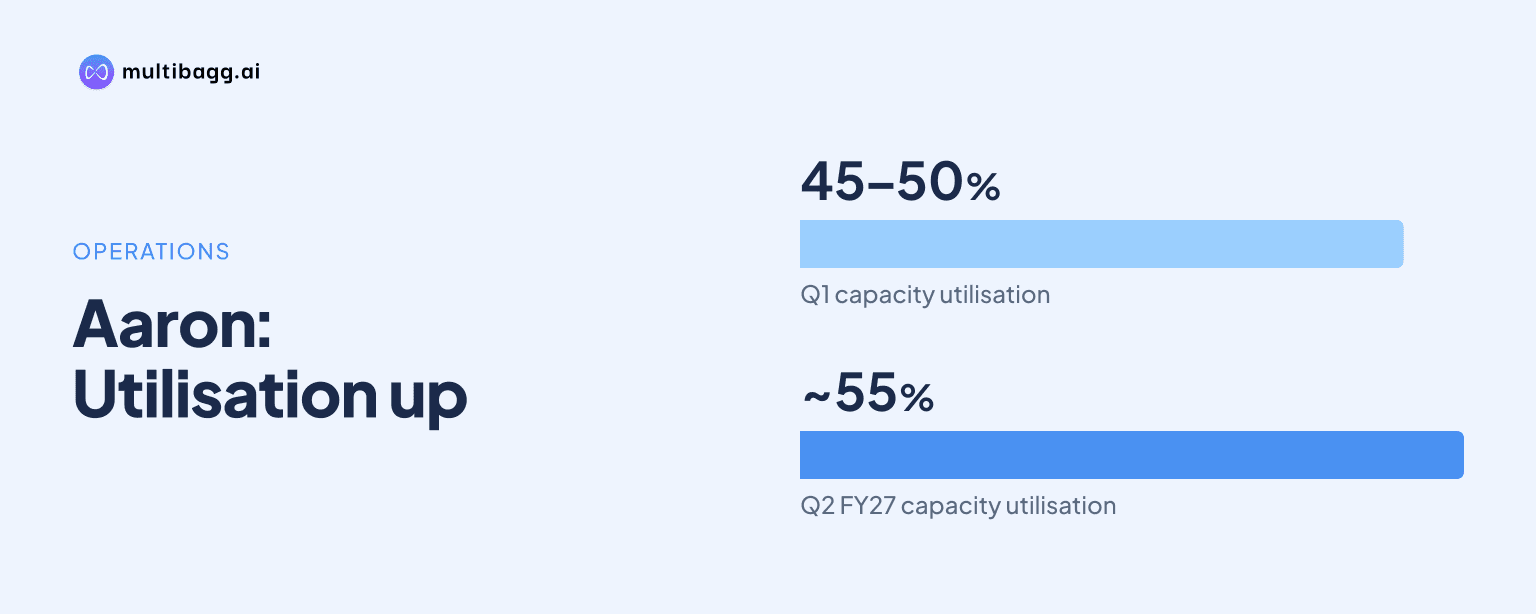
Aaron Industries Limited had moved elevator doors and other elevator components to Kosamba by its Q2 FY27 call on November 24, 2026, retaining Udhna exclusively for cabin production after space constraints at the earlier site. Management reported overall production-capacity utilisation of about 55%, against the 45%-50% Q1 range cited by an analyst.
Know Aaron Industries inside out
Results, valuation, peers and who's buying, in one view.
What did Aaron Industries move from Udhna to Kosamba?
Aaron Industries moved elevator doors and all other elevator components from Udhna to Kosamba, while retaining only elevator-cabin production at Udhna. Chief Financial Officer Monish Doshi said the reorganisation followed space constraints at Udhna, where elevator components had previously been manufactured before the November 24, 2026 call.
The new arrangement divides manufacturing work by product. Kosamba now makes doors and other elevator products, while Udhna makes elevator cabins. Management did not disclose the cost of moving equipment, the date each product line was transferred, or separate installed-capacity figures for the two sites during the Q2 FY27 call.
An analyst specifically asked whether steel-door processing and elevator doors had moved or whether the change involved a single project. Doshi said doors and all other products were now made at Kosamba, leaving cabins at Udhna. The distinction is relevant to the Elevator division, which also includes the EVOQ home-lift product.
How much of Aaron Industries’ capacity is being used?
Aaron Industries was using around 55% of its production capacity at the Q2 FY27 call. This was above the 45%-50% Q1 utilisation range stated by an analyst, although management did not independently provide a Q1 figure. Doshi said the company would seek new market areas and gradually raise production capability.
Management provided output indicators for doors and cabins but no location-specific utilisation rates. President Paresh Naik said monthly door production had increased by more than 1,200 to 1,300 units from the earlier level. He said cabin output had risen from 200 to more than 250 cabins a month, with cabins produced at Udhna rather than by the Salvagnini-linked door operation.
An analyst referred to a previously stated capacity of 5,000 doors a month and 400 cabins a month after Unit 3 was launched, as well as an earlier aim to reach at least 3,500 doors a month within 18 to 24 months. Management did not confirm the current absolute monthly door volume or restate those capacity figures. It instead reported the 1,200-to-1,300-unit door-output increase and ongoing market-penetration efforts.
How does the Kosamba shift relate to Aaron Industries’ FY27 results?
Aaron Industries reported revenue from operations of Rs 27.12 crore in Q2 FY27, up 21.93% year on year from Rs 22.24 crore in Q2 FY26, while utilisation was about 55%. H1 FY27 revenue increased 24.29% to Rs 51.56 crore from Rs 41.48 crore. These company-wide results cover both the Elevator and Stainless-Steel divisions and do not isolate Kosamba’s financial contribution.
Management said the Elevator division grew about 14% in H1 FY27, including EVOQ sales. Aaron Industries dispatched 19 EVOQ projects in Q2 FY27, and Naik estimated average billing of about Rs 6 lakh to Rs 6.5 lakh per project, or roughly Rs 1.2 crore for those projects. He said the remaining Elevator division sales came from conventional elevator parts.
The company did not say the site reorganisation alone drove the 21.93% Q2 revenue rise. In discussing the pace of Elevator division growth, Naik cited monsoon conditions and geopolitical issues that delayed customer procurement. He said products ordered by customers had not been lifted, which explained inventory accumulation raised by an analyst.
Aaron Industries reported a Q2 FY27 earnings before interest, tax, depreciation and amortisation margin of 20.01%, compared with 18.54% in Q2 FY26. Management attributed the expansion to operating performance and efficiencies, but did not quantify the contribution from Kosamba, door volumes, cabin volumes, product mix or the Udhna reorganisation.
Got a follow-up? Ask IRIS
What will Aaron Industries do with its manufacturing capacity?
Aaron Industries plans to pursue new markets and deeper market penetration to increase utilisation from the roughly 55% reported in Q2 FY27. Doshi said the company was exploring areas in which it could supply materials, while Naik said door and cabin production would rise with broader market reach. Management did not provide a specific utilisation target or time frame.
Management said its capacity enhancement could support revenue of Rs 180 crore to Rs 200 crore. Doshi said Aaron Industries was targeting revenue above Rs 150 crore, later specifying Rs 150 crore to Rs 160 crore, by FY28. Those are management targets for the company’s overall capacity and product range, not separate targets for Kosamba, Udhna, doors or cabins.
EVOQ remains part of the Elevator division and was still being established, according to management. Doshi said EVOQ was delivering a margin of 20%-25% and said higher volumes could help it move towards 25%. The call did not disclose whether EVOQ is assembled at Kosamba, Udhna or another location.
Management also said Aaron Industries had added more than 100 customers during the year, initially supplying a particular project or component before seeking larger order values. It did not disclose how many of these customers bought Kosamba-made doors or components, so the relationship between customer additions and the manufacturing move cannot be quantified from the call.
Conclusion
Aaron Industries has specialised its elevator manufacturing footprint, with Kosamba making doors and other components and Udhna dedicated to cabins. The move addressed Udhna space constraints and coincided with reported utilisation of about 55%, while management cited a more-than-1,200-to-1,300-unit increase in monthly door output and cabin production above 250 units a month.
The next point to watch is the Q3 FY27 result. Management said post-monsoon project procurement had begun, described its order book as full, and expected higher growth in Q3 and Q4. Further disclosures on utilisation, door volumes, cabin volumes, inventory conversion into billings and progress towards the FY28 revenue target of Rs 150 crore to Rs 160 crore will indicate how the reorganisation is translating into output.

